
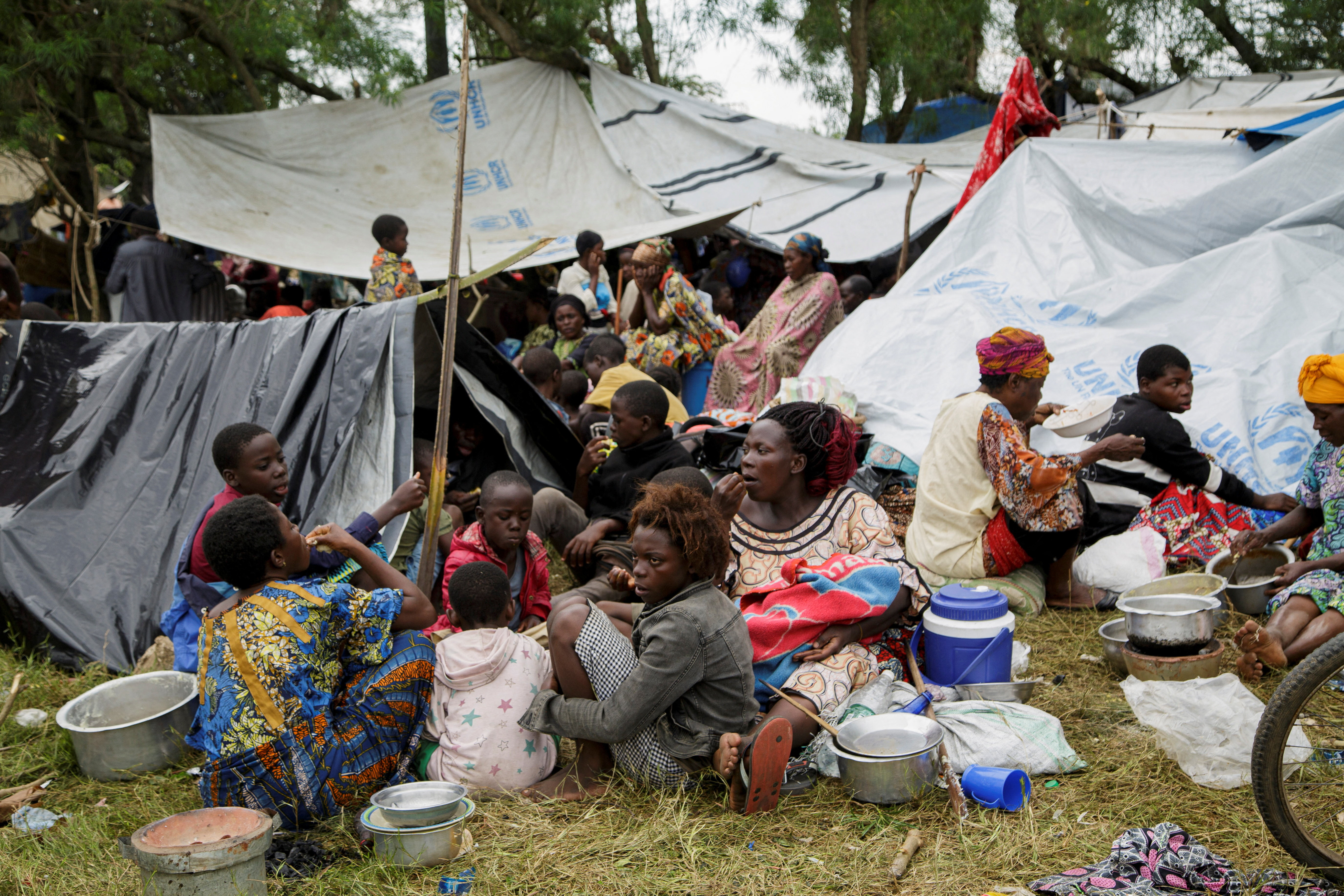
The M23 rebel group consolidated control over the strategic town of Uvira in eastern Democratic Republic of Congo on Thursday, residents said, as Kinshasa warned that the Rwanda-backed advance could derail U.S. President Donald Trump’s efforts to broker peace in the region.
The rebels’ gains bring the conflict to the doorstep of neighbouring Burundi, which has had troops in eastern Congo for years, aggravating fears of further regional spillover of fighting that has already killed thousands of people and displaced hundreds of thousands more since January.
Sporadic gunfire echoed on Uvira’s outskirts Thursday morning. For months, the town had served as the base of the Kinshasa-appointed provincial government after rebels captured the provincial capital, Bukavu, in February.
RESIDENTS SEARCH FOR FOOD
Despite the tension, residents ventured out in search of food after spending the previous day hiding in homes or fleeing to the countryside to avoid clashes.
“The government told us that Uvira would never fall and that the situation was under their control,” Godefroid Shengezi, a local teacher, said. “The reality today is quite the opposite.”
Shengezi said he had been unable to locate his three young children and feared they had crossed the nearby border into Burundi, where officials say they have received tens of thousands of refugees in recent days.
The rebel coalition called the Alliance Fleuve Congo (AFC), which includes the M23, said Uvira residents were safe and could resume their activities in the town.
U.N. Secretary-General Antonio Guterres on Thursday condemned the offensive in South Kivu that he said has resulted in civilian casualties in several locations, according to U.N. deputy spokesperson Farhan Haq.
Guterres warned that the escalation “increases the risk of a broader regional conflagration” and called for an immediate and unconditional cessation of hostilities.
WAR SPILLOVER FEARED
Uvira, on the shores of Lake Tanganyika, had until this week served as the headquarters of the Kinshasa-appointed government in South Kivu province and its regional military base since the provincial capital, Bukavu, fell to M23 in February. Control of Uvira could open the way for the rebels to advance beyond South Kivu.
The town is on the border with Burundi, just 30km (20 miles) from that country’s largest city, Bujumbura.
AFC leader Corneille Nangaa said on X on Thursday that the fighting in Uvira was “a strictly Congolese affair”, that M23 respected Burundi’s territorial integrity and sovereignty and that the group had no ambitions beyond Congo’s borders.
Burundian soldiers initially deployed to Congo to hunt down Burundian rebels there, but they have more recently helped in the fight against M23. Until early February, Burundi had 10,000-12,000 men fighting in eastern Congo on the side of government forces, according to analysts and diplomats, though that number has since fallen considerably.
M23 spokesperson Lawrence Kanyuka said on X on Thursday that some remaining Burundian forces had withdrawn this week while others had entrenched themselves in the mountainous Hauts Plateaux area of South Kivu province, where they were “launching bombs and using heavy artillery” that was killing civilians.
Reuters could not immediately verify the claim and Burundi’s government did not immediately respond to a request for comment.
A U.N. official told Reuters that while M23 wants the Burundians to leave South Kivu province completely, they are unlikely to enter Burundi itself and would instead pursue a diplomatic solution, knowing that Burundi depends heavily on Uvira for essential supplies including fuel.
Nearly 25,000 people crossed from Congo into Burundi between December 5 and December 8, Haq told a briefing on Wednesday.
A senior army officer told Reuters that the Gatumba border post near Uvira was closed and that refugees were coming by river.
PEACE PROCESS UNDER THREAT
The latest breakthrough in M23’s advance in mineral-rich eastern Congo comes a week after Congolese President Felix Tshisekedi and his Rwandan counterpart Paul Kagame met Trump in Washington and affirmed their commitment to a U.S.-brokered peace deal.
In a statement late on Wednesday, the Congolese government called for the international community to take “urgent measures” to ensure compliance with the deal, saying that “Rwandan aggression” was jeopardising it.
The United Nations said this week that some 200,000 people had fled their homes in recent days and scores of civilians had been killed.
Congo’s Foreign Minister Therese Kayikwamba Wagner told Reuters this week that the United States should consider expanding sanctions on Rwandan individuals and the military.
Rwanda denies backing M23 and has blamed Congolese and Burundian forces for the renewed fighting.
M23 is not party to the Washington-mediated negotiations. It has been participating in a separate, parallel round of talks with the Congolese government, hosted by Qatar.
The fall of Uvira to M23 underscores that durable peace in a region wracked by conflict for decades is still far off, said Jervin Naidoo of Oxford Economics.
“The (U.S.-brokered) DRC–Rwanda deal fails to address the structural drivers of the conflict and crucially excludes M23, highlighting a fundamental flaw: lasting peace cannot be achieved without including the armed group at the negotiation table,” Naidoo said.




Click here to change your cookie preferences