
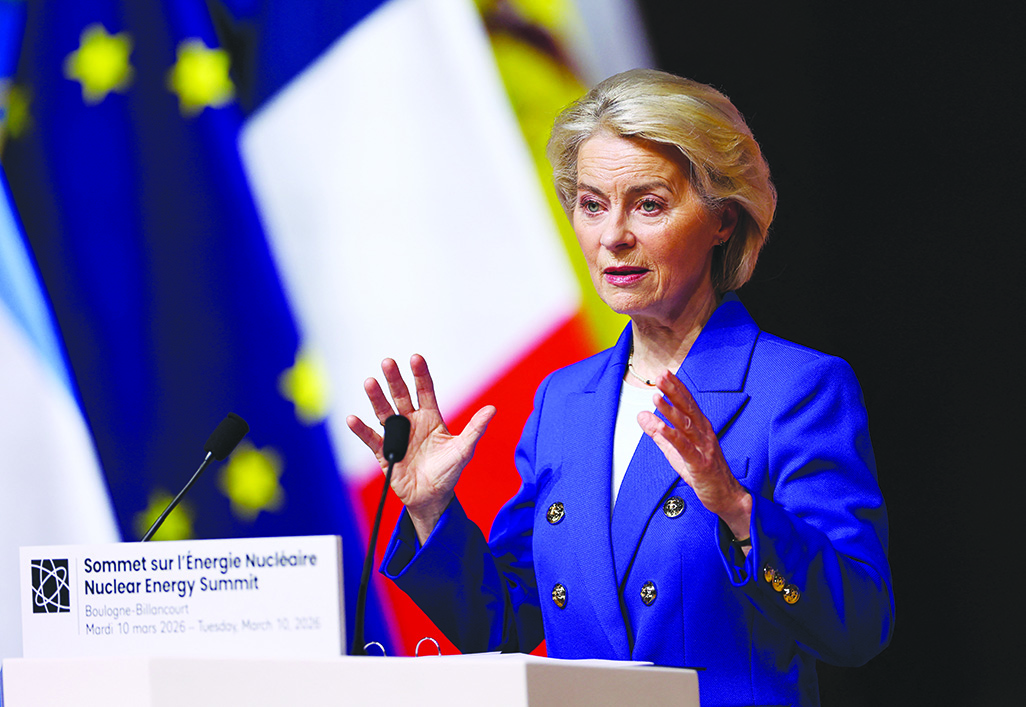
Reducing Europe’s nuclear energy sector was a “strategic mistake”, European Commission chief Ursula von der Leyen said on Tuesday, as governments grapple with an energy crunch from the Iran war.
Europe produced around a third of electricity from nuclear power in 1990 but that has fallen to 15%, she told an event in Paris, leaving it reliant on oil and gas imports whose prices have surged in recent days.
Being “completely dependent on expensive and volatile imports” of fossil fuels puts Europe at a disadvantage to other regions, von der Leyen said in a speech.
“This reduction in the share of nuclear was a choice. I believe that it was a strategic mistake for Europe to turn its back on a reliable, affordable source of low-emissions power.”
Von der Leyen’s native Germany took a political decision under then-Chancellor Angela Merkel to phase out nuclear power plants owing to public opposition and safety concerns after the 2011 Fukushima disaster. Von der Leyen was a minister in Merkel’s government when that decision was made.
Germany’s Environment Minister Carsten Schneider on Tuesday criticised von der Leyen’s “backward-looking strategy” on nuclear power.
“Cleaner, safer electricity from wind and sun is cheaper, has long been driving the energy transition, and produces no radioactive waste,” Schneider said in a statement.
The EU has rapidly expanded renewable energy, but gas power plants still form an important part of its power mix, and fossil fuels still dominate energy consumption in sectors such as transport and heating.
Thecontinued heavy reliance on imported oil and gas exposed European countries to soaring energy prices in 2022, when Russia cut gas deliveries after the invasion of Ukraine.
NUCLEAR RENAISSANCE?
The EU budget does not directly fund nuclear energy projects because they are not unanimously supported by its 27 member governments.
In a sign of the EU’s increasing acceptance of the technology, von der Leyen said the executive Commission would offer a 200-million-euro guarantee for private investments in innovative nuclear technologies.
She said the money would come from the EU’s carbon market.
Some EU countries which previously opposed nuclear, such as Denmark and the Netherlands, have recently softened their stance, as they hunt for ways to secure large amounts of stable, low-carbon electricity for heavy industry.
Others, including Austria and Luxembourg, remain opposed.
France, Europe’s biggest nuclear energy producer, argues that stable, low-carbon power from nuclear plants is key to industrial competitiveness.
French President Emmanuel Macron said the EU – where nuclear power producers still imported 15% of their uranium from Russia in 2024 – needed to move towards other suppliers.
“We need to cooperate internationally to make progress on this issue, to diversify our supply sources,” he told the Paris event, adding that France planned to increase its own enrichment capacity.
France imported 39% of its enriched uranium from Russia in 2025, customs data showed.
Macron also proposed standardising reactor designs across Europe. That could benefit France’s state-owned nuclear giant EDF, which has struggled to win recent tenders for new projects.
In 2024 South Korea’s KHNP won a tender worth at least $18 billion to build a new nuclear power plant in the Czech Republic, a decision which losing bidder EDF sought to block in the courts.



Click here to change your cookie preferences