
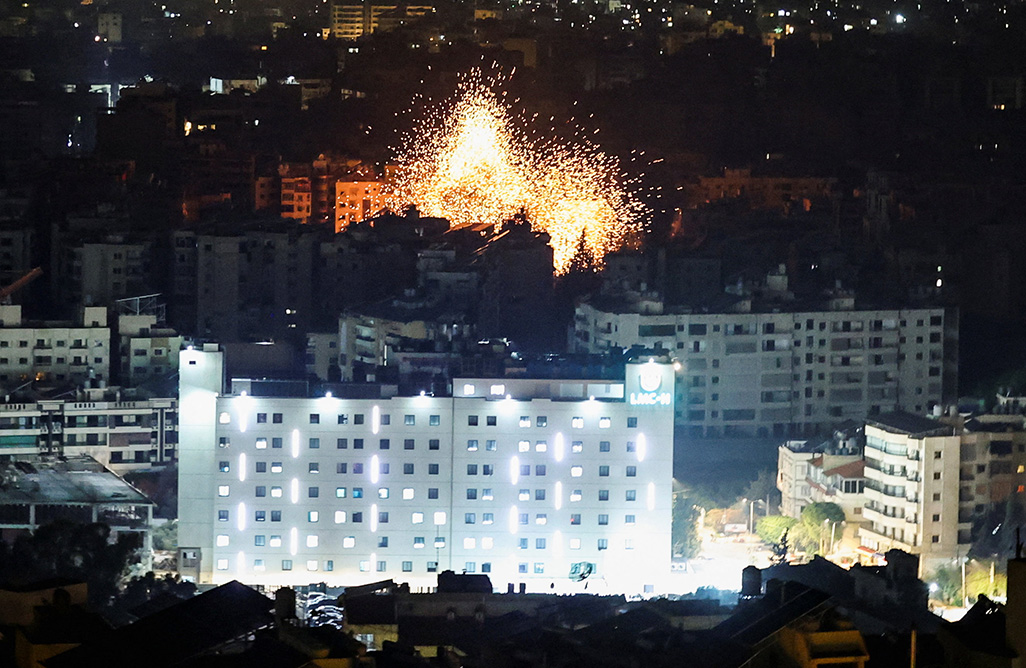
Israel destroyed a bridge in southern Lebanon on Friday and dropped leaflets in Beirut threatening Gaza-scale devastation as it deployed more troops to fight Iran-backed Hezbollah and warned of more attacks on the country’s infrastructure.
As Israeli warplanes pounded Beirut’s suburbs with air strikes, Lebanon’s interior minister said authorities were unable to accommodate the hundreds of thousands of people who have sought refuge in the capital.
Israel launched its offensive against Hezbollah after it opened fire on March 2 to avenge the killing of Iran’s supreme leader at the start of the U.S.-Israeli war on Iran. Israeli strikes have killed nearly 700 people and uprooted 800,000 more, according to Lebanese authorities.
Making a visit to Lebanon on Friday, United Nations Secretary-General Antonio Guterres said he was seeking $325 million in emergency funding to help authorities grapple with the humanitarian fallout.
“Solidarity in words must be matched by solidarity in action,” Guterres said.
ISRAEL SAYS LEBANON WILL ‘PAY INCREASING COSTS’
Israel’s military said it struck the Zrarieh Bridge spanning the Litani River early on Friday, claiming it was being used by Hezbollah militants to move between Lebanon’s north and south. The military provided no evidence for the claim.
It appeared to be the first time Israel had acknowledged attacking civilian infrastructure during its current military campaign in Lebanon.
“The Lebanese government … will pay increasing costs through damage to infrastructure and loss of territory” until Hezbollah is disarmed, Defence Minister Israel Katz said a statement.
International law generally prohibits militaries from attacking civilian infrastructure, though it can be permitted in some instances if it is being used for military purposes.
Lebanon’s government has sought to disarm Hezbollah, and the country’s army had said before the war that progress had been made in areas near the Israeli border. On March 2, the Lebanese government banned military activities by Hezbollah, which has refused to fully disarm.
Israel says that Hezbollah’s military capabilities have been degraded since a 2024 war but that it still poses a formidable threat and possesses hundreds of rockets.
ISRAEL DROPS LEAFLETS OVER BEIRUT
Israeli aircraft dropped flyers over Beirut threatening to inflict damage on Lebanon similar to the devastation the military wrought on Gaza during its two-year war with Hamas. Much of Gaza has been reduced to rubble and nearly all its population displaced.
“In light of the great success in Gaza, the newspaper of the new reality arrives to Lebanon,” the flyer said.
Another flyer called on Lebanese to strip Hezbollah of its weapons. It featured two QR codes to links on WhatsApp and Facebook, accompanied by a message telling Lebanese to make contact if they want to see “real change” in their country.
Israel’s military did not immediately respond to a request for comment on the flyers.
NOT ENOUGH SHELTERS FOR DISPLACED PEOPLE
Lebanon’s state media reported on Friday that a drone struck a residential apartment in Beirut’s Bourj Hammoud district on the northern outskirts of the Lebanese capital. It was the first time in the war that Beirut’s predominantly Christian northern suburbs have been hit as Israel appeared to widen its targeting.
Lebanon’s Interior Minister Ahmad Al-Hajjar said the country had opened as many shelters as possible in Beirut for internally displaced Lebanese, many of whom have been sleeping on streets or in parks.
“No matter how many shelters are opened in Beirut, they cannot accommodate all the displaced,” Al-Hajjar told a press conference.
After redeploying an infantry brigade from near to Gaza to the border with Lebanon earlier this week, the Israeli military said Chief of Staff Eyal Zamir had ordered a further reinforcement of troops in the north.
On Wednesday night, Hezbollah launched 200 rockets at northern Israeli communities.





Click here to change your cookie preferences