
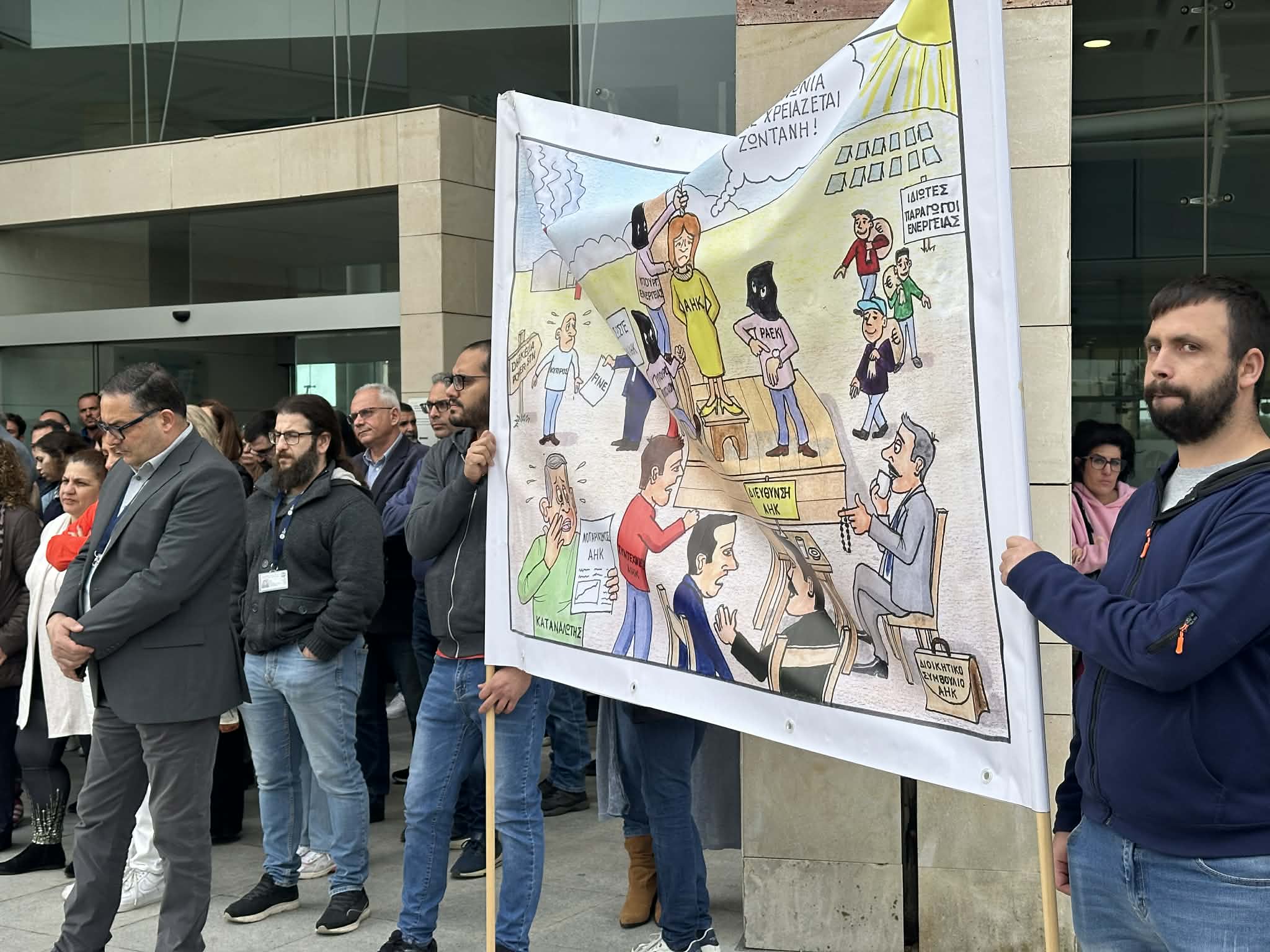
Trade unions representing employees of the Electricity Authority of Cyprus (EAC) accused the state of promoting private interests instead of projects aimed at reducing electricity costs for consumers, while also citing an “absence of strategic planning”.
The unions staged a three-hour work stoppage from 8am to 11am, following a two-hour warning strike held around 10 days earlier.
EAC chairman Giorgos Petrou is expected to address energy sector issues in statements to the press on Thursday.
Kyriakos Tafounas, president of Epopai – the largest trade union representing EAC workers – said on behalf of all unions that consumers should support workers’ demands, reiterating concerns over the lack of a coherent state strategy.
He suggested that certain current and former state officials may have acted in ways that do not serve the public interest, noting that “many of them are now involved in companies operating in the energy sector”.
Tafounas also said there had been no response from the energy minister to the unions’ concerns, claiming that “the minister has time to meet associations representing private interests”.
He highlighted the work carried out by the EAC and the rapid response of its crews in emergencies, citing the needs that arose following last summer’s major wildfires in Limassol.
“Any strategy targeting the organisation is deliberate and cannot be justified,” he said, adding that the EAC “should not be undermined for the work it has produced”.
Referring to recent legislation, Tafounas said that beyond a bill involving Cyta entering the energy market, parliament had also granted private entities the right to construct networks in both public and private spaces, citing delays attributed to the EAC.
He noted that in recent years the authority has connected more than 97,000 photovoltaic systems – both residential and commercial – to its grid, with renewable energy penetration reaching up to 65 per cent on certain days.
“We may be the only country in the world where we replaced all lamps with LED, installed photovoltaics in schools, military camps, hospitals and for vulnerable groups, and developed infrastructure for electric vehicle charging,” he said.
On the Dhekelia power station, Tafounas said it continues to operate with units over 40 years old that face serious operational issues, yet still contributes 360 megawatts to the system.
Replacing these units with modern ones, he said, would reduce electricity costs and emissions while ensuring system reliability. He added that 2029 is the final deadline set by the European Union for the station’s operation.
Tafounas also raised concerns over water policy and desalination, claiming that although the EAC has had studies since 2018 for a large desalination plant in Moni, “private interests in the energy sector are intervening to prevent it”.
Instead, he said, the authority is being pushed towards smaller, mobile desalination units, which are more costly and only offer temporary solutions, potentially affecting future water prices.
He further criticised delays in implementing centralised energy storage, attributing them to opposition from private interests that would be impacted by systems supporting rooftop solar installations.
Tafounas also referred to what he described as “myths” about reducing electricity costs, including the expected benefits from natural gas and electricity interconnection.
“We are not against interconnection,” he said, adding that if pursued for national or geopolitical reasons, the state should proceed.
He also claimed that a former head of Cyprus Energy Regulatory Authority (Cera) had approved cost recovery of such investments at 63 per cent from Cyprus’ roughly 500,000 consumers and 37 per cent from the other side.
He added that the EAC had effectively created the natural gas market two decades ago by installing compatible units, but said a €160 million unit is still not generating revenue, alleging that Cera “failed to create a market benefiting consumers”.
“As a public organisation, we will not operate on a profit-driven basis. Our role is to invest in projects aimed at reducing electricity costs for consumers, in the interest of the economy and the public good,” Tafounas said.
Asked whether employees and management are aligned, he said meetings with the organisation’s leadership indicated a shared understanding, adding that union positions are based on the views of the authority’s technocrats.
He cited as an example the EAC’s €43 million participation in infrastructure linked to the Natural Gas Infrastructure Company (Etyfa), where technocrats had disagreed with the decision, claiming that “no one knows where that €43 million is or how it has been used”.






Click here to change your cookie preferences