
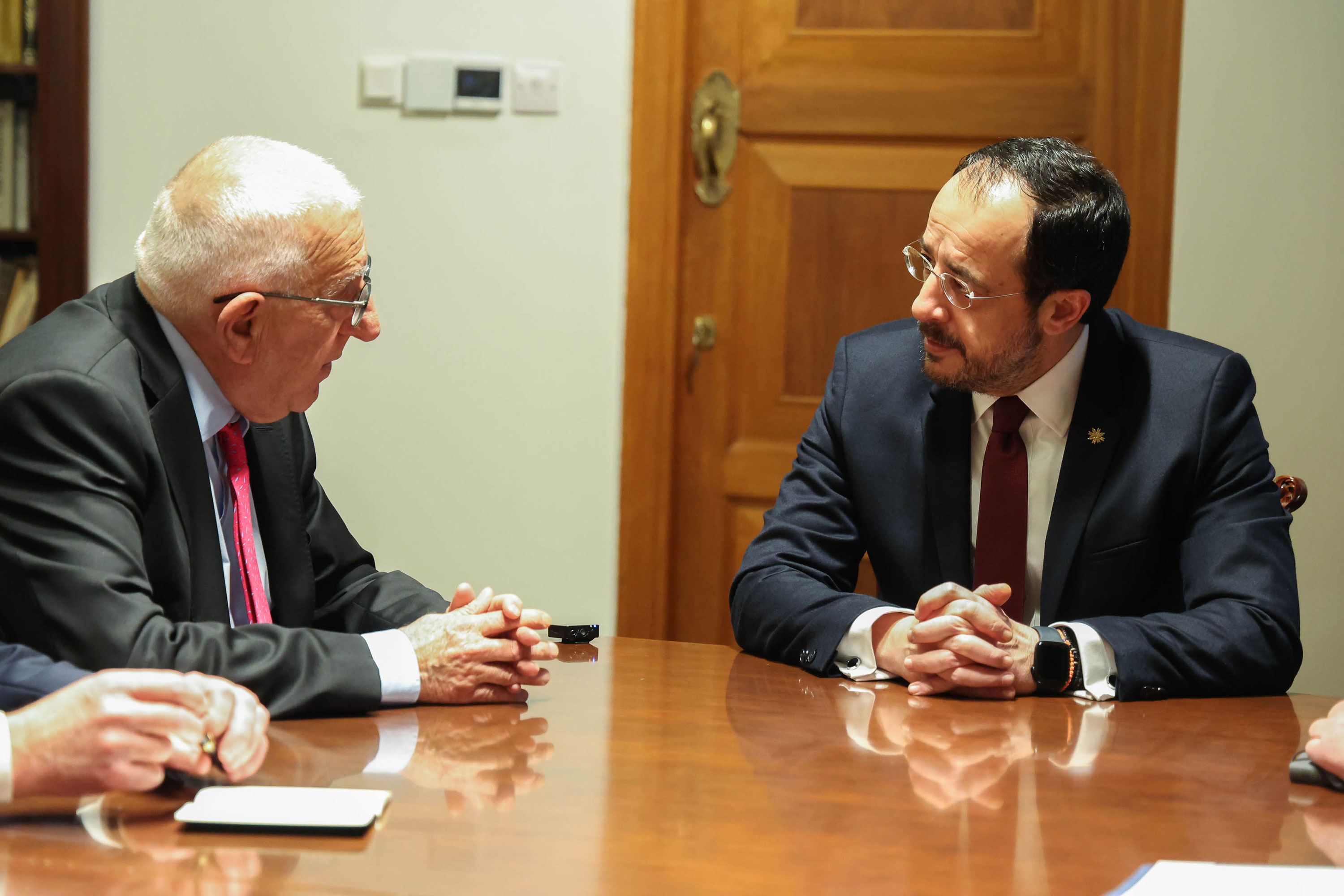
Greek parliament speaker Nikitas Kaklamanis on Friday urged Cypriot President Nikos Christodoulides to “exert as much influence as you can” during the remainder of Cyprus’ six-month term as the holder of the Council of the European Union’s rotating presidency.
“You must exert as much influence as you can as the president-in-office of the Council of the EU. We must do something about the cost of living and about energy,” he said during a meeting with Christodoulides at the presidential palace, before describing both issues as “global phenomena”.
He also invited Christodoulides to give an address to Greece’s parliament on May 14.
Christodoulides thanked him for the invitation, describing it as a “great honour for me, for the Republic of Cyprus” and a “historic moment”.
He then recounted his contacts in Brussels, where he had travelled earlier in the week for the European Council summit, saying that he and Greek Prime Minister Kyriakos Mitsotakis “achieved specific goals we had set”.
“I will start with the discussion on Article 42.7,” he said, referring to the EU’s mutual defence clause, before thanking Greece for its decision to send two frigates and four F-16 fighter jets to the island after it was hit by an Iranian-made drone earlier this month.
He explained that in light of the drone strike, “it was decided to specifically discuss the European Union’s operational plan for when Article 42.7 is triggered by a member state”, before outlining discussions on competitiveness and energy, with the cost of energy now rising as a result of the ongoing conflict in the Middle East.
“All of us, in cooperation with the [European] Commission, will proceed with some very specific measures, so as to address the increased cost of energy,” he said, before adding that those measures will “be targeted” and will be implemented “for a specific period”, and that the government will “constantly evaluate each state of affairs”.
He added that at the European Council summit, “it was decided that each member state should consult directly with the commission, because each country has a different energy mix”, and that for this reason, not every country faces “the same energy issue”.
The commission’s response to this, he said, was positive.
“From there, we discussed the situation at length, the situation as it is developing in the wider Middle East. In particular, [we spoke] about the need to take an initiative that will lead to de-escalation, because you understand that this state of affairs is working against all of us,” he said.
For this reason, he added, “it is necessary for the European Union, in cooperation with the states of the region, especially the Gulf states, the Middle Eastern states, but also the United States, to take a joint initiative to see how conditions can be created for de-escalation and to end this difficult state of affairs”.
“War certainly does not solve problems. Diplomacy is what always solves problems and in diplomacy today, there are no dead ends. Despite the difficulties and the problems, a very specific proposal should be put before all those involved, so that this crisis can be brought to an end,” he said.

Click here to change your cookie preferences