
Urges stronger diplomatic role from Cyprus
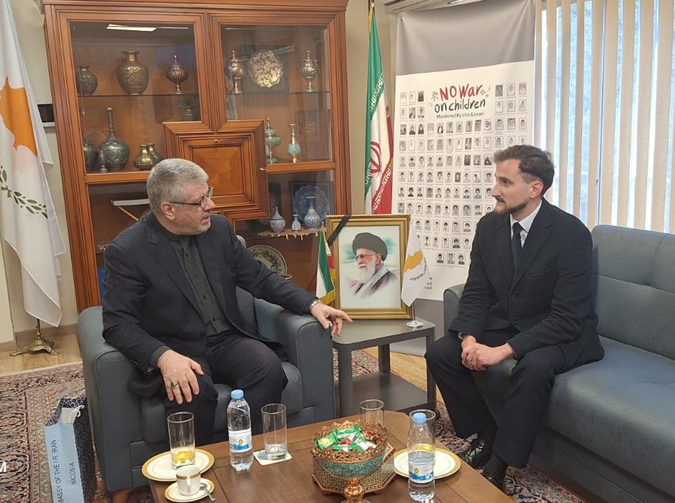
Iran’s ambassador to Cyprus, Alireza Salarian, said on Friday that neither the republic nor the British bases are considered targets in Iran’s ongoing conflict with the United States and Israel, while calling on Cyprus to take a more active diplomatic role as holding the EU council presidency.
In an interview with the Cyprus Mail, addressing recent regional developments, Salarian said there was “no sign of any provocation” from Cyprus or the British bases and stressed that Iran had “no report that the bases carried out any act of aggression against Iran.”
He added that Iranian assessments align with public statements by British Prime Minister Keir Starmer that the bases are not being used offensively, concluding that “there is thus no justification to consider them a target.”
Pressed directly on whether the British bases could feature in Iranian retaliatory measures, Salarian assured that “it is indeed not a target,” and does not view them as being involved “in any capacity” in the conflict which began on February 28 with coordinated US and Israeli strikes on Iranian territory.
His remarks follow earlier reports that an Iranian missile intercepted over northern Lebanon may have been aimed at British military installations in Cyprus.
The United Kingdom’s defence ministry has since rejected those claims, stating that its intelligence “does not suggest the missile in question was aimed at the bases,” while declining to comment on whether a US naval asset may have been involved in the interception.
Salarian also addressed the earlier incident in which a drone struck an aircraft hangar at RAF Akrotiri.
He said Iran’s foreign ministry “confirms that no such drone was fired from Iran,” adding that Tehran has not investigated the case in detail due to the pressures of the ongoing war.
He did not rule out “the possibility of a false flag operation,” suggesting that other actors could have been responsible.
When asked whether the drone could have originated from Hezbollah, he said he “could not confirm” this and emphasised that “Hezbollah is its own independent entity.”
He further raised the possibility that “the United States may have developed a copy of the Shahed drone in question,” without providing evidence.
The ambassador’s comments contrast with earlier rhetoric from Iranian officials, including statements attributed to Islamic Revolutionary Guard Corps commander Sardar Jabbari, who warned of missile strikes on Cyprus in response to what he described as an expanded US presence on the island.
Salarian dismissed those remarks, saying Jabbari “was not an acting general and not an official spokesman for the IRGC,” and therefore did not represent official Iranian policy.
He also rejected reports of a missile attack targeting Diego Garcia in the Indian Ocean, describing them as “pure propaganda” and said Iran “does not have the range to reach” such locations.
Similarly, he denied Israeli claims that Iran possesses the capability to strike cities such as London or Paris, calling those assertions unfounded.
Turning to the humanitarian impact of the conflict, Salarian said that “some 1,500 civilians have thus far been killed” in Iran, with a further “5,000 civilian casualties.”
He provided detailed figures for damage to civilian infrastructure as of Thursday, March 26, stating that “87,294 civilian units” had been affected, along with “600 schools” and “17 Red Crescent centres.”
Addressing accusations that Iranian strikes have targeted civilian infrastructure in Gulf states including Bahrain, the United Arab Emirates, Qatar and Kuwait, Salarian said such claims overlook the presence of US military assets in those countries.
“The United States not only maintains military bases and infrastructure in these states,” he said, “but is also concealing military equipment within those locations,” implying that such civilian sites could be considered legitimate military targets.
On the question of diplomacy, Salarian refuted suggestions regarding contacts between Iran and the United States.
He initially said that “no negotiations are being held” and described reports of talks as “psychological warfare.”
He added that any future negotiations would require “a guarantee of compensation for the damage caused by the conflict” and assurances that a cessation of hostilities “could not be automatically incurred again.”
In reference to the previous negotiations held between the US and Iran before the outbreak of hostilities, the ambassador stressed that talks had reached even a technical-level of implementing a deal regarding Iran’s uranium, stating that the two sides were engaged “both in Geneva and in Oman,” while questioning “the sincerity with which US officials are acting in good faith.”
He criticised US envoy Steve Witkoff, saying he “was not a specialist in this department,” and pointed to the deployment of “a significant convoy of military equipment to the Middle East” as evidence of contradictory intentions.
Salarian argued that the conflict “is not in the interest of the United States,” and claimed that president Donald Trump was acting “at the behest of Benjamin Netanyahu,” framing the war as driven primarily by Israeli ambitions and not American foreign policy.
He also addressed Iran’s actions in the Strait of Hormuz, insisting that Tehran is “acting entirely within its sovereign rights” to control access during wartime.
He confirmed that measures are in place to allow “friendly flagged vessels” to pass and denied reports that Iran intends to impose transit fees on shipping.
In his remarks on European policy, Salarian criticised what he described as a lack of condemnation from EU member states regarding US and Israeli actions.
“This lack of condemnation facilitated the present conditions that permitted the conflict,” he said, linking it to both the current war and a previous 12-day escalation where the US bombed nuclear facilities in Iran.
He argued that Cyprus, as a regional actor and current holder of the EU Council presidency, “should do more to facilitate an end to hostilities and a return to diplomatic efforts.”
He said the crisis “is affecting everyone in the region, including Cyprus due to its geography,” and therefore it is “in Cyprus’ interests to push Europe for an end to the war.”
Salarian also addressed tensions between Iran and the European Union over the designation of the Islamic Revolutionary Guard Corps as a terrorist organisation.
He said Iran’s decision to label both Cyprus’ and more broadly European naval forces as terrorists was “a direct reaction” to that move.
He added that Iran had been in contact with EU foreign policy chief Kaja Kallas and was “ready for fresh talks in implementing a deal,” but said these efforts had not progressed.
On internal developments within Iran, Salarian rejected reports that recent protests were driven by domestic grievances.
He said intelligence indicated that “Mossad and foreign insurgents were behind the protests,” claiming they were intended to “create internal instability.”
He maintained that demonstrations “began as peaceful” but escalated after “Israeli, American and European actors had called on the public to take further action.”
He denied that civilians had been targeted by Iranian authorities during the unrest, instead describing those killed as “armed insurgents.”
Drawing a comparison, he remarked that if police in Cyprus were confronted by “armed rioters with guns and weapons, burning down civilian infrastructure,” they would not be treated as peaceful protesters.
Salarian also commented on demonstrations held by members of the Iranian diaspora in Cyprus following the assassination of supreme leader Ali Khamenei during US-Israeli strikes.
Some protesters had expressed support for foreign intervention and called for regime change.
The ambassador lamented this as “a grave shame,” saying it was regrettable that “so many of his compatriots would rather see their own people attacked by a foreign power.”
Salarian repeatedly emphasised that Iran’s position towards Cyprus remains unchanged.
“We are well aware Cyprus is indeed not involved in this conflict,” he said, adding that the status of the British bases is determined by their current non-offensive role.
“At present,” he said, they are “not considered a direct target due to the refusal to use the bases in an offensive manner.”
His remarks align with earlier statements from the Iranian embassy in Nicosia stressing a “cordial and constructive relationship” between Iran and Cyprus and reiterating that Tehran does not engage in aggression towards its neighbours except in self-defence.



Click here to change your cookie preferences