
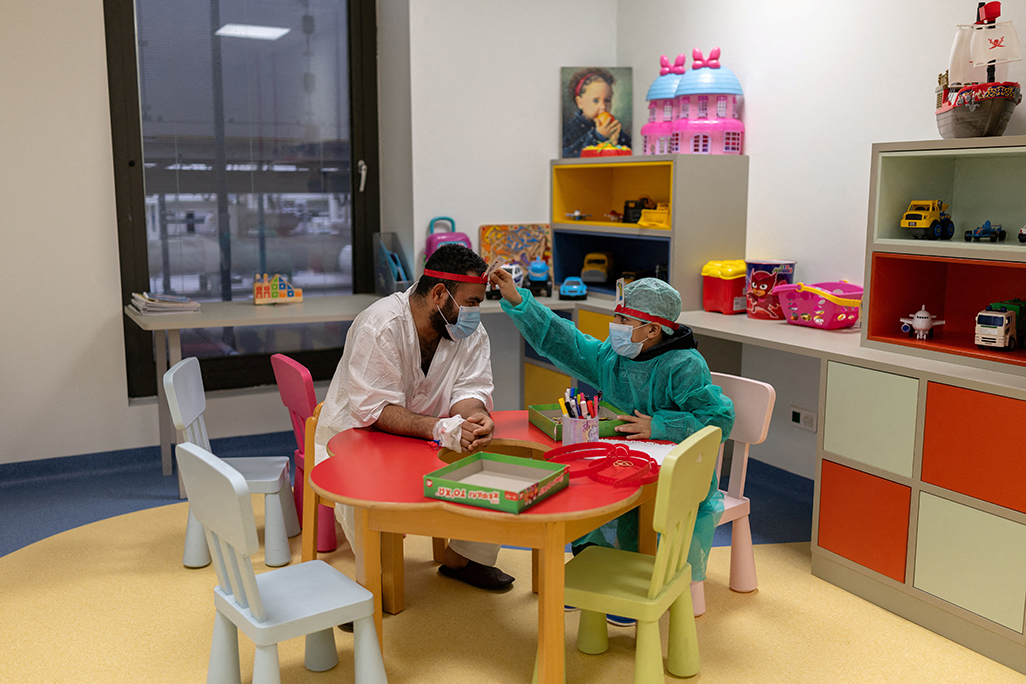
Abdulaziz Aldarwish decided to take drastic action after his son Yahia’s young kidneys failed.
The Syrian construction worker could not afford the 1,200 euros per month needed for dialysis treatment and in any case the public healthcare system in Lebanon, where he worked, is in a state of near-collapse after years of conflict and neglect.
So Aldarwish managed to muster 5,000 euros from savings and family loans for them to board a boat ferrying migrants 200 km (120 miles) to Cyprus, hoping to find doctors who could give his son a new kidney and a new life.
His wife and their eight other children remained behind, in a small Syrian village near the Lebanese border.
In January, two years after leaving Lebanon, Yahia became one of the first young children to receive a transplant at the newly-established Onassis National Transplant Center in Greece – an emblem, doctors say, of what can be achieved through international medical cooperation. His father was the donor.
At the hospital after the operation, Aldarwish, 32, smiled with relief: “I had to take a risk: either things work out, I get him treated… or that’s it, we both die.”
Yahia, now 10, is upbeat, saying he wants to rejoin his classmates in Cyprus and dreams of one day opening a supermarket.
‘IT WAS A MIRACLE’
On a recent day in Athens, Aldarwish recalled their hardest moments as he pushed Yahia on the swing of a local playground.
When they boarded the boat in Lebanon in 2024, they took water and some dates – enough for a trip only expected to take a few hours. Before boarding, Yahia received a round of peritoneal dialysis to see him through.
But they ended up adrift in rough seas for a week, surviving on rainwater, before being spotted by a merchant vessel.
“I didn’t expect my son to endure something like this,” Aldarwish said. “It was a miracle.”
“In the end, death was not our fate.”
When they arrived in Cyprus, doctors informed them that Greece – a few hundred miles away across the Mediterranean – was set to resume kidney transplants for low-weight children in May 2025, after years of suspension.
Greek and Cypriot authorities cooperated to allow father and son to be flown to Athens, where they were monitored by doctors from three hospitals and assisted by interpreters.
On January 22, the day of the surgery, Aldarwish and Yahia hugged before they were wheeled to separate rooms for parallel surgeries that lasted hours.
“This whole bridge of life was built for this child,” said Smaragdi Marinaki, the head of the nephrology department at Laiko Hospital which participated in the process.
“Transplantation transcends every barrier: borders and countries, races and religions.”
Smaragdi, who calls Yahia “sweet tooth” for his long-thwarted desire for chocolate, says he is recovering well.





Click here to change your cookie preferences