
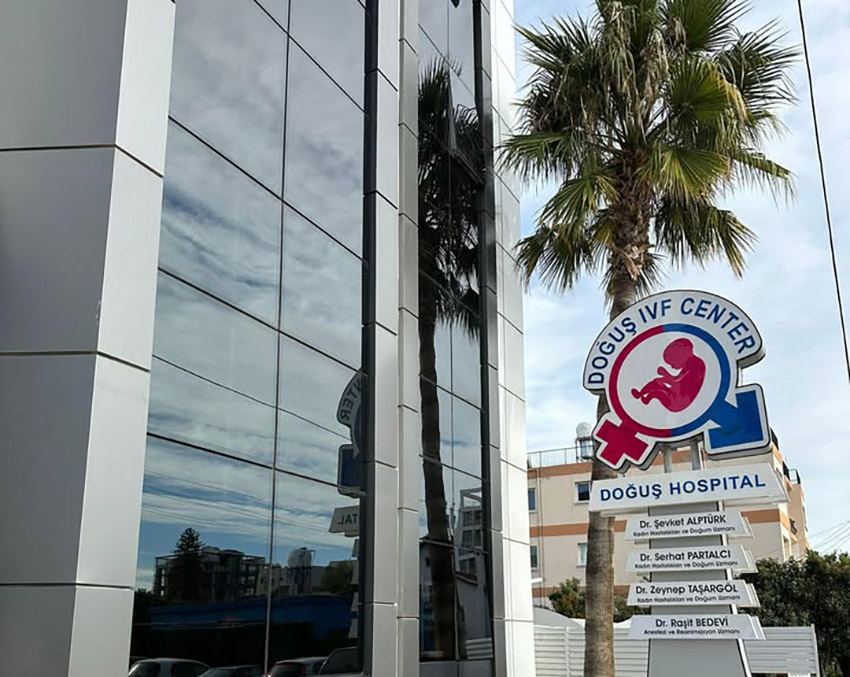
An IVF clinic in the north is facing accusations of negligence as patients claim their children were conceived after they were given the wrong sperm, the BBC reported on Tuesday.
According to the BBC report, several families accuse the clinic of using different donors to those they had selected, meaning children were not as biologically similar as had been planned.
“It was pretty soon after James was born that I knew something wasn’t right,” one of the mothers, named Laura, told the BBC.
Laura and her partner Beth conceived two children via the clinic around 15 years ago.
While they said that they were suspicious from the moment their second child James was born with dark brown eyes, they only found out their children’s genetic dissimilarities recently.
“We thought we had ordered sperm from Denmark,” the couple said.
The two women had started their in vitro fertilisation (IVF) process at the Dogus IVF centre in the north, which had reportedly said it collaborated with the Danish sperm and egg bank Cryos International – the largest of its kind in the world.
The couple told the BBC they were impressed by the large number of anonymous donors that had reportedly completed health screenings and psychological evaluations.
Beth and Laura said they chose a donor named Finn, an athletic, non-smoking Danish man, for both of their children, Kate and James.
But their doubts increased when their son developed darker features and olive skin.
This led to them carrying out a DNA test, which revealed not only that their children were not conceived with Finn’s sperm, but they did not have the same father.
“We went from having this nice profile of donor Finn and feeling like we knew the family history and the health history, to just nothing,” Beth told the BBC.
The British broadcaster’s investigations led them to two further alleged cases.
According to the BBC, in both of those cases also the families were suspicious of the genetics of their children conceived via the clinic in the north.
These concerns were reportedly validated by DNA tests, just as in the case of Beth and Laura.
All three were treated by Dr Firdevs Uguz Tip, described by Beth and Kate as “nice and friendly”.
Responding to a request by the BBC, the doctor denied all allegations and stressed that she had not been in charge of the sperm orders at the centre.
Firdevs also denied having received information about the couple’s donor Finn at any point and questioned the findings of the couple’s DNA test.
Sperm bank Cyros said that despite the occurrence of an error, it is extremely uncommon due to the stringent security protocols in place. They emphasised that this particular error has never been documented in the company’s 45-year history.
Fertility specialists told the BBC that such an error is highly unlikely, particularly if it has happened more than once, which suggests that the medical team may have been negligent.
Overall, the couple’s fertility treatment in the north cost an estimated £16,000, £2,000 of which was supposedly for the sperm of donor Finn.
The other families treated at the same clinic received egg cells but said they did not match the egg donors they had selected.
“I don’t want people to think that I need to have a baby that looks like me, that’s not what this is about,” one of them said, stressing that rather than a matter of physical traits, it was important to her to tell her kids the truth about “where they come from.”
The BBC confronted Firdevs with the accusations, who responded that the choice of the egg donor shad been made “made exclusively” by the clinic.
She said the clinic did not provide patients with profiles of egg donors and explicitly states this in its consent forms.
One of the women, emphasising the love for her child, said she would not have proceeded with the treatment if she knew that another donor would be used.
Beth and Laura said they have since told their children about the situation, with James still figuring out how to deal with it.
“You can’t just say someone’s something and then they’re not. That’s bad,” he told the BBC.
The BBC has set up an email address, [email protected], where those affected can get in touch.


Click here to change your cookie preferences