
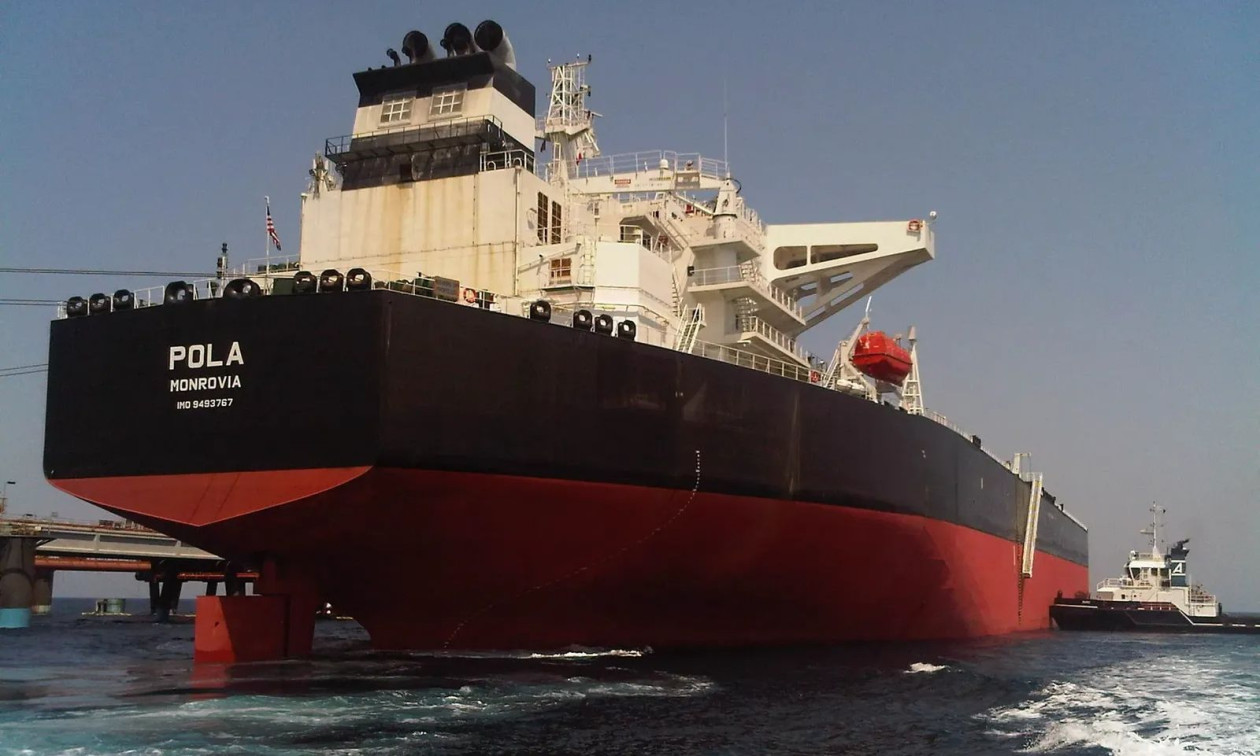
Another tanker belonging to Greece-based shipping firm Dynacom has been confirmed to have exited the Middle East Gulf through the Strait of Hormuz, but vessel traffic through the chokepoint remained only a trickle in late March, with Iran-linked shadow fleet trade still dominating the limited energy outflows.
According to Lloyd’s List Intelligence data corroborated by port agents, the Malta-flagged suezmax Marathi arrived in the Gulf of Kutch in India on Thursday, March 26, indicating Sikka as its destination.
The vessel had transited the strait inbound on February 28, the day the war began, and, according to Vortexa, later loaded 1 million barrels of Arab Light crude from Ras Tanura in early March.
Marathi is only the 10th non-shadow fleet tanker tracked to have made an outbound voyage through the Strait of Hormuz since March 8, underlining how sharply mainstream tanker transits have fallen as Iran’s attacks on shipping continue to disrupt traffic.
At the same time, the flows least affected by the conflict appear to be Iran’s own exports, with shadow fleet oil and gas carriers now accounting for the overwhelming majority of movements through the strait.
According to Lloyd’s List estimates, shadow fleet tankers carrying Iranian-origin oil and liquefied petroleum gas made up about 15 per cent of Strait of Hormuz transits between February 1 and 27, but now account for more than 80 per cent.
Traffic also appears to be routed almost exclusively through a passage dictated by the Islamic Revolutionary Guard Corps (IRGC), described as the “Tehran toll booth”, requiring ships to sail around Iran’s Larak Island and through Iranian territorial waters.
It was not possible to determine whether Marathi followed that route, as its Automatic Identification System was switched off during its voyage from the Middle East Gulf to India.
As previously reported by Lloyd’s List, Iran is using this mechanism both to project power and, at least in part, to generate revenue by charging some ships for passage. While not all ships are paying for transit, at least two operators are understood to have paid.
A diplomatic source familiar with the arrangement said reports that Iran had sought $2 million payments in yuan were credible, while adding that cryptocurrencies were among the possible payment methods.
Dynacom’s George Prokopiou attributed Marathi’s transit through the strait solely to “the courage of the crew”. He also said to Lloyd’s List that “There has been no bribes.”
Another tanker belonging to Dynacom, owned by George Prokopiou, has braved the dangers and crossed the Strait of Hormuz. This is the Pola, which has managed to cross the scorched-earth zone for the second time since the start of the war.
The tanker in question, the 150,000 dwt Suezmax Pola, built in 2011, made the rounds on the internet when it passed west through the Strait of Hormuz in early March.
This is the fourth oil tanker managed by Athens-based Dynacom Tankers Management Ltd. to successfully cross the passage controlled by the Revolutionary Guards. The strategically important waterway remains largely closed to commercial shipping, having caused chain problems in the global oil supply, as about 1/5 of the tankers carrying the “black gold” pass through that point.
The Pola, which crossed the Straits of Hormuz for the second time, was not the only Prokopiou ship to defy danger, as the Shenlong, Smyrni and Marathi had previously charted the same route.
The suezmax Pola, which had “erased” its position by deactivating its transponder, reappeared on Monday in the eastern Indian Ocean, off the coast of Sumatra, which means it crossed the Straits undetected.
A source in the dry bulk industry likewise denied that payments had been made in exchange for passage.
Meanwhile, US president Donald Trump said on Thursday that Washington was in talks with “the right people” in Iran and that they had offered a “present” as a sign of goodwill.
According to Trump, that “present” was Iran agreeing to allow “eight big boats of oil” to transit the strait, with the vessels expected to depart on Wednesday.
Vessel-tracking data from recent days did not suggest any broader recovery in mainstream tanker movements.
According to Lloyd’s List estimates, at least 13 tankers transited the strait outbound since Monday, but 10 of them were shadow fleet vessels. No mainstream tankers were estimated to have transited between Wednesday and Friday.
However, Lloyd’s List noted that, as in the case of Marathi, other mainstream tankers may have crossed the strait with AIS switched off and could reappear in tracking data in the coming days.
On Saturday morning, two India-flagged very large gas carriers and the Greek-owned, Marshall Islands-flagged aframax P.Aliki sailed through the Larak detour ahead of transiting the strait outbound. None of the three were shadow fleet vessels.
The aframax P.Aliki indicated via AIS that it was bound for Karachi, Pakistan, while its owners, Performance Shipping Incorporated, said earlier in March that the vessel was chartered to Pakistan National Shipping Corporation.
The two Indian-flagged VLGCs identified themselves via AIS as Indian ships with Indian crews.
Elsewhere, two Cosco Shipping-operated ultra-large containerships were reported to have diverted at the last minute while trying to leave the Middle East Gulf via the Larak Island route, in a sign that even Tehran-approved transits are not proceeding smoothly or at scale.
They became the third and fourth vessels tracked making abrupt course changes while attempting to exit the Gulf since Tuesday.
The other two were the 75,120-dwt bulk carrier Lotus Rising and the St Kitts and Nevis-flagged 658-teu containership Selen, which attempted to transit the strait on March 24 before changing course off Qeshm Island.
The exact reasons for the diversions remained unclear, but the incidents came only days after a call between Chinese Foreign Minister Wang Yi and Iranian Foreign Minister Abbas Araghchi, during which the latter said the Strait of Hormuz remains open to all and that vessels could pass safely, although countries involved in the conflict were excluded from consideration.





Click here to change your cookie preferences