
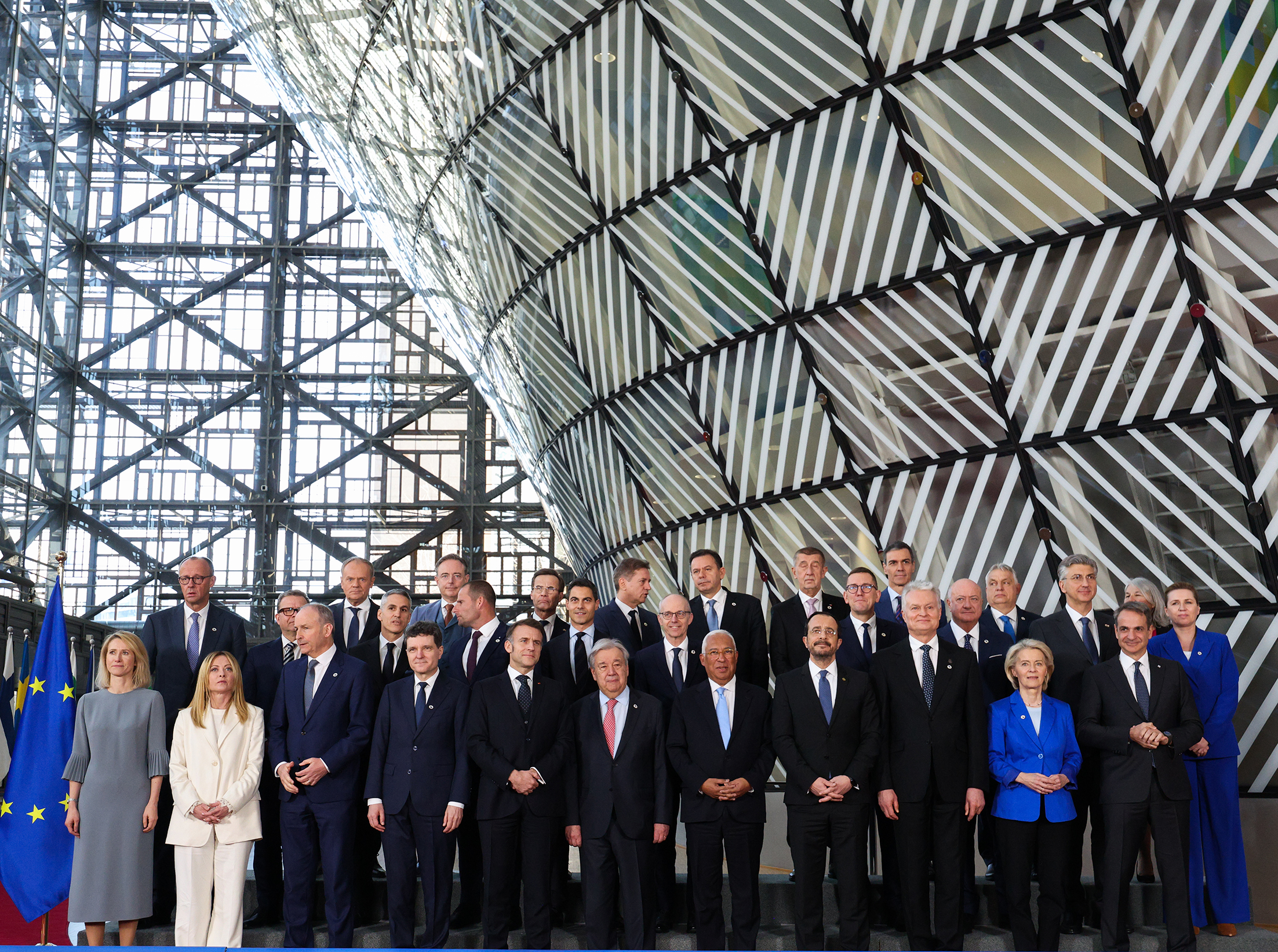
Invites were sent on Tuesday to leaders of the European Union’s 27 member states to attend a summit in Cyprus later this month.
The invites were sent by European Council President Antonio Costa, who said that the meeting will also be attended by “key regional partners”, who will be present to discuss “the situation in the Middle East”.
“The focus of our informal European Council meeting will be twofold: we will address the challenging geopolitical environment and Europe’s response to it, and we will also provide political guidance for the work on the multiannual financial framework,” he said.
The multiannual financial framework is the EU’s budget for the period covering the years between 2028 and 2034.
Costa said that the discussions will begin on April 23, with Ukrainian President Volodymyr Zelenskiy set to offer European leaders an update on the latest situation regarding the ongoing war in Ukraine. It is thus far unclear whether Zelenskiy will be in Cyprus in person.
Afterwards, he said, “we will then address the conflict in Iran and the Middle East, which poses serious challenges to the European Union”.
He said that European leaders will “discuss our response to this rapidly evolving situation”, and that this response will “include Europe’s contribution to de-escalation and peace in the region, as well as to the freedom of navigation” through the Strait of Hormuz.
“Furthermore, the effects of high fossil fuel prices are already visible in the everyday lives of our citizens and companies. Given the potential further negative economic consequences of a prolonged conflict, we will discuss the instruments at our disposal,” he said.
He added that this discussion will build “on the decisions taken at the March European Council”, in which European leaders had called on the European Commission to “continue to report to the council on the potential economic impact of recent developments for the EU in terms of energy security and energy prices, supply chains, and migration”.
Additionally, he said that the discussion will entail “the union’s readiness to respond to the challenging geopolitical and security environment”, and that it could “include aspects related” to Article 42.7 of the Treaty of the European Union, better known as the Lisbon Treaty.
That article is the EU’s mutual defence clause, which states that “if a member state is the victim of armed aggression on its territory, the other member states shall have towards it an obligation of aid and assistance by all the means in their power”.
Costa also said that the forthcoming discussion on the multiannual financial framework had initially been set to take place last month, but had been postponed in light of the conflict in the Middle East.
However, he said, since then, “it has … only become more urgent”.
“We need to have an open discussion about how we can match our ambitions with the appropriate level of financing,” he said, before adding that those plans should be linked to “our competitiveness agenda”.
This, he said, is because “it will be the main instrument at our disposal for common strategic action”.
After this discussion, he said, “we will continue our discussions on current events in the Middle East over an informal working lunch with leaders from the region”, with this meeting set to “provide an opportunity for an exchange of views on shared challenges, but also on emerging opportunities for cooperation”.
“Our meeting in Cyprus comes at a crucial moment for the European Union’s agenda,” he said, before adding, “I look forward to seeing you in Cyprus”.



Click here to change your cookie preferences