
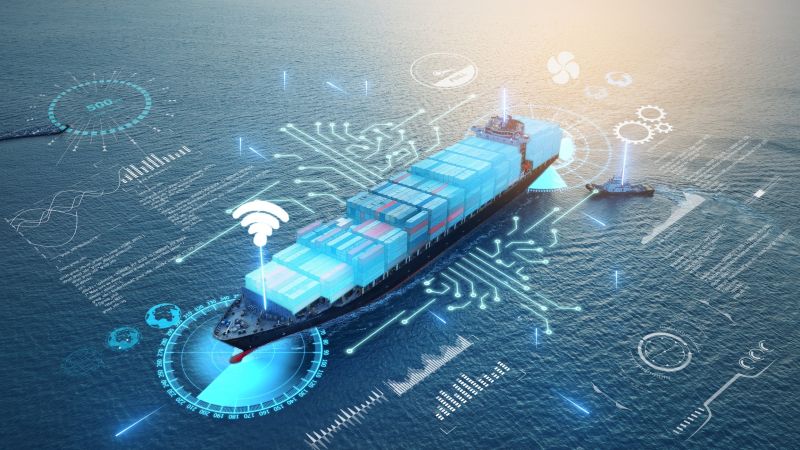
All newly available maritime artificial intelligence services and products will be presented at Posidonia, as the industry slowly incorporates their potential into everyday operations.
Indeed, the maritime industry, traditionally measured in its adoption of new technologies, is steadily advancing its engagement with AI, though not without caution, according to findings from a recent Posidonia survey.
Ahead of Posidonia 2026, which will take place from June 1 to 5, at the Athens Metropolitan Expo, organisers say dialogue is growing among exhibitors and industry stakeholders around AI-driven solutions spanning predictive maintenance, fuel optimisation, digital compliance and operational analytics.
The overall sentiment across the sector remains balanced: shipping is neither rushing into AI nor standing still.
“Artificial Intelligence is clearly transitioning from theoretical discussion to operational application,” Posidonia Exhibitions managing director Theodore Vokos said.
“Over 40 Posidonia 2026 exhibitors have lent their insights regarding AI adoption by their businesses,” he added, noting that “what we are witnessing is not blind adoption, but structured experimentation”.
At the same time, Vokos said the maritime industry is assessing AI through the lens of safety, compliance and return on investment.
He also pointed to the wider backdrop against which this year’s findings have emerged. “In a period of intense geopolitical turbulence, the shipping industry is already preparing for next day,” he said.
Posidonia 2026, he added, “will be more topical than ever, as a wide range of issues and developments will be discussed, including, among others, the consequences of the conflict in Iran”.
“But as has been proven in the past,” Vokos continued, “shipping responds faster than other sectors to challenges, and this is also reflected in this year’s survey on the adoption of Artificial Intelligence.”
Industry responses gathered in the run-up to the exhibition reveal three distinct approaches, active adopters embedding AI into products and services, companies selectively integrating AI for internal optimisation, and others maintaining a cautious, observational stance.
Classification societies and technology leaders appear among the most proactive.
Bureau Veritas, for example, sees AI increasingly embedded in routeing optimisation, fuel consumption prediction and risk-based inspection frameworks. Through digital tools that combine drone imagery, scanning and intelligent data processing, AI is helping to enhance survey precision while preserving human oversight.
“AI adoption in the shipping industry is progressing steadily and is expected to accelerate as digitalisation, decarbonisation and data-driven decision-making become central to maritime operations,” said Alex Gregg-Smith, president, marine and offshore at Bureau Veritas.
Rather than replacing existing practices, Gregg-Smith added, AI is increasingly being embedded in practical applications such as vessel routeing optimisation, fuel consumption prediction, risk-based inspection, and predictive maintenance schemes.
He further noted that regulatory drivers and the growing availability of real-time ship data are supporting this shift.
Some companies, meanwhile, are going all-in on AI.
Among them is Nereus Digital Bunkers, an AI-native company. According to founder and chief executive Nikolas Gkikas, AI is not an added feature but “a structural component” of the platform.
Gkikas said the company’s AI Procurement Advisor is already in active development and being piloted with select clients.
“It uses large language model technology, combined with domain-specific maritime and commodity market data, to provide contextual, actionable insights directly inside the procurement workflow,” he said.
Nereus also uses machine learning models for price forecasting, enabling clients to anticipate port-level bunker price movements and make more informed stem timing decisions, thereby reducing fuel costs in a meaningful way.
In the technical services segment, the Dynamic Group of Companies is leveraging decades of maintenance data to move from reactive repairs to predictive asset management. By applying analytics to hull and ballast tank records, the company is aligning maintenance cycles with both financial efficiency and environmental performance targets.
“The maritime industry is adopting AI at an accelerated pace, driven by the immediate demands of CII and EU ETS compliance,” said Captain Ioannis Nikolitsis, chief executive of the Dynamic Group of Companies.
Speaking ahead of the exhibition, Nikolitsis said the company would use Posidonia 2026 to showcase how its combination of historical data and industrial robotics can help fleets remain both competitive and compliant.
Similarly, Fortune Technologies has embedded AI-powered modules within its enterprise software platforms, automating processes and generating operational insights for ship operators.
Electropneumatic S.A. is also integrating AI into its research and development activities, while Endress+Hauser expects faster deployment in predictive diagnostics and fleet performance monitoring.
Yet beyond the early adopters, a more measured tone prevails.
MAS S.A., which is active in advanced automation systems, expects AI adoption to expand mainly within decision-support tools and optimisation layers, while core control systems remain bound by deterministic safety and classification requirements.
Navigator Shipping Consultants, meanwhile, echoes that pragmatic view. While AI already supports emissions monitoring and data analytics, critical operational decisions, particularly under emergency conditions, remain firmly human-led.
“Shipping operations require continuous human involvement, direct communication, immediate intervention and the ability to assess and manage situations on a case-by-case basis,” said Danae Bezantakou, chief executive of Navigator Shipping Consultants.
She added that “operational challenges, complex decision-making and, above all, emergency situations cannot be fully addressed by platforms or automated systems alone”.
The regulatory dimension is also shaping industry posture. Normec Verifavia, which is active in emissions verification and auditing, points to the need for traceable and auditable AI frameworks in what remains a highly regulated sector.
Environmental compliance, moreover, is widely seen as a catalyst. Decarbonisation pressures, CII performance monitoring and EU ETS requirements are accelerating demand for digital tools capable of managing complex datasets and improving efficiency metrics.
In logistics and support services, firms including Royal Blue Logistics and Adamar International Maritime Services report using AI-based tools to improve inventory planning and operational forecasting, while stressing that implementation remains selective.
“AI has become an essential component across most industries, including the maritime sector, and its influence continues to expand,” said Taner Topkara, general manager of Adamar.
He added that Adamar, “without eliminating the human factor”, already uses advanced digital technologies and is actively integrating AI-driven solutions to address emerging industry demands, particularly in enhancing operational efficiency, logistics optimisation, and inventory planning for shipping companies.
Perhaps the clearest conclusion across the industry responses is that AI will augment rather than replace the human element.
From shipyards to surveyors, executives stress that maritime operations involve dynamic, real-time decision-making in unpredictable environments. Automation may improve efficiency and reduce risk, but accountability, safety and operational trust remain human responsibilities.
Economic considerations, meanwhile, continue to temper adoption rates. Return on investment, data ecosystem collaboration and cyber security resilience are repeatedly cited as prerequisites for broader AI integration.
As Posidonia 2026 approaches, AI solutions are expected to become a major point of interest both on the exhibition floor and in the conference discussions surrounding the event. Rather than signalling a sudden technological upheaval, the industry appears to be navigating a gradual transformation, consistent with its longstanding culture of measured innovation.
As Vokos put it, shipping has historically balanced tradition with technological advancement, while artificial intelligence represents the latest chapter in that evolution.
He added that, at Posidonia 2026, the debate would not centre on whether AI belongs in maritime operations, but on how, where and how fast it should be deployed.
And in his final assessment, Vokos said the prevailing industry view suggests that AI’s course is set. The pace, however, he added, will remain characteristically maritime, resembling a U-turn of a tanker in high seas: steady, deliberate and guided by safety, regulation, and operational realism.
Posidonia 2026 is organised under the auspices of the Ministry of Maritime Affairs and Insular Policy, the Hellenic Chamber of Shipping and the Union of Greek Shipowners, with the support of the Municipality of Piraeus and the Greek Shipping Co-operation Committee.




Click here to change your cookie preferences