
April 24, 1915: the legacy of the Armenian genocide and all those that have followed
April 24 is not simply a date. It marks a beginning and a warning.
In 1915, in the final years of the Ottoman Empire, Armenian intellectuals and community leaders were arrested in Constantinople. It was the opening act. What followed was the Armenian Genocide: a systematic campaign of deportation, death marches, starvation and mass killing that destroyed the Armenian presence across much of the empire and devastated an entire people.
For decades, the world struggled to name what had happened.
Raphael Lemkin, the jurist who later coined the term “genocide”, was shaped in part by the Armenian case. He posed a simple question: why is the murder of an individual a crime, but the destruction of a nation not?
The precedent did not go unnoticed. On the eve of the Second World War and while finalising the Nazi attack on Poland, Adolf Hitler reportedly asked, “Who, after all, speaks today of the annihilation of the Armenians?”— a chilling reflection of an assumption that has proved enduring: that the world forgets, and that such forgetting enables repetition.
The answer to Raphael Lemkin’s question, after the catastrophe of the Jewish Holocaust, was the creation of a new legal and moral category – genocide – and the promise that followed: Never again.
That promise has defined international discourse ever since. It has also been repeatedly tested – and too often found wanting.
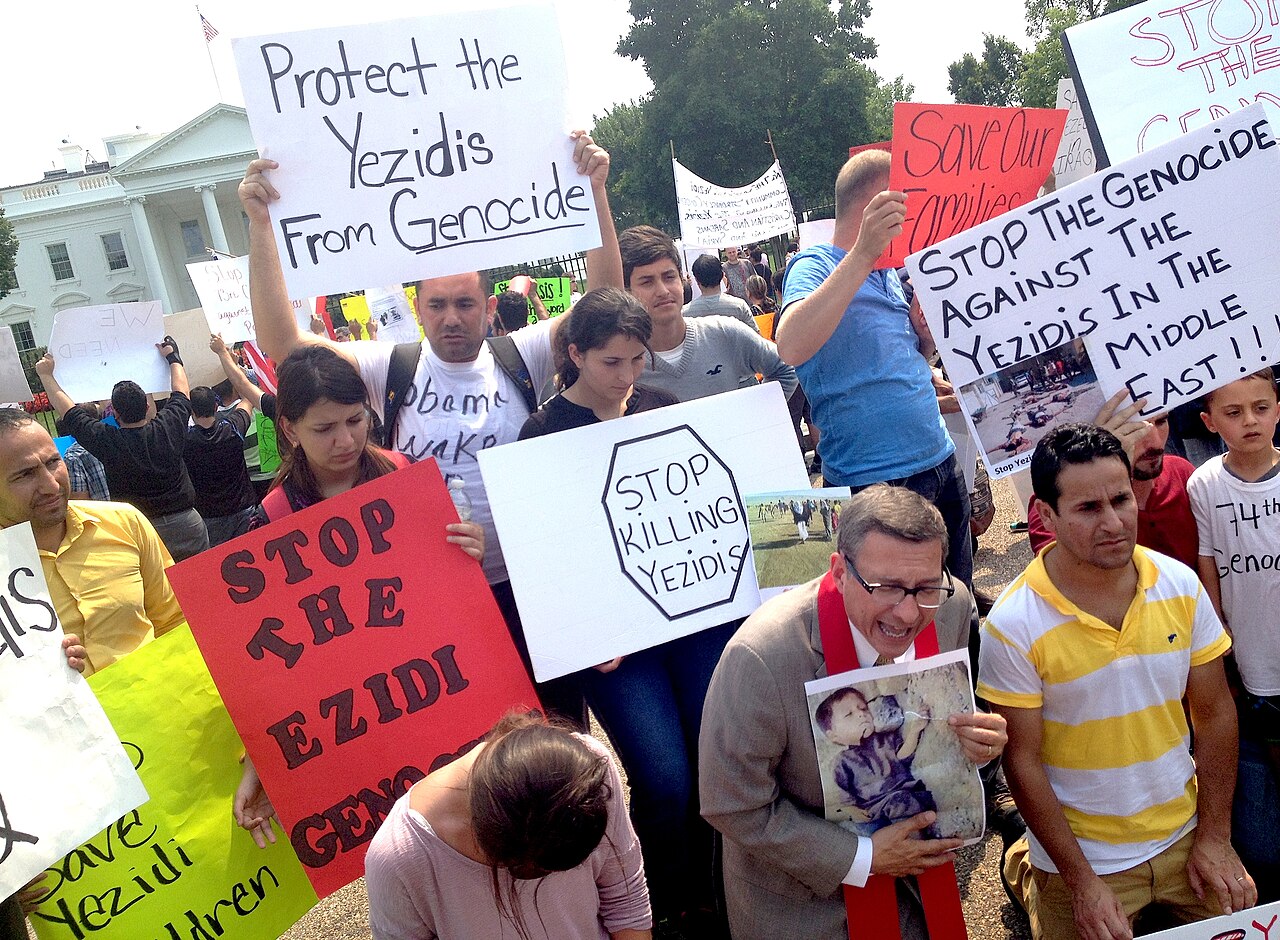
Following the Holocaust came Cambodia, Rwanda, Srebrenica, Darfur and, more recently, the Yazidi genocide in Iraq and the genocidal campaign against the Rohingya in Myanmar – alongside contemporary conflicts in which allegations of mass atrocities against civilians and of crimes against humanity remain subject to intense international disagreement and competing narratives. Different contexts. Different actors. A recurring logic.
Genocide is not spontaneous. It is the end point of a process. It begins with language – with hate speech, the dehumanisation of a targeted group, the normalisation of exclusion and the redefinition of victims as threat. By the time violence begins, the moral and psychological barriers have already been dismantled. The pattern is familiar: war or crisis. Dehumanisation. Organisation. Execution. Silence – or indifference – beyond those directly involved.
“Never again” became an aspiration. Not a guarantee.
This is why April 24 matters. Not only as remembrance but as a warning of what follows when early signs are ignored.
Denial has played a central role in this story. It does not erase the past. It distorts the present. It endangers the future. It hinders reconciliation. It lowers the barriers to repetition. Denial is not neutral. It is consequential. When truth is contested, accountability becomes elusive. When accountability is absent, precedent hardens.
In diplomacy, one learns early that memory is not abstract. It travels with people, with states, with decisions.
I was reminded of this on March 18, 1992, in Moscow – and on other occasions before and after. As interim chargé d’affaires of Cyprus, I signed, together with Armenia’s deputy foreign minister, the late Arman Kirakosian, the Protocol on the Establishment of Diplomatic Relations between our two countries.
It was a formal act. It was also something more. Armenia had just emerged as an independent state. The memory of 1915 was not distant history. It was present – quiet, dignified, but unmistakable. It informed identity. It travelled into diplomacy.
I later came to know Arman well as a colleague in London. A historian by training, he was a gentle presence – physically imposing yet measured in manner. He embodied the quiet resilience of Armenia’s diplomatic service.
What struck me then – and remains with me today – was the absence of bitterness, but the presence of clarity. A sense that history could not be undone, but must not be forgotten. That distinction matters.
For states, memory is not only about the past. It is about how the past informs conduct.
The international community has sought to build mechanisms to prevent recurrence of genocide: conventions, courts, doctrines of responsibility. These are necessary. They are also insufficient when applied selectively – or deferred.
The lesson of the Armenian Genocide is not that the world did not know. It did. It failed to act in time – and later failed to agree on how to remember.
The lesson of the Holocaust is not only that evil can reach industrial scale. It is that recognition and accountability must be integral, not optional.
The genocides that followed – across different regions and decades – reinforce the same pattern: knowledge without timely action, memory without consistent consequence – or worse, amnesia.
Together, they form the foundation – and the unfinished test – of what we call the post-war moral and legal order. Today, that order is under severe strain – and with it, the constraints that were meant to prevent the recurrence of atrocities. The warning of 1915 becomes more, not less, relevant.
Conflicts multiply. Norms are invoked selectively. Language is contested. Facts are politicised. The distance between principle and practice widens. The abnormal becomes normal.
In such an environment, the temptation is to treat memory as ceremonial – detached from policy, secondary to interest. That would be a mistake. Memory is not a substitute for strategy. But neither is it irrelevant. It shapes legitimacy, influences alliances, and defines red lines – when we choose to uphold them, and when we do not.
Strategy must be grounded in reality – but also anchored in clarity: of law, of principle, of narrative. Without that anchor, positioning becomes opportunistic; with it, it becomes credible. The lesson is not abstract but strategic: memory must inform judgment, clarity must guide action, and silence – whether through indifference or calculation – carries risk.
The Armenian Genocide is not only about remembrance. It is about recognition – of patterns, of warning signs and of the consequences of delay: the failure to act when early signs appear, allowing conditions to harden. The Armenian Genocide was not an isolated tragedy. It was a precedent. Others followed not because history repeats itself, but because the conditions that enable such crimes persist.
April 24 is not about revisiting the past for its own sake. It is about understanding it – and acting on that understanding. Not about assigning inherited guilt to later generations, but about recognising state and historical responsibility, and the necessity of truth and accountability in preventing repetition. Where recognition is absent, denial persists – and with it, the risk of recurrence.
“Never again” is not a conclusion. It is a test – of judgement, of consistency and of will. One that must be met before the pattern completes itself. Not after.
In memoriam Arman Kirakosian





Click here to change your cookie preferences