
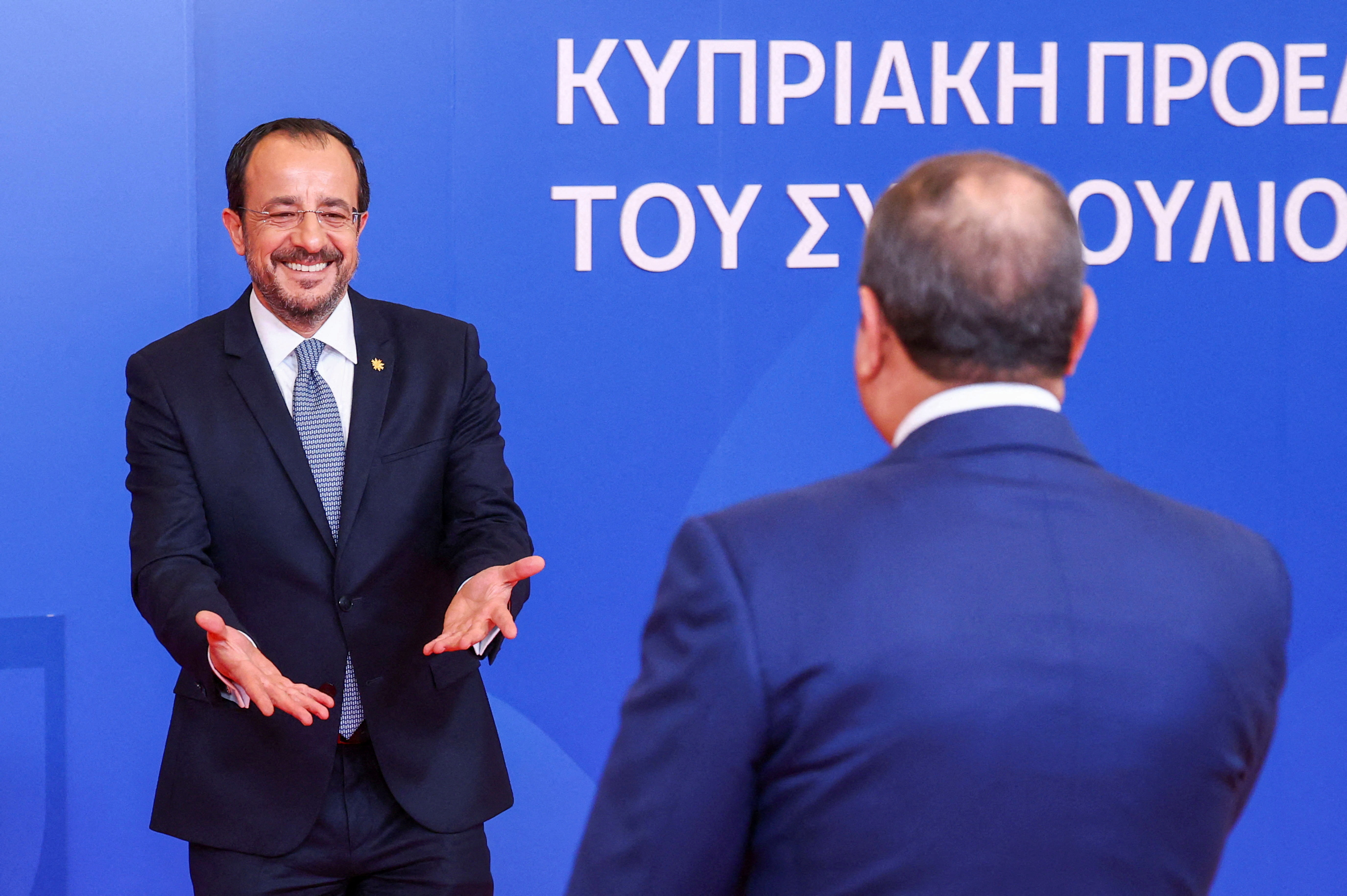
The government staged an impressively well-organised and smoothly-run informal EU summit on Thursday and Friday. It was unaffected by protesting farmers at the Rizoelia roundabout who had threatened to block all access roads and cause maximum inconvenience to the many important guests on their way to meetings. More importantly, the presence of so many EU leaders on the island was a much-needed international advertisement of Cyprus’ safety after the bad publicity caused last month by the drone attack Akrotiri.
The first day of the summit in Ayia Napa finished on a high with the approval of a €90 billion loan to Ukraine, the opposition of Hungary having ended with the election of a new government. The summit also passed its 20th round of sanctions against Moscow. These were the practical decisions that were followed by much talk about Ukraine’s accession course, the mutual defence clause which has become President Nikos Christodoulides’ cause and ways of protecting the bloc from the negative economic effects of the Iran war.
The mutual defence clause, article 42.7 of the EU treaty, which until two months ago very few were aware of, obliges member states to provide aid and assistance “by all means in their power” to a fellow member if it is attacked by a foreign state or non-state actor. Article 42.7 was triggered only once, by France, after the 2015 Paris attacks in which terrorists killed 130 people. It had called on EU member states to assist its overseas military obligations so it could free troops for internal security.
In early March, there was what European Council president Antonio Costa, speaking on Friday, referred to as the “test case” in Cyprus, with Greece, France, Italy, Spain and the Netherlands sending frigates to defend the island from external attacks after the drone strike on Akrotiri. None of the mobilised military equipment and forces were needed, but by asking for help Christodoulides had brought attention to article 42.7 without actually triggering it. It became a major discussion point at the informal summit, with member-states and officials believing the lack of detail in the article was not helpful.
European Commission president Ursula von der Leyen, said article 42.7 needed “some gaming out” if was going to work out properly in practice. “The treaty is not clear about what happens when and who does what,” she said Friday. Costa explained that “we are designing a handbook for how to use this mutual assistance clause,” while Christodoulides spoke about “preparing a blueprint”.
It is very interesting that hardly anybody was aware of the existence of this article. One newspaper analysis said “the lack of detail in the EU treaty on article 42.7 was previously seen as a strength, enabling a flexible response.” Could the lack of detail also have enabled no response? For as long as EU member states knew they were guaranteed protection by Nato, in the event of an attack by another country, the Union’s mutual defence clause was considered redundant. Of the 24 EU member states on the continent, only Austria is not a Nato member so the 23 relied on Nato (Cyprus, Malta and Ireland are not members) for their defence and had no reason to think about article 42.7.
President Donald Trump’s criticism of Nato, and threats of quitting the transatlantic military alliance, changed all this. His attacks on the “very disappointing Nato” were stepped up after European countries refused to join the US-Israel war against Iran, while earlier in the month he said he was “absolutely without question,” considering pulling the US out of Nato. While the informal summit was taking place in Nicosia it was also reported that Washington was exploring how to suspend Spain’s membership of Nato because of its criticism of the war on Iran and refusal to grant the US access, basing and overflight (ABO) rights.
The deteriorating relations between the US and Europe have raised questions about the future of Nato and suddenly highlighted the need to re-visit article 42.7 of the EU treaty. President Christodoulides should take some of the credit for putting it on the agenda at the informal summit and getting the EU bigwigs talking about it.





Click here to change your cookie preferences