
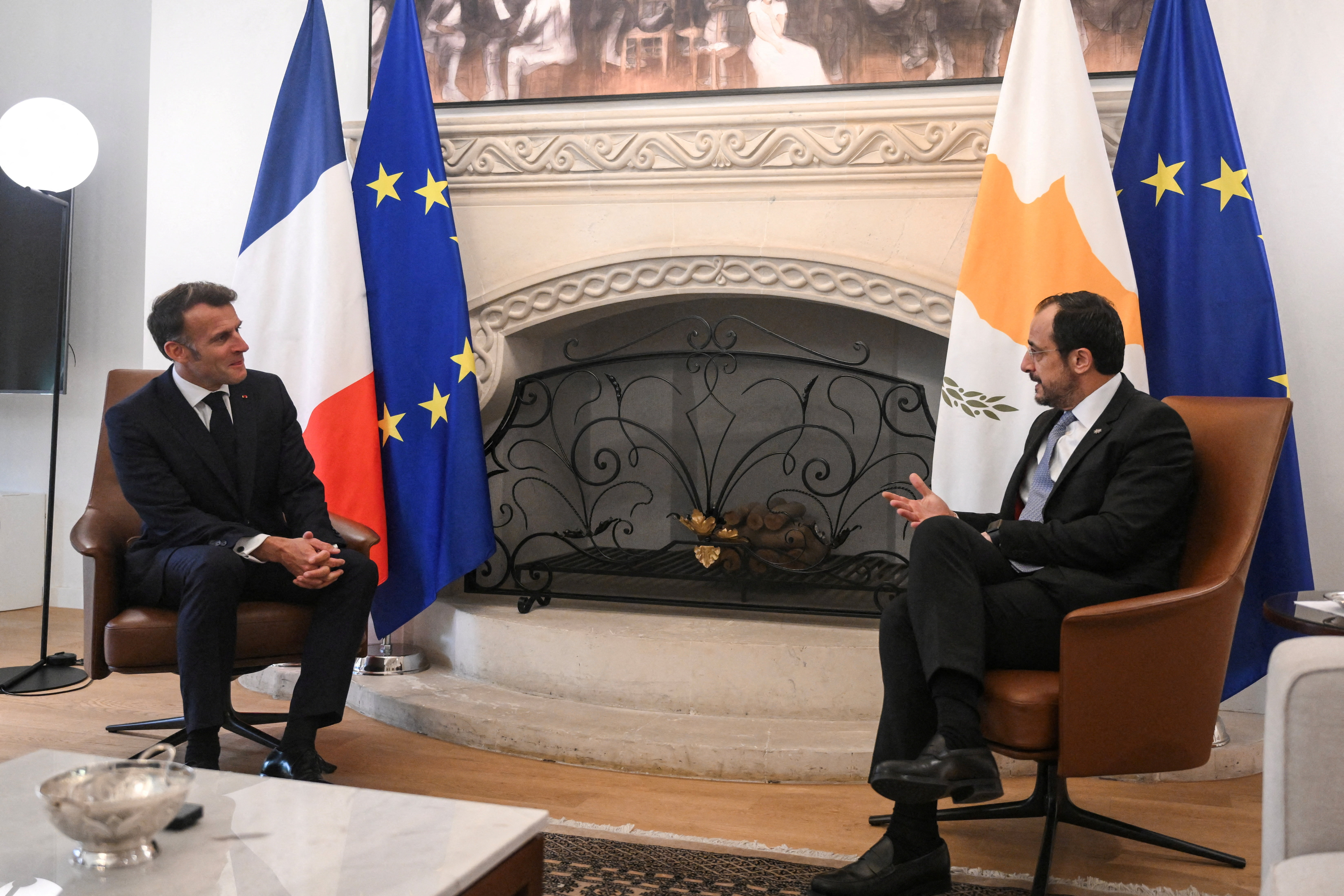
Cyprus is moving towards the signing of a Status of Forces Agreement (SOFA) with France in June, formalising an expanded defence and security partnership that government officials describe as the closest level of bilateral relations between the two countries to date.
Government spokesman Konstantinos Letymbiotis said the agreement represents the next step in deepening Franco-Cypriot cooperation, particularly in defence and security.
Speaking on CyBC’s To Trito radio programme on Monday, he said relations with France are “at their closest level”, adding that the forthcoming SOFA agreement will “strengthen humanitarian military cooperation and joint action at a regional level”.
President Nikos Christodoulides confirmed that negotiations have entered a formal phase, with the agreement to be concluded at ministerial level.
He said the arrangement “will provide for the presence of French forces on Cypriot territory for humanitarian purposes”, framing it as part of a broader strategic alignment between the two states.
The agreement establishes the legal and operational framework governing the presence, movement and activities of French military personnel in Cyprus.
It defines jurisdiction, taxation, customs procedures and conditions of deployment, while ensuring reciprocity for Cypriot personnel operating in France.
The partnership is structured around four main pillars.
These include enhanced operational coordination and interoperability between armed forces, cooperation in defence technology and equipment procurement, institutionalised joint exercises and training and administrative provisions covering legal and logistical matters.
The agreement also enables access to military facilities for support operations and provides for temporary stationing and transit rights.
Christodoulides stressed that the agreement reflects practical outcomes rather than merely symbolic diplomacy.
“What we sign are not just texts to take a picture,” he said. “They are substantive texts… proven in practice to have an effect.”
He pointed to France’s previous deployment of the aircraft carrier Charles de Gaulle to the region as evidence of tangible support.
The SOFA builds on a strategic partnership agreement signed in Paris in December last year, which established a structured framework for cooperation across defence, energy, security, innovation and education.
That agreement included an action plan for 2026–2030, introducing regular monitoring mechanisms and coordinated policy planning.
France has emerged as a central defence partner for Cyprus in recent years, with cooperation extending beyond political alignment into operational and industrial domains.
Joint military exercises have focused on interoperability and response to modern threats, while Cypriot personnel have participated in training programmes and deployments on French naval assets.
In parallel, Cyprus is advancing procurement discussions with French defence companies.
Talks are under way for the acquisition of Griffon armoured personnel carriers and Serval light tactical vehicles, alongside upgrades to existing VAB armoured units.
These acquisitions are being pursued within the framework of the European Union’s SAFE programme, which facilitates defence investment through financing mechanisms.
The agreement also includes French technical involvement in the development of Cyprus’ naval infrastructure, particularly at the Mari naval base, where planning and training support is expected to expand as cooperation deepens.
French military presence in the Levant has already increased in response to regional instability, with naval and air assets deployed in coordination with Cyprus and other European partners.
French President Emmanuel Macron has described Cyprus as a key strategic partner, stating at the time that “when Cyprus was attacked, it was all of Europe which was attacked”.
Cyprus has also positioned the agreement within a wider European framework, linking it to efforts to strengthen the European Union’s strategic autonomy and collective defence mechanisms.
Christodoulides has promoted discussions on Article 42.7 of the EU Treaty, which provides for mutual assistance among member states in the event of aggression.
At a recent informal European Council meeting in Cyprus, leaders agreed to develop a structured process for activating the clause, including defining operational procedures and coordination mechanisms.
The initiative reflects Cyprus’ aim to embed its bilateral partnerships within broader European security structures.
Letymbiotis emphasised that the SOFA agreement is not limited to military objectives but further allows for coordinated responses to regional crises, including evacuations and emergency operations.
Cyprus has previously served as a hub for such missions under the Estia plan, facilitating the evacuation of foreign nationals from conflict zones.
Christodoulides linked the development to the broader trajectory of Cyprus–France relations, describing France as “the EU member state with which we have the strongest cooperation at all levels, starting with defence and security”.


Click here to change your cookie preferences