
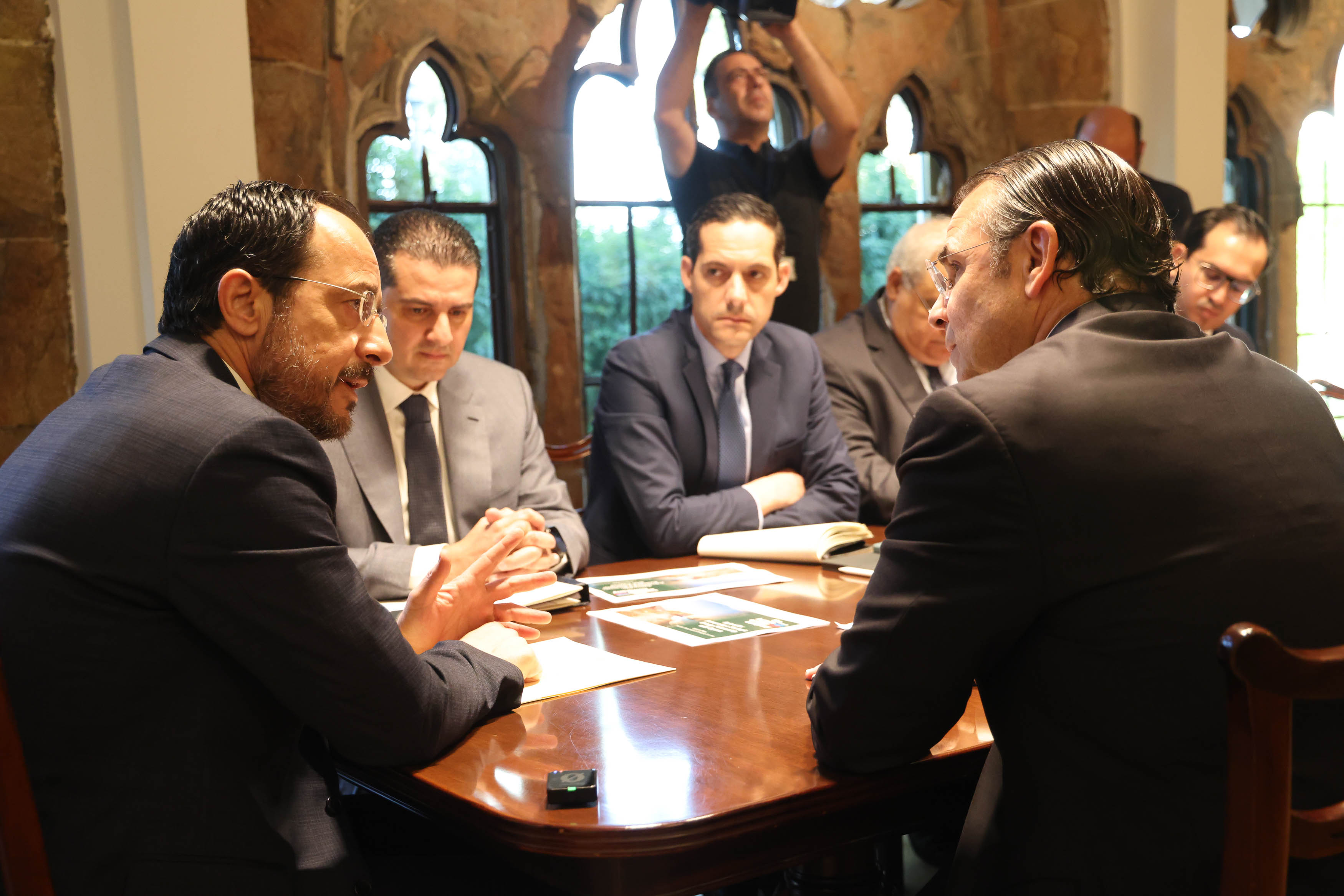
President Nikos Christodoulides on Wednesday called for an “acceleration” of plans to extract natural gas off the coast of Cyprus, following a meeting with a delegation from American multinational energy corporation Chevron, which was headed up by its emerging countries chairman Javier La Rosa.
He said during that meeting that “the internal process in relation to the agreement” with Chevron, Israeli energy company NewMed Energy, and the BG Group, which is owned by Royal Dutch Shell, concerning the Aphrodite gas field on Block 12 of Cyprus’ exclusive economic zone (EEZ) is “close to completion”.
“In light of international developments, the need to accelerate the implementation of the Republic of Cyprus’ energy plans is becoming even more urgent,” he said.
He added that those plans are “of particular importance for the wider region and for the European Union”, saying they are being devised and executed “at a time when energy security, diversification of sources, and the energy autonomy of Europe are at the heart of the European agenda”.
He said the matter had been discussed at last week’s informal European Council summit in Nicosia, with leaders from across Europe paying increased attention to the issue of the supply of energy after the conflict in the Middle East led to Iran closing the Strait of Hormuz, stemming the global flow of oil.
References to Cyprus’ natural gas supplies at last week’s summit, he said, “underlined the geostrategic importance of the eastern Mediterranean for the EU’s energy security”.
He added that within the coming weeks, “internal procedures” with regard to a new agreement over the Aphrodite field “are expected to be completed”.
“Decisions are to be taken by his cabinet which are part of the action plan which had been set.”
He said that he had discussed the matter with Egyptian President Abdel Fattah El-Sisi, who also attended last week’s European Council summit, and that this “confirms the importance of regional cooperation for the promotion of specific energy projects and the interconnection of the region’s energy with the needs of Europe”.
Chevron signed a memorandum of understanding with the governments of Cyprus and Egypt, as well as with NewMed Energy and the BG Group, last year, with the Cypriot government saying at the time that the memorandum “establishes the framework for the effective commercialisation of the natural gas which will come from the field”.
In November last year, Cyprus’ energy minister of the day George Papanastasiou had said that a “techno-economic study” on Block 12 is being prepared and will be submitted by the end of this year.
After that study is complete, he said, a final investment decision will be made and gas from the Aphrodite field will be transported to the Segas liquefied natural gas (LNG) terminal in the Egyptian port city of Damietta for liquefaction.
Seabed surveys to find a sinking point for the pipeline which will take natural gas from Cyprus’ EEZ to Egypt for liquefaction began in June last year, with the initial aim being for natural gas from the Aphrodite gas field to be taken to Damietta.




Click here to change your cookie preferences