
In the face of US contempt, it’s time to move away from old alliances
Cyprus hosted the informal meeting of EU leaders on April 23–24, an event that proved a notable success for President Nikos Christodoulides. Such gatherings are usually forgettable affairs, serving mainly as photo opportunities for the country holding the rotating EU presidency to score domestic public relations points.
It proved to be different this time.
Had I not been at a wellness retreat trying to shed some excess weight, I might have been forced to eat humble pie and admit that Christodoulides managed to secure meaningful attention for Article 42.7 of the European Union Treaty – the mutual assistance clause requiring EU member states to aid another member under threat.
This clause is significant not only for Cyprus in relation to Turkey, a point Christodoulides wisely avoided exploiting. Instead, attention shifted to broader European security concerns, including the recent drone incident involving the Akrotiri military base, which attracted disproportionate international attention. Whether Article 42.7 could apply in such a case is debatable, given that the Sovereign Base Areas remain UK territory, and the UK is no longer an EU member.
Regardless, strengthening the operational meaning of Article 42.7 is likely to become increasingly important as Europe continues to reassess its security dependence on the United States. For when the US-Israel war with Iran reaches some form of normalisation, (whatever that may mean), President Trump is surely to vent his anger and frustration at Nato’s European members for not complying with his wishes to join the war against Iran.
Although, any attempt to withdraw the US from Nato may face significant obstacles – there is a need for a two thirds majority in the Senate – Trump can still reduce the presence of US military strength in Europe. He recently announced the withdrawal of 5,000 troops from Germany (the US has an estimated 67,000 troops in Europe) warning of more to come. More importantly he has cancelled the deployment of a battalion of long-range missiles – approved during Biden’s presidency – weakening the deterrence capability of Nato.
Readers of this column will know that I have long argued that the EU, and Europe more broadly need to bolster their own defences (including importantly, their nuclear deterrence). The US cannot be relied upon not only in terms of trade, (Trump recently announced increased tariffs to the EU car industry of 25 per cent) but in security issues as well. This view is increasingly gaining traction in European capitals – despite the positioning of Nato’s secretary-general, Mark Rutte, that Europe cannot defend itself without the US. President Trump’s contempt for Europe is all too evident. Hence Christodoulides push for article 42.7 has fitted nicely with that narrative.
Germany – historically a key Atlanticist, advocating for a strong partnership with the US – has pushed up its military spending and removed the debt brake that existed for decades, allowing for increased borrowing for defence expenditures. Meanwhile, Britain announced plans to create a joint naval force with the Netherlands, as well as the Nordic and Baltic countries as a ‘complement’ to Nato. Canada was also considering taking part for a combined effort to police the North Atlantic from increasing Russian interference. No doubt the furore over Greenland has sharpened the minds of everyone concerned.
Article 42.7 however, comes with obvious complications. Most notably, it raises uncomfortable questions regarding Ukraine’s quick EU accession ambitions. How would the article apply to Ukraine’s continued war with Russia? Any lessons drawn from there could possibly be a blueprint for Cyprus as well. Or maybe it is Cyprus that will act as the blueprint. Much will depend on how the EU defines the practical implications of article 42.7 which is the next step following the leaders’ discussions.
What the debate about Ukraine has demonstrated is that the EU has been forced to stop serving President Zelenskyy (who was also present in the Cyprus summit) porky pies about Ukraine’s easy accession to the EU. The leaders were fortunate to sweeten the pill by announcing the approval of the €90 billion loan to Ukraine, now that Hungary’s Orban was not there to veto the decision.
More broadly, we are witnessing growing fragmentation in global governance, as smaller coalitions of states increasingly pursue issue-specific cooperation outside traditional multilateral frameworks. President Trump’s Board of Peace is such an example, and an obvious sidestep to the UN framework.
In a similar vein, in a recent conference in Colombia, about 60 countries managed a breakthrough adoption of practical climate initiatives, outside the usual UN processes. Frustration with the slow pace of global consensus-building has pushed states toward smaller, more flexible arrangements. Whether such initiatives can produce meaningful outcomes however, remains uncertain.
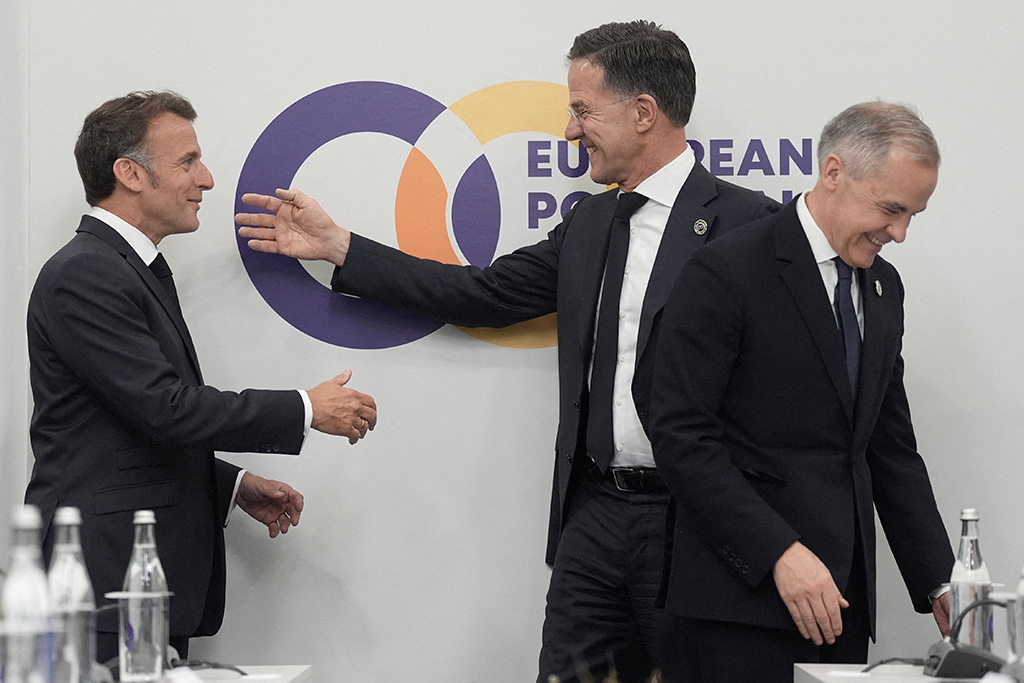
Rather than relying exclusively on a top-down approach, a bottoms-up effort may be more effective. The European Political Community (EPC), an expanded EU group of 48 plus nations, has welcomed on Monday’s summit in Armenia, its first non-European attendee, Canada. Given the present state of the world’s disenchantment with US policies many countries have realised they are better off with different, diverse friendship groups.
In Yerevan, Canadian Prime Minister Mark Carney made another eloquent speech (following his widely noted address in Davos earlier this year), suggesting that Europe will form the basis of the new order. Carney stated: “It is my strong personal view that the international order will be rebuilt, but it will be rebuilt out of Europe.”
Christodoulides, who was also present at the meeting similarly remarked that “we are witnessing a fundamental shift in our security landscape. From conventional warfare to hybrid threats, today’s challenges do not stop at the borders of the European Union. They are continental, and they demand a ‘Whole-of-Europe’ response.”
Perhaps Christodoulides should take his own words more seriously and consider having a slice of my humble pie. For his continued opposition to Turkey’s participation in the European Safe defence mechanism, looks increasingly like populism rather than an example of genuine statesmanship.





Click here to change your cookie preferences