
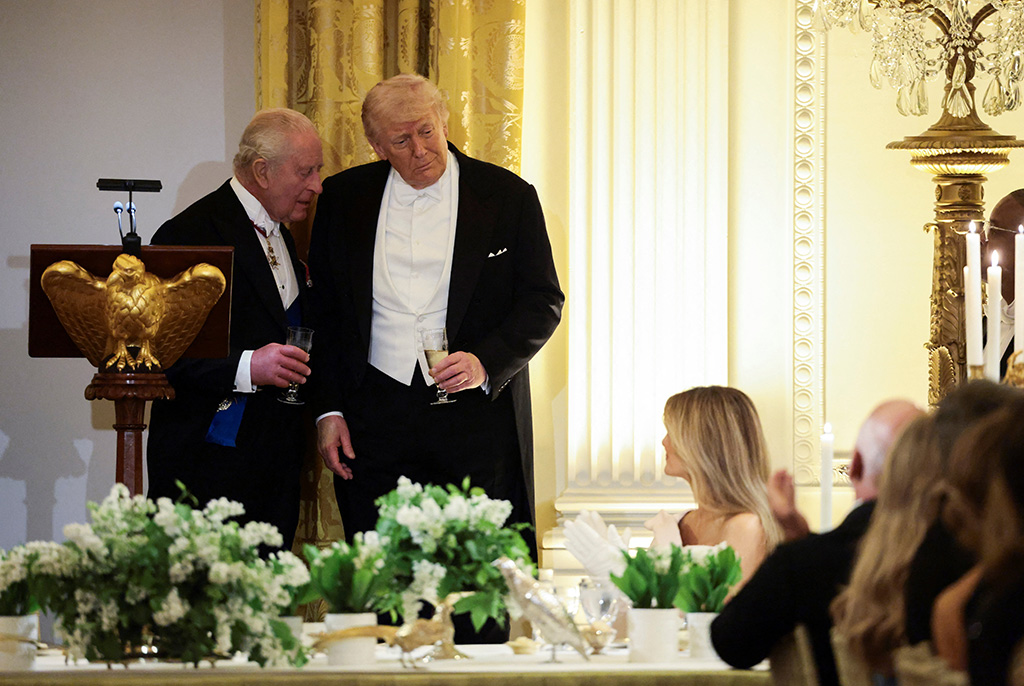
The effect of the British king’s speech in the US was to make the point without accusation
Civilisation has always depended on the disciplined use of language, on the ability to define, to persuade, to restrain and to give meaning to authority. In diplomacy, words shape outcomes.
King Charles III’s recent address to the United States Congress, alongside the White House State Banquet, offered a reminder of this enduring truth. Strip away the ceremony and what remains is something more fundamental: the management of words.
The ancient Greeks called it logos – word, reason and order. In diplomacy, its proper use is not a nicety. It is power.
The speech was presented as non-political. Formally, that is correct. Constitutionally, it could not have been otherwise.
A British monarch does not make policy, does not campaign and does not engage in partisan debate.
And yet, the speech was full of meaning.
Magna Carta. Nato. Ukraine. The rule of law. The limits of executive power. The danger of complacency. Climate change. Each reference was carefully crafted and placed. Each carried weight beyond the words.
In serious diplomacy, very little is accidental.
The method was classical – no direct criticism, no naming, only invocation: history, law, alliance, restraint. The effect was to make the point without accusation. Those who needed to hear it did. Those inclined to resist found little to reject.
The speech operated on multiple levels. It addressed Congress in the chamber, but also audiences beyond it: the American public, European allies, Ukraine, the British audience at home, and those who questioned the purpose of the visit.
One message, several receivers, each hearing what was necessary.
This is diplomacy at its most refined.
Humour played its part. It came early by design. Even difficult history was handled with tact: references to past conflict were recast with a tone that disarmed rather than divided.
The British have long understood this: a signal, delivered with a light touch, often travels further than a blunt assertion.
Policy, too, was present – but never presented as such. It was framed as principle – indeed, as first principles. The reminder that alliances cannot rest on past achievements alone was not phrased as instruction. It was offered as reflection.
Some will say this is all fine language. Niceties. That actions speak louder than words.
Correct.
But words determine whether action is understood, accepted, or resisted. Poor language narrows options. Crude language closes doors. Precise language creates space. In diplomacy, that space can be decisive. At times, it determines whether action succeeds or fails.
In my 43 years in the diplomatic service, I learned that the most effective messages are rarely the loudest. They are delivered with restraint – allowing the recipient to absorb the point without loss of dignity, altering the atmosphere in the room without leaving visible marks. Silence often does the rest.
This is where the crown remains one of the United Kingdom’s most effective instruments of diplomacy: its most refined form of soft power.
Not because it commands. It does not.
Not because it governs. It must not.
But because it embodies continuity. It speaks from above party and beyond electoral cycles. That gives it a particular authority – rooted not in force, but in tradition and legitimacy.
A monarch, by constitutional design, does not negotiate policy. Yet that limitation creates space. He can engage where governments cannot, and communicate in registers unavailable to formal diplomacy. Access becomes influence. Presence becomes message.
Governments argue. Institutions remind.
This is not to romanticise history. The legacy of empire – and the hard-won independence of many states, often forged through struggle and coercion – remains part of the context in which such symbolism is received.
During my tenure as High Commissioner of Cyprus to the United Kingdom, I had occasion to meet King Charles when he was Prince of Wales, as well as his late mother, Queen Elizabeth II. I also engaged with the palace in the course of Commonwealth work – within a framework that reflects the Commonwealth as a free association of sovereign states. What stood out was not the absence of personality, but its discipline: tone, listening, and a cultivated awareness that the institution must always come first.
That is not flattery. It is observation.
The late Queen Elizabeth II understood this instinctively. She practised a form of diplomacy defined by restraint, often achieving what more direct methods could not.
King Charles III now operates in a more unsettled environment: alliances under strain, language coarsened, the rules-based order often invoked, less consistently observed.
In such a context, soft power is not soft because it is weak. It is soft because it works through memory, legitimacy and the authority of example.
The reference to Magna Carta was not decorative. It was a signal. A reminder of a constitutional inheritance older than any administration: that power must be limited, that liberty rests on law, that authority – however strong – remains bounded.
This was not a lecture. Not didactic. Just a reminder.
A prime minister delivering the same message would have triggered partisan reaction. A foreign secretary might have been read as tactical. An ambassador as official positioning.
The king could say less and convey more.
That is the paradox of constitutional monarchy in diplomacy: its formal constraint becomes its practical advantage.
It did not confront. It defined. And in diplomacy, definition is power.
The familiar aphorism – often, and incorrectly, attributed to Winston Churchill – suggests that diplomacy is the art of telling people to go to hell in such a way that they ask for directions.
The King’s English sent no one anywhere. It addressed multiple audiences, offended none, and reminded all of the language in which power once agreed to speak.
A masterclass in the disciplined use of language of how to say without saying.
The map was already there.
The king simply unfolded it.




Click here to change your cookie preferences