
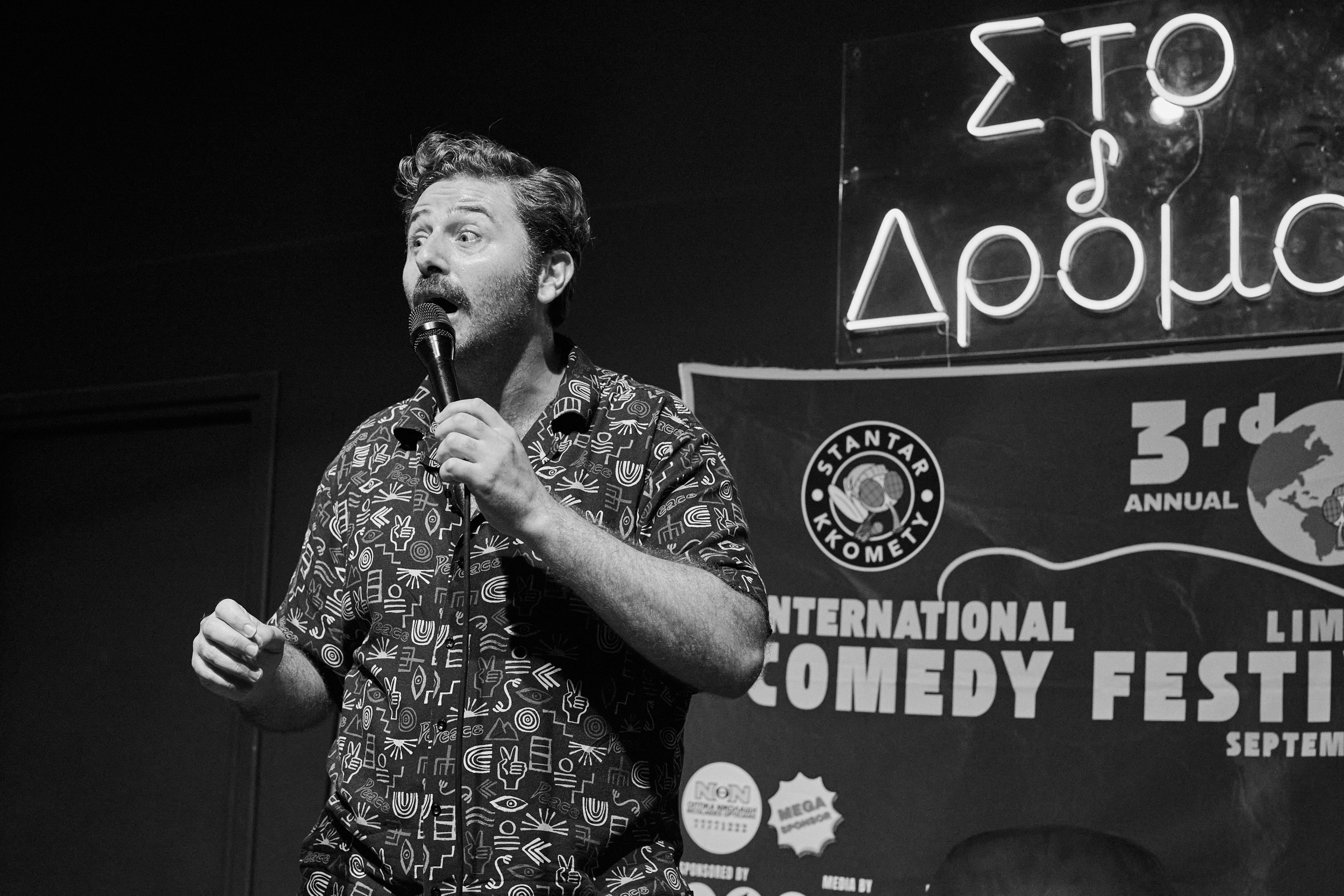
Is laughing at it the best way to cope in a world that seems to have gone mad? One local stand-up comedian thinks so
Stand‑up comedy on the island was practically nonexistent a decade ago. Still young and informal, today’s tight-knit scene boasts acts in Greek, Cypriot Greek and English, with regular international stand‑up comedians making appearances on the island too.
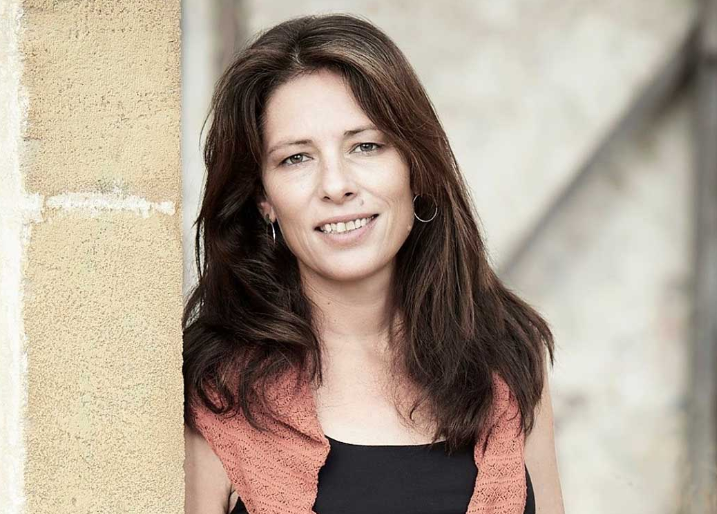
Actor and founder of Stantar Kkomety, one of the best‑known local comedy collectives that runs open mic nights, podcasts, curated showcases, festivals and themed shows, Yorgos Kyriakou spearheaded a tour of Cyprus with his ‘Yorkos the Comically Cypriot’ act in both Cypriot Greek and English at the beginning of the year, a first for local audiences who are usually only get to see comedians perform in one language.
Kyriakou studied drama and did a master’s degree on how to teach and coach actors at the Royal Central School of Speech and Drama, London. Since 2011, he’s been acting locally in both TV and theatre, playing prominent roles in both genres. “This is my first craft and my first profession,” explains Kyriakou as we sit in a coffee shop in Nicosia, a town he has appropriated himself to for work. Kyriakou is from Limassol.
“But I always wanted to do stand-up comedy… I knew it was something that would speak to me,” he recalls. “And I was spot on. In 2017, I started using acting tools to hack stand up and analyze it; break it down to its parts and see it technically; that’s how it started.”
Starting off in an era when stand-up was almost non-existent, Kyriakou was very much one of the people who set up the local scene. “With other comedians, we created festivals, workshops, I taught people… after my first three years of doing solo stand-up comedy shows, I started working with the other comedians, and we collaborated. And then, collective dreams began,” explains Kyriakou.
“Once I created my company, I gave a lot of myself to the collective, the scene and comedy podcast; we took almost all local comics to do a podcast with us and featured them. But that slowly faded out, and now, I’m more focused on my solo career again.”
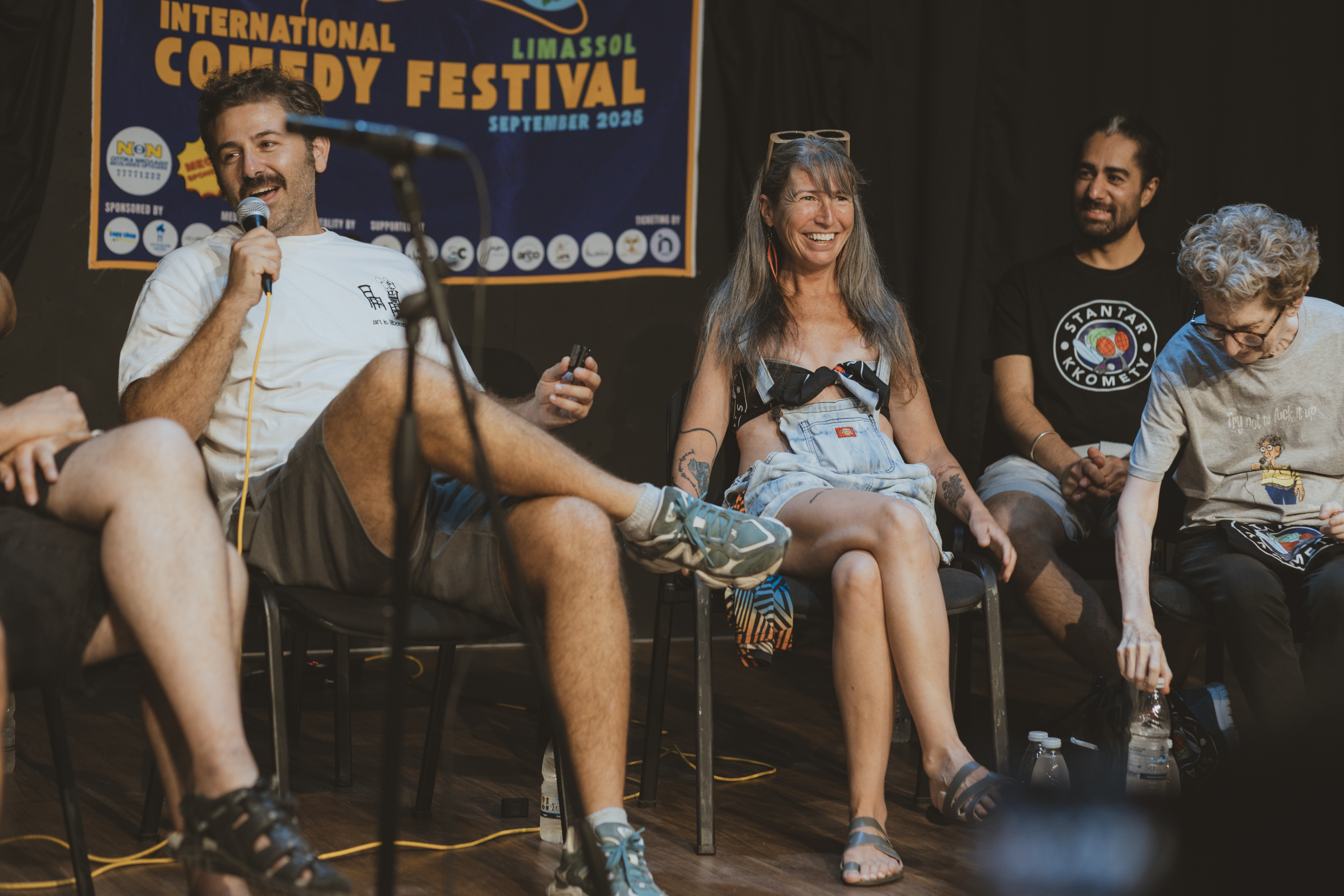
For Kyriakou, the scene was built through comedians persevering in putting themselves out there. “Of course, social media helped. Netflix and the comedy specials helped, Covid helped immensely because people stayed home and heard about us, and that’s when they thought, ‘ah, there’s a compatriot of mine who does comedy, hm, they’re not going to be good, but let’s go check them out,” he laughs.
Platforms such as TikTok popularised what Kyriakou estimates at approximately a dozen local personas who can hold a solo show on their own and make up the local scene. “But you’ve got to have the actual live scene too, you’ve got to have the actual fun, the fun nights. It’s a live art.” It’s also true that the local scene is made up of predominantly men, although women have started featuring in opening acts more frequently. “I think women have to overcome way more hurdles in their own psyche, in their environment, in their family, and the way society views them. It’s harder for women to be comedians,” says Kyriakou, admitting that women’s voices would add an entirely different perspective.
But there are challenges enough setting up, organising and materialising a show in English. “Experience has many fronts. It was harder to come up with a show (in English). In Cypriot, I have hours worth of bits that I could remove, add and adjust. But in English, it was harder for me. And I actually came up with bits during the tour,” explains Kyriakou. Previous performances also contributed to his act. “One of the shows I participated in in the north called Peace Talks gave me the chance to go more into politics, have a more political humour, which is my brand, in the English language too. It allowed me to come up with jokes specifically tailored for the Cypriot political situation. I want to have a line of storytelling in my solo shows; a theme that connects each bit and leads to the next one; that’s how I feel that it’s a complete experience for the audience,” he explains. “I’m very strict with myself. There are comedians who do solo shows just with crowd work and I envy how much they allow themselves to do. I would feel like I’m betraying the craft, that if I don’t have some bits, I’m wasting the audience’s time. I love crowd work, but first it’s the bits.”
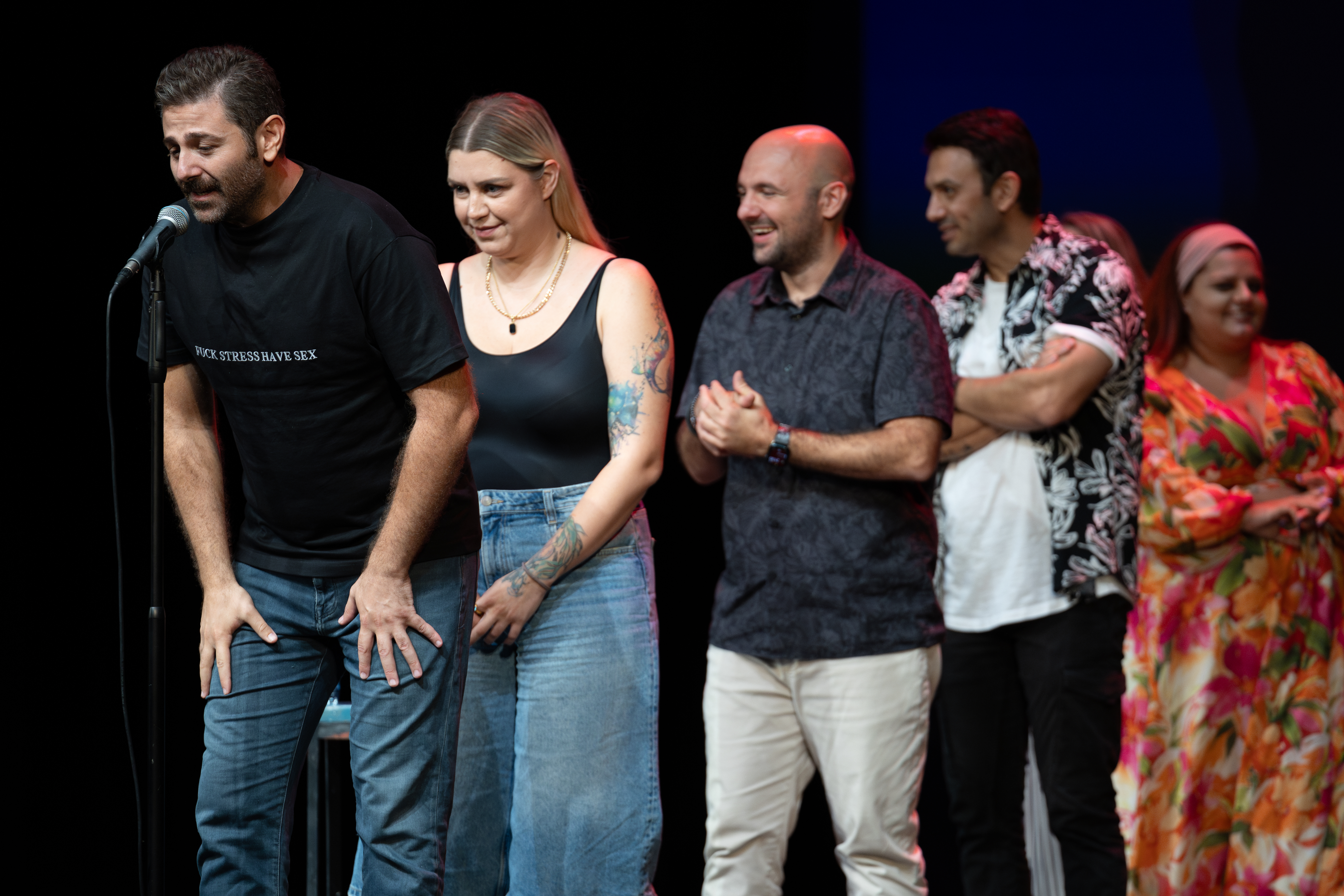
Delving deeper into his craft, Kyriakou puts stand-up comedy forward as a social experiment. At least for him. “It’s masquerading as a business transaction, but it’s a social experiment. It’s a human just standing or sitting there, uttering absurd things and observing people’s reaction and building on that. We’re reflecting off each other. That’s what we’re experimenting on,” he says.
“With crowd work it’s a different experiment. It’s like you’re changing hats and the audience changes hats as well. And since it’s becoming more and more popular, I’m trying to understand it from a sociological and anthropological perspective: why is crowd work more viral now? Why do crowds need that dialogue?” he asks. For one, because people spend more time behind their screens and perhaps crave this type of interaction more. “Or perhaps because they don’t have any honest dialogue in their lives,” adds Kyriakou, “this direct dialogue puts them in a position of equal power with the comedian. When you’re on stage and you start doing crowd work, you lower yourself and you raise the audience. And that thing, that psychological thing, that gift you give them, who else gives them that? Politicians? Their boss? Their partners? Why do they crave it? Because they don’t get it in their everyday life”.
Kyriakou has also seen local audiences change over the years. “It has changed, and we have changed with it. We have become more mature in the way we do it. We are more able. We figured ourselves out in terms of how Cypriots react to what subjects and how to hack them. So it’s becoming better and better. And I think it’s a parallel process. Again, to go back to the social experiment; there was the first experiment, then trial and error. After persistence, we figured each other out, and then the audience figured the comedians out.”
And it’s true, when you watch Kyriakou on stage in English, it’s a very different persona than in Greek. “There’s more ideology to the Greek shows, I take a stance, I use the common experience to unite audiences and corner them into allowing me to take this ideological stance, which is pretty much alternative and doesn’t get represented in politics or mass media. I need to stand on a stage in front of my contemporaries and have them experience a person voicing and putting words into their own connection with this island. Whereas in the English show, I don’t have a horse in the race; nobody has a horse in the race. We’re just laughing over the Cypriot absurdity.”
The English show took almost four years to construct. “The first time I did stand up in English was in Berlin. The first time I toured Cyprus with an English stand-up was with Victor Patraskan, again a first where an internationally acclaimed comedian comes to Cyprus and tours with a local comedian. That’s the first time I realised that what I’m doing can sell, because there are internationals who want to learn more about Cyprus, and there are Cypriots who laugh about their Cypriotness. Then I went to Barcelona, then New York, where I tested these jokes in a place which is so far away from the European or Cypriot identity. That’s where I came up with a joke about we are below Turkey, next to Syria and Lebanon: talk about a loud neighborhood… and that’s what I loved about this: by traveling and trying to explain us to people with different proximities, jokes got created, and that was magic. And that’s a process I want to keep doing: being Yorkos the Cypriot guy or the halloumi guy or whatever people say. But it’s also something that I’m looking forward to shedding off and just talk about life in general, but for the time being I want to put me on the map by putting Cyprus reality on the map.”
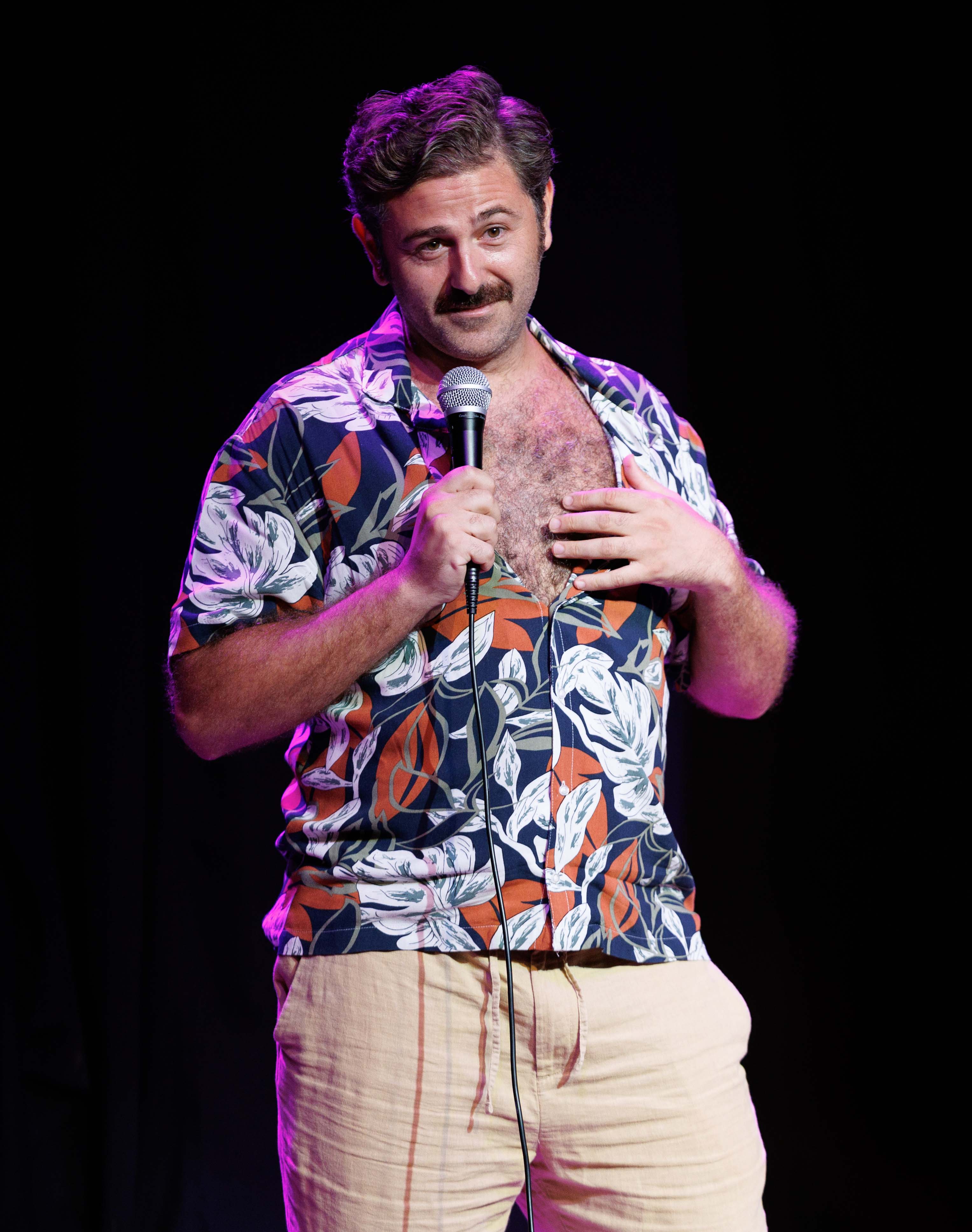
Kyriakou’s English tour touched on sensitive elements. The war in Gaza, the sensoring of local artists, differences in religion, racism on the island. But all along, he preached that cultures must come closer together. We talk about the difficulties of addressing tough matters through the art of comedy. But also perhaps that it’s easier to address certain matters with humour too. That we need more of it. He refers to Trikoupi street in Nicosia. Bustling with food markets and barber shops, locals refer to the street as the Arab quarter of the old town. “I love the fact that there’s a street in Cyprus where I get the sensation that I’m somewhere else. I love these things, but I simultaneously experience it through the lens of a person who sees it and is afraid. And I do this as an exercise, just to try to realise what Cypriots who are afraid of this are seeing. Why are you afraid of this? As a comedian, as a person, as a human being, I have to find a way to address that and coming closer together and finding humour in the situation is the best way.”
Kyriakou finds stand-up a completely different process than doing theatre. “I experience a split personality. When I’m doing theatre, I have different values, different skills; different parts of my character and life force are called upon, and I live a different reality, a different everyday life than when I’m doing stand-up. It’s jarring as an experience,” he says. “But acting is healthier for me because I have more experience; it’s an industry that I’m already recognised in. That cannot exist in stand-up right now… There’s no industry that’s fleshed out yet,” he adds but he can’t see himself without one or the other.
“If I stop theatre, the roles will be performed by somebody else. It’s not going to be my way, my body, but this is dramaturgy. If I stop doing stand-up, the dramaturgy of my jokes stops existing; that’s something that I put out there. I’m bound and doomed to believe that the world is a better place when I do comedy,” he laughs. “And I do it for the ride as well. It’s fun, as Bill Hicks says, it’s just a ride, but it’s a fun one.”
Kyriakou has a series of shows coming up, both locally, in Europe and New York. He’s also manning up to organise the International Comedy Festival in Limassol.
He speaks fondly about the festival and its offerings. “It’s where you exchange people’s culture and for me, it’s the best way of battling the absurdity that I experience every day when I go online and I see ICE agents killing people in the street, Iran, Gaza, the reality of the world is getting to me emotionally and I’m trying to shield myself, but I cannot and stand-up comedy and the festival is my way of somehow coping.”




Click here to change your cookie preferences