
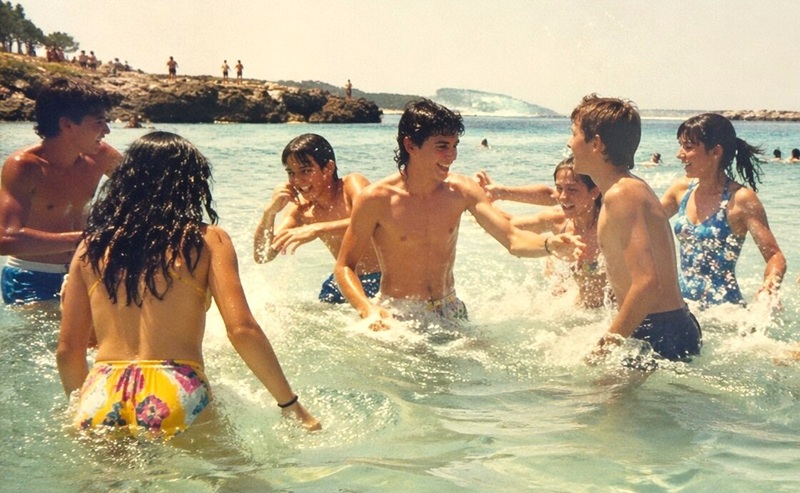
Remember being 15 in Cyprus?
Long days on Makronissos or Konnos; straight into an evening of clubbing and pubbing (yes, we did everything younger back then!). Rolling home at 4am after a yeros.
We were alive. The island was alive. Cyprus was ours!
Of course, as teenagers, we had worries, too. All the usual stuff: am I too much, too little, too loud, too quiet? Am I enough?
But then yiayia made us soup. Thea set out watermelon and halloumi. A cousin laughed from the next room. And just like that, we were safe again. Accepted. Loved.
That feeling – of being held without having to ask – is easy to overlook. Until you realise not everywhere has it anymore.
Which is perhaps what this week’s proposed social media ban is really illuminating.
On April 16, Cyprus announced plans to ban social media use for under-15s – no Instagram, no TikTok, no Snapchat — as part of a broader effort to protect children’s mental health.
The aim is clear. The instinct understandable.
But the question worth asking isn’t just whether social media is harmful. The question is this: what, exactly, has social media been replacing?
Because the need to be seen, to belong, to know where you fit is not new. It didn’t arrive with screens. It’s always been there…
Once, in an ancient agora, a girl tugged at her peplos, sure Demetra’s was finer; a boy watched Alexandros throw the discus, certain he’d never measure up. Teenage angst has been a part of life for millennia, it has not changed.
But what has changed is what answers it.
In much of the West, the answer used to be built on: the extended family, the neighbour at the door, the community that knew your name before you had worked out who you were. Belonging wasn’t something you searched for. It was something you were born into.
Over time, those structures thinned. Families scattered. Daily life became more individual, more private, more disconnected. And into that space came social media – offering identity, validation and the powerful illusion of being seen.
It created a generation trying to meet a very real need in a very artificial place. And then it fed the hunger — making insecurity louder, and belonging harder to find.
At which point, governments started stepping in.
Australia was the first to act, introducing a nationwide ban on social media for under-16s in December 2025. Others are following. Cyprus amongst them.
But our island is different. Because here, the older structures haven’t disappeared entirely. Not yet…
Over half of people in Cyprus still see their families daily – the highest rate in Europe. And just three in 10,000 have no relatives at all.
Here, yiayia is still in the kitchen. The cousin comes to Sunday lunch. The neighbour knows your grandfather’s name.
These are not small things. They are the quiet, everyday systems that tell a teenager – without an algorithm, without a like count – that they belong. ‘You are seen. You matter.’
It’s the same truths we absorbed, back when we were 15, on those long summer nights.
That doesn’t mean social media isn’t a challenge. Or that the ban won’t have its place. But it does mean this: the real protection was never going to come from legislation alone.
It comes from something far older: the kitchen table, the family noise, the deep, unquestioned belief that you are part of something important, and the world is not asking you to prove it.
And in Cyprus, for now at least, that still exists.






Click here to change your cookie preferences