
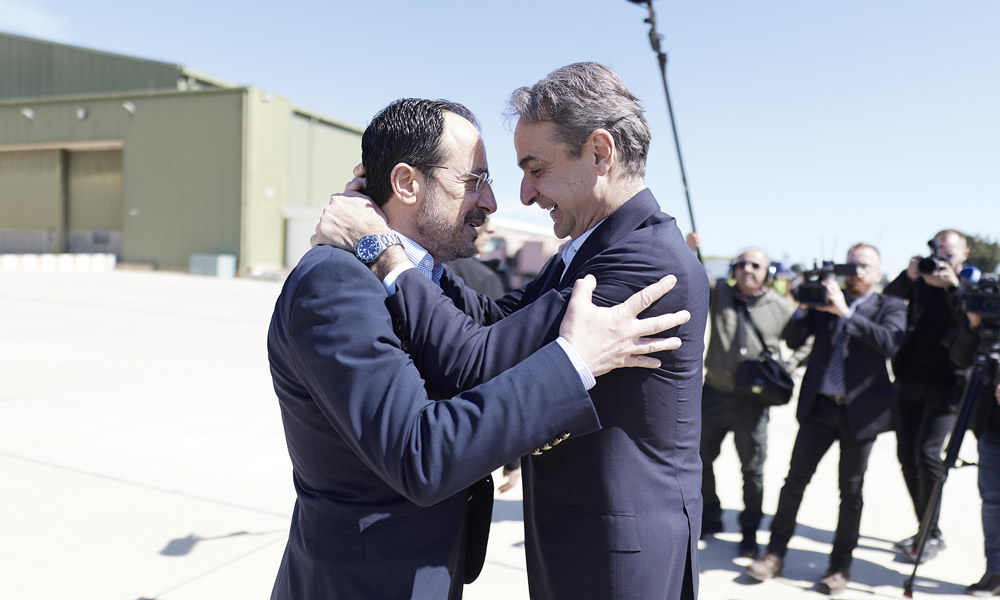
President Nikos Christodoulides has reaffirmed the close ties between Cyprus and Greece, praising bilateral cooperation and outlining shared priorities on security, European policy and regional stability during an address at ruling New Democracy Party’s congress in Athens.
Speaking at the metropolitan exposition on Saturday, Christodoulides said he participated “with great pleasure and pride” and conveyed “the brotherly love and appreciation of the Cypriot people, along with our gratitude for the substantial support and practical assistance”.
He described New Democracy as having made a “leading contribution to the titanic effort for national reconstruction and unity”, adding that its record over 52 years had left a “positive imprint”.
Christodoulides referred to founding figures of modern Greek politics, citing Konstantinos Karamanlis and his phrase that “Greece belongs to the West, politically, defensively, economically and culturally”, saying it remained “timeless” in the current geopolitical environment.
He said Greece and Cyprus were acting as “pillars of progress and development” and “factors of security and stability” in the mediterranean.
The President also referred to security developments in Cyprus, stating that after “the attack on the British base in Akrotiri”, Cyprus had been forced to strengthen its deterrent capacity.
He said he would “never, ever forget” the response of Greek Prime Minister Kyriakos Mitsotakis, adding that “without hesitation” Greece had deployed air force assets and naval vessels to support Cyprus.
He said the response also demonstrated wider international solidarity, referencing activation of the EU mutual defence clause Article 42.7.
Christodoulides said Cyprus and Greece were pursuing initiatives within the EU on issues including employment, competitiveness, migration, housing and the digital and green transition.
On the Cyprus issue, he said Greece had provided “decisive assistance” in efforts toward “the end of the occupation and the reunification of our homeland”.
He warned against political approaches that rely on “denouncing without proposing”, saying such positions do not constitute policy.
“The great national issues, the economy, defence and security, do not lend themselves to experimentation,” he said.
Addressing his own party’s congress, Greek Prime Minister Kyriakos Mitsotakis remarked that “The support for Cyprus by Greece, I believe, acted as a catalyst so that the psychological ties between Greece and Cyprus will never be stronger than they are now.”
Echoing Christodoulides’ own statements, Mitsotakis affirmed that “Greece is the most steadfast ally of Cyprus in the ongoing effort to resolve the Cyprus issue.”
“Let this wound which has been hurting Hellenism so much for 52 years, finally close,” he concluded.





Click here to change your cookie preferences