
Cyprus’ growing technology sector may be struggling to find skilled workers, but one of its largest untapped talent pools is already inside the system, speakers said during a panel discussion on women in STEM and technology.
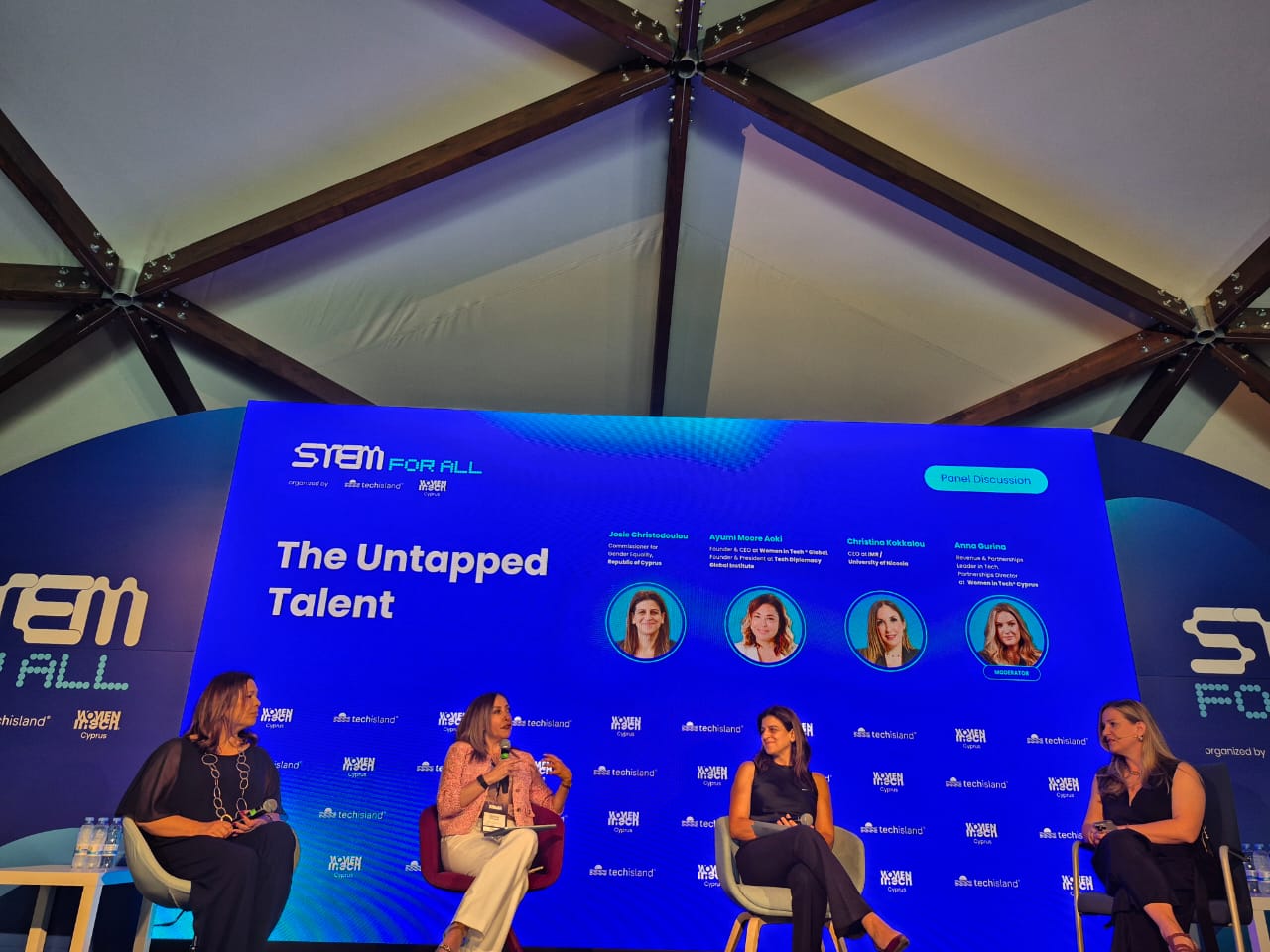
The panel, titled ‘The Untapped Talent’, was held at the Doers Summit in Limassol, as part of the ‘STEM for All’ initiative, organised by TechIsland and Women in Tech Cyprus.
Moderated by Anna Gurina, Revenue and Partnerships Leader in Tech and Partnerships Director at Women in Tech Cyprus, the discussion brought together Gender Equality Commissioner Josie Christodoulou, Women in Tech Global Founder and CEO Ayumi Moore Aoki, and IMR / University of Nicosia CEO Christina Kokkalou.
Opening the discussion, Gurina said the debate was taking place at a time when two very different conversations are happening at once. On the one hand, there are growing fears that artificial intelligence will take jobs. On the other, companies building teams say they cannot find enough skilled people to fill the roles already being created.
“There is a talent shortage. A real one,” Gurina said.
That contradiction, she said, is where the discussion begins. For Cyprus, it points to a pool of women who have already gone through the education system and entered the workforce, but who often leave before reaching senior roles or long-term growth opportunities.
“This isn’t just a ‘what a shame’ story,” she said, adding that “unrealised potential has a price tag”.
In other words, the cost is not only carried by the women themselves. It is also felt by businesses that lose talent and by economies that cannot afford to waste it.
For Christodoulou, the conversation was both necessary and overdue. Having worked on gender equality issues for 25 years, she said she felt both frustrated and hopeful.
“I feel frustrated, angry at the same time, but also hopeful,” she said.
The reason for that frustration, she explained, is that progress is coming too slowly. While women in Cyprus are highly educated and strongly represented in science and engineering overall, they remain significantly underrepresented in ICT and leadership.
This, Christodoulou said, shows that getting women into the system is only part of the answer.
“Representation is not enough,” she said, “retention is also important.”
Many women, she said, enter STEM successfully but leave before reaching senior positions. As a result, Cyprus is investing in talent but failing to create the systems that allow that talent to stay, grow and lead.
The numbers point to the same problem. Christodoulou said that in 2025, women represented around 20.1 per cent of employed ICT specialists in Cyprus, meaning that roughly four out of five ICT professionals were men.
At the same time, women made up 34.2 per cent of STEM graduates in 2024, while Cyprus continued to rank low among EU countries for women employed in tech-related fields.
Kokkalou said the IMR survey, carried out with TechIsland and Women in Tech Cyprus, interviewed 320 women in STEM professions and showed that the problem starts long before women reach leadership level.
Young girls, she said, may grow up with the ambition or interest to follow a technology or STEM career. However, along the way, many women step back, slow down or leave, often before reaching senior positions.
The reasons are familiar but still powerful: lack of support, stereotypes, and the perception that women are not equally knowledgeable or able to hold such roles.
“It is a lot more difficult for women to have a career, especially in STEM,” Kokkalou said.
One of the most critical pressure points, she added, is maternity and childcare. In technology, where knowledge changes quickly, even a few months away from work can create a gap. Yet women often return without the support they need to catch up, continue and progress.
Kokkalou said the survey showed that 80 per cent of women reported burnout because of the combined pressure of work and childcare responsibilities at home.
Christodoulou said this is precisely why the government has been trying to expand childcare facilities, so that women do not have to choose between work and family.
She said all-day schools have already been extended, preschool education from the age of four has also been expanded, while discussions are under way with the Labour Ministry on extending maternity leave.
However, she made clear that the issue cannot be solved by women alone.
“We need to involve men and boys in this discussion,” she said.
Gender equality, she added, is not a competition between women and men. It is about equal participation, equal responsibility and equal presence where decisions are made.
“We want 50-50 everywhere,” she said.
The discussion then moved to artificial intelligence, where Moore Aoki said the need to include women has become even more urgent.
Women, she said, must be present at every stage of technology, from research and algorithms to decision-making. This matters because AI systems are already being built on data that reflects existing social bias.
“We have proved by empirical evidence that the data is biased,” she said.
If women are not part of the process, she warned, AI risks accelerating those biases. At the same time, she said AI can also be used to correct them, because bias can be measured and addressed by design.
For Moore Aoki, this also means people must not treat AI outputs as absolute answers. Instead, they should ask whether those answers reflect their values, culture and judgement.
Returning to the Cyprus data, Kokkalou said women in STEM are not asking for extreme or unrealistic changes. According to the survey, what they need most includes on-site childcare, part-time roles or reduced hours, and a supportive workplace culture.
These are practical issues, she said, not abstract demands. Yet they matter deeply, particularly when six out of ten women in STEM are currently considering quitting their jobs.
That figure, Kokkalou said, should make employers pause, especially since many of the issues raised, including equal pay and inclusive culture, have been discussed for years.
“We’re not in 2026 with women fighting for equal pay,” she said.
What is needed now, she said, is a system that works together in practice, rather than placing the burden on women to keep adjusting themselves to structures that were not designed for them.
Christodoulou agreed, saying the hardest part of the work is changing culture.
Stereotypes, she said, begin before children are even born. From gender-reveal parties to toys, clothes and expectations, boys and girls are placed into different boxes from the start. Boys are encouraged to explore the world, while girls are pushed towards caring roles.
“We need to start combating stereotypes,” she said.
Legislation, she continued, is important and will be strengthened. Cyprus is moving ahead with the transposition of the EU directive on pay transparency and measures on equal representation of women and men in listed companies.
However, the deeper challenge is making sure that women who enter the system do not continue to face discrimination as they move higher.
In this context, Christodoulou referred to legislation passed in parliament on gender mainstreaming in the public and wider public sector. Under this framework, ministries designing laws or policies will have to carry out a gender impact assessment to examine how those decisions affect women and men differently.
The next step, she said, is gender budgeting, so that gender mainstreaming can be translated into practice through the state budget.
Asked how she stays motivated when the system pushes back, Christodoulou said the answer was simple: she does not want her daughters to have the same discussions.
“I want women and men to reach their full potential, away from any stereotypes, biases, AI unconscious biases, real-life unconscious biases or conscious biases,” she said.
Moore Aoki said these stereotypes start very early. Referring to research on how children imagine scientists, she said that when five-year-olds are asked to draw a scientist, most draw a man.
The age of 12, she added, is another critical point. It is often when girls begin to lose interest in STEM, influenced by peer pressure, school guidance and family expectations.
“You can change policies, you can make laws, you can do all of that, but the hardest thing to change is people’s mindsets,” she said.
Speaking about global initiatives, Moore Aoki referred to the Osaka Protocol, which she said is built around commitments and accountability.
Women in Tech Global, she said, aims to impact 75 million women and girls by 2030, while tracking how many girls are mentored, how many programmes are delivered and how many founders are invested in.
“What can you do? We can all do something,” she said.
Her point was that every person, company and government can make a commitment. What matters, however, is that once a commitment is made, it is delivered.
Looking ahead, Christodoulou said real progress in Cyprus would mean seeing gender mainstreaming and gender budgeting fully implemented.
Her priority, she explained, is not only women in politics, women in tech, women in diplomacy or women in maritime. It is gender equality as a whole.
“The reason is because I like to work holistically, away from the ticking-the-boxes kind of method,” she said.
Kokkalou said the survey had already made clear where action is needed. Thirty-eight per cent of women in STEM said they experience gender stereotypes at work, while 37 per cent said they feel pressure to prove their technical competence more than male peers.
A further 35 per cent reported patronising or dismissive attitudes from colleagues or managers, while 32 per cent reported inappropriate or sexist comments.
For Kokkalou, one of the most important ways to change this is through visibility. More women need to be seen as role models in STEM and technology, not as exceptions, but as part of the normal picture.
Moore Aoki said the same principle applies at the highest levels.
“When women are in the highest positions of power, I think change can only come when we are in power,” she said.
Until women hold half of the world’s most powerful positions, she added, real equality has not yet been reached.
Asked what employers could do differently from tomorrow, Moore Aoki said recruitment processes must become more intentional. Companies should actively ensure that they have equal numbers of male and female candidates, including through anonymised CVs where necessary.
“If you don’t have it, then go find it,” she said.
In other words, the absence of women in a candidate pool should not be accepted as the end of the conversation. It should be treated as a signal that the search has not gone far enough.
Christodoulou added that quotas can be used as a temporary measure to change habits and build equity.
Moore Aoki also said inclusion should not end once women enter the room. Companies should look at who is around the table, who speaks, and who is heard.
“When you’re sitting around the table, what does it look like?” she said, adding that “Do you have women and men? And then, if the women are there, but they’re just there, they say nothing. Ask them questions.”
Kokkalou agreed, saying support after hiring is just as important as recruitment itself. Women need workplace structures that help them stay, avoid burnout and progress towards senior roles.
The discussion also returned to the question of family responsibilities, with Christodoulou saying the language around fathers must change.
When a father looks after his child, she said, he is not “babysitting”, he is taking care of his own child.
“As equal representation we want in the workforce, we want equal responsibilities at home,” she said.
She added that Cyprus is training school counsellors to deconstruct gender stereotypes and unconscious bias, so they can guide children according to their skills rather than stereotypes.
Moore Aoki said the “modern village” needed by working parents can also be created through workplaces and communities.
Support, she said, does not only have to come from family. It can also come from colleagues, neighbours, networks and communities.
“There’s always someone,” she said, adding that people should not be afraid to reach out for help.
For Gurina, that was where the discussion came together. Policy, data and business decisions matter. But so does the daily reality of whether people support one another, whether workplaces are designed for everyone, and whether Cyprus can stop losing talent it has already helped to create.



Click here to change your cookie preferences