
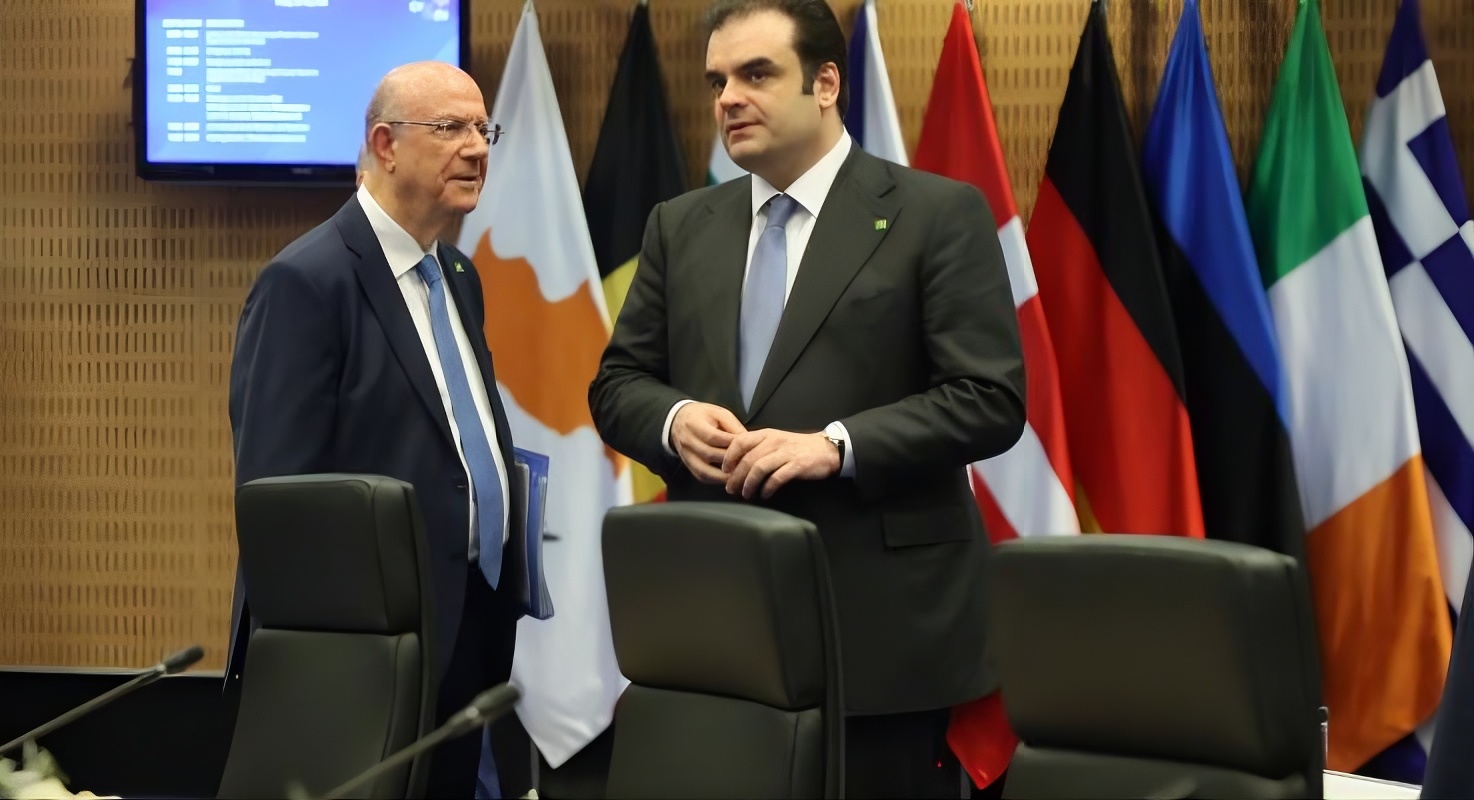
Nicosia Eurogroup warns against broad fiscal stimulus
Eurozone finance ministers and central bankers on Friday said the Middle East crisis requires targeted and temporary support measures for households and businesses, warning against broad fiscal intervention as a new energy shock weighs on growth, inflation and public finances across Europe.
Indeed, the message emerging from the Eurogroup gathering in Nicosia reflected growing concern that the economic fallout from the conflict could prove more persistent than initially expected.
Officials warned that energy market disruptions are already feeding through to households, companies and state budgets.
European Commissioner for Economy Valdis Dombrovskis said recent developments have significantly altered the EU’s economic outlook.
“The conflict in the Middle East has triggered a new energy shock affecting inflation, growth and public finances across the EU,” he said.
According to the European Commission’s Spring Economic Forecasts, inflation in the EU is expected to rise to 3.1 per cent in 2026 before easing to 2.4 per cent in 2027, while growth is projected at 1.1 per cent in 2026 and 1.4 per cent in 2027.
At the same time, fiscal pressures are expected to intensify. Average EU budget deficits are forecast to increase from 3.1 per cent of GDP in 2025 to 3.5 per cent in 2026 and 3.6 per cent in 2027, while the number of member states breaching the 3 per cent threshold is set to rise from ten to thirteen.
Despite weaker projections, officials repeatedly stressed that the situation remains distinct from the energy crisis that followed Russia’s invasion of Ukraine in 2022.
Eurogroup president Kyriakos Pierrakakis said updated forecasts still point to resilience rather than recession in the euro area economy.
“We are clearly far from a recession scenario,” he said.
He warned, however, that developments around the Strait of Hormuz have widened risks beyond oil and gas supplies to include strategic goods and supply chains.
“The disruption concerns not only oil and gas flows but also strategic products such as fertilisers,” he said, pointing to broader risks for European industrial activity.
Inflation risks seen extending beyond immediate shock
European Central Bank (ECB) president Christine Lagarde said the effects of the crisis could continue even after any easing of geopolitical tensions.
Responding to questions on whether inflationary pressures would fade quickly if the conflict ended, she said transmission effects would persist.
“Even if the crisis were resolved now, there would be lagged effects that would continue to emerge,” she said.
She added that even if inflation eventually declines, consumers should not expect a return to previous price levels.
“It is likely that price levels will be higher at the end of this crisis,” she said.
Lagarde reiterated that the ECB remains focused on bringing inflation back to its 2 per cent medium-term target, stressing continued attention to wage and pricing dynamics and inflation expectations.
She gave no indication on the ECB meeting scheduled for June 11, 2026, saying decisions will continue to depend on incoming data and be taken on a meeting-by-meeting basis.
Resistance to broad fiscal expansion grows
A further key theme of the meeting was increasing resistance to large-scale fiscal stimulus despite pressure from some member states for greater flexibility.
Questions during the press conference focused on Italy’s calls for more fiscal space under EU rules to address the crisis impact.
Dombrovskis acknowledged ongoing discussions on policy options but said there appears to be broad agreement against generalised support measures.
“Italy is perhaps the country raising the issue most systematically,” he said, adding that most member states favour a more targeted approach.
Asked about potential EU-level financial support for more affected countries such as Cyprus, he said responses should remain focused and rely on existing instruments.
He pointed to funding available under RepowerEU and the Recovery and Resilience Facility, saying these tools were designed precisely for energy-related challenges and still include significant unspent investment capacity.
He added that as the Recovery and Resilience Facility enters its final implementation phase, further disbursements will continue alongside rising cohesion fund absorption under the multiannual financial framework.
“It is possible, at least at this stage, to address these pressures through existing financial efforts,” he said.
Moreover, Pierrakakis stressed the need for alignment between fiscal and monetary policy.
“We all understand we must not act in a counterproductive way,” he said. “Fiscal policy and monetary policy must move together.”
Lagarde reinforced the same message, saying support measures should follow what she described as the ‘Triple T principle’, meaning temporary, targeted and tailored.
She warned that broader interventions could ultimately trigger a different monetary policy response from the ECB.
Pierrakakis said lessons from the 2022 crisis have already shaped current policy, noting that measures introduced since then have reduced the economic impact of energy shocks by around 12 per cent.
“We are trying to be surgically precise and optimal in how we respond to the crisis,” he said.
Structural weaknesses return to the forefront
Beyond the immediate shock, officials highlighted deeper structural vulnerabilities in the European economy.
European Stability Mechanism (ESM) managing director Pierre Gramegna said markets have revised growth expectations lower and inflation forecasts higher, while noting the region remains more resilient than four years ago.
He warned that Europe continues to face additional pressures, including higher borrowing costs, weaker purchasing power and widening divergence from the United States economy.
“There is a clear need to strengthen investment and innovation,” he said.
Ministers also discussed longer-term issues including housing affordability and plans for a digital euro.
Finally, Pierrakakis said there is broad agreement to continue coordination on housing despite national differences, and expressed optimism that legislation on the digital euro could be completed by the end of the year.





Click here to change your cookie preferences