
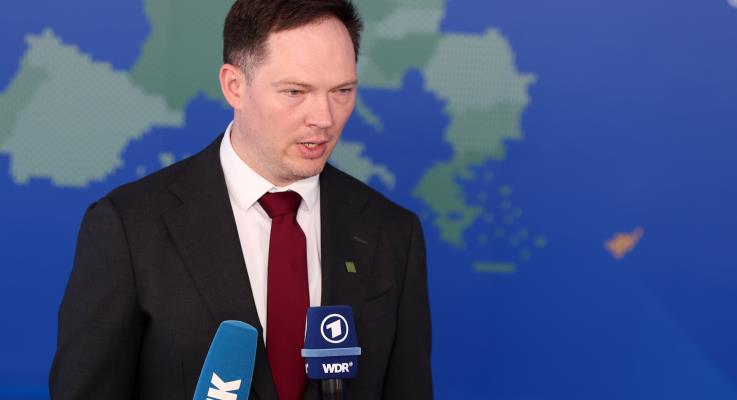
Lithuania’s Finance Minister Kristupas Vaitiekūnas said Cyprus and Lithuania can deepen cooperation, particularly in tourism and defence, while visiting Cyprus for the informal ECOFIN meeting in Nicosia on Friday.
Speaking to the Cyprus News Agency (CNA) ahead of the EU finance ministers’ gathering, Vaitiekūnas highlighted shared characteristics between the two countries and pointed to untapped opportunities for closer collaboration.
“We have much more in common than it may seem at first glance, and our businesses and people can find more ways to cooperate, for example in tourism and defence,” he said.
He explained that both countries face similar challenges, including security concerns such as drone threats, while also relying significantly on their financial sectors.
Turning to the ECOFIN agenda, Vaitiekūnas said discussions would focus on the global economic outlook, the oil crisis, fiscal stability across Europe and measures to address rising fuel prices.
“We will discuss the global economic situation, the oil crisis and how to respond if the situation in the Middle East is not resolved,” he said.
He warned that continued instability in the region could trigger further economic disruption, particularly through energy markets.
Housing affordability was also identified as a key issue, with the Lithuanian minister noting sharp increases in property prices, especially in major cities such as Vilnius.
“This is a very important issue for all western countries, but especially for Lithuania where housing prices have risen rapidly,” he said.
On energy policy, Vaitiekūnas suggested that a coordinated European response could include a unified mechanism, supported by shared expertise and targeted measures.
“The EU can share best ideas and expertise, and we already have recommendations to implement more targeted and temporary measures instead of broad and costly ones,” he said.
He added that discussions are ongoing regarding potential windfall taxes on refineries, as well as possible exemptions for certain categories of spending.
Linking energy policy to long-term strategy, Vaitiekūnas confirmed that Lithuania is redirecting investment towards energy independence, renewable energy and storage capacity.
“We are redirecting investments from EU funds and other sectors, and we have a plan to produce more electricity than we consume by 2028,” he said.
On Ukraine, the minister reiterated Lithuania’s strong support, describing the war as a broader conflict affecting the entire western world.
“This is a war against our way of life, our freedom and who we are,” he said.
He called for faster EU accession for Ukraine, while acknowledging the need for continued reforms.
“We would like to see a faster accession process and offer a clear timeline, as this is in our mutual interest,” he said.
He argued that EU membership would bring economic prosperity to Ukraine, while enhancing security and defence capabilities for existing member states.
On defence funding, Vaitiekūnas welcomed the EU’s SAFE programme, describing it as beneficial despite being based on loans.
“We estimate we could receive around €6.4 billion and save about €250 million in interest payments over a decade,” he said.
He explained that most of the funding would be directed towards strengthening Lithuania’s armed forces, with a smaller portion allocated to military support for Ukraine.
The minister also pointed to the emerging defence industry in Lithuania, supported by the country’s national development bank.
“This is a high value-added sector and an opportunity that depends on how actively we work,” he said.
Regarding the next Multiannual Financial Framework, Vaitiekūnas expressed cautious optimism, noting that defence and security appear to be gaining prominence.
“Around 10 to 12 per cent of the total budget is linked directly or indirectly to security and defence, which is positive for us,” he said.
However, he also raised concerns about cohesion funds and agriculture, warning that real purchasing power may not improve despite higher nominal figures.
“If cuts are made, the framework could effectively become smaller, which is worrying,” he said.
He cautioned that this could weaken the European Union’s overall strength and unity, if resources fail to keep pace with growing demands.
On geopolitical developments, Vaitiekūnas said Lithuania is closely monitoring the Middle East, with particular attention on Iran and the Strait of Hormuz.
“This situation has negative economic effects and creates stagflation pressures, which is the worst scenario for an economy,” he said.
He expressed hope for a swift resolution to the conflict, warning that prolonged instability could further strain economic performance.
Looking ahead to Lithuania’s EU Council Presidency in the first half of 2027, the minister said Ukraine would be a central priority.
“We must help them with EU accession, reforms, reconstruction and defence, and also learn from them,” he said.
He concluded by emphasising shared European values, stressing that Ukraine’s struggle is tied to the broader pursuit of freedom and prosperity across the continent.
“They are fighting for freedom, prosperity and all the European values we share,” he said.



Click here to change your cookie preferences