
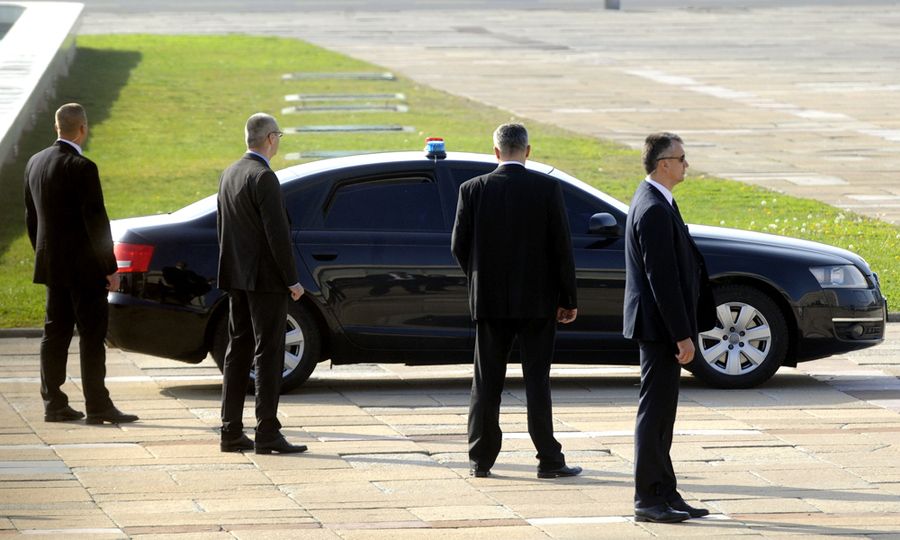
Police will postpone decisions on security arrangements for political leaders and state officials until after the election of the new House president next Thursday, when the security committee will assess existing protection details.
The committee is responsible for evaluating security provisions for public figures.
Among the issues under consideration is whether outgoing House president Annita Demetriou will retain her current level of protection if she is not re-elected.
The committee will also consider whether police protection should be provided to the leaders of the newly established parliamentary parties Alma and Direct Democracy, those being Odysseas Michaelides and Fidias Panayiotou.
Panayiotou’s case presents particular considerations as he will spend much of his time in Brussels in his capacity as MEP.
Another matter expected to be examined is whether the security detail assigned to Elam leader Christos Christou should be strengthened.
The review comes amid continuing debate over the criteria used to determine protection levels for political figures.
The issue was drawn attention to in a report published by the audit office in November 2023, which concluded that protection arrangements appeared closely linked to the electoral strength of political parties.
The report remarked that the number of officers assigned to party leaders seemed proportional to parliamentary representation, raising concerns that state protection risked being treated as an entitlement rather than a response to specific security threats.
Under current arrangements, the leaders of the two largest parties, Disy and Akel, receive the largest protection details among party leaders.
Akel secretary-general Stefanos Stefanou currently receives protection from four police officers.
Diko’s Nikolas Papadopoulos and Elam’s Christos Christou each have three officers assigned to their protection.
Dipa leader Marios Garoyian and Edek’s Nikos Anastasiou are each protected by two officers.
The committee is also expected to examine whether protection for Anastasiou should continue following Edek’s loss of parliamentary representation.
His security detail was inherited from former party leader Marinos Sizopoulos.
Garoyian is expected to retain his protection despite Dipa’s failure to secure parliamentary representation because of his status as a former House president.
The Ecologist’s remains an exception among parliamentary parties. Its leader, Stavros Papadouris, does not have a bodyguard.
Until January 2020, the party received a monthly allowance from the finance ministry to employ a driver and guard for its leader.
The arrangement was later abolished at the party’s request.
Any changes to protection arrangements follow a formal procedure.
The security committee conducts risk assessments and records recommendations for each case before submitting them to police-chief Themistos Arnaoutis.
Arnaoutis then forwards proposals to Justice Minister Costas Fitiris, who presents them to cabinet for approval.
The committee is chaired by deputy police-chief Panikos Stavrou.
The current review follows a series of reductions introduced over recent years.
In January 2021, the cabinet approved a proposal by then Justice Minister Emily Yiolitis to reduce security details for party leaders and former presidents by 20 per cent.
At the time, 97 police officers were assigned to protect politicians and state officials at an annual cost exceeding €1 million.
The reductions removed 21 positions.
Further changes followed later that year when Demetriou assumed the role of House president.
After taking office in June 2021, she reduced her own security detail from eight officers to five and declined a proposal for police escort.
Former President Nicos Anastasiades currently receives the largest security detail among former office holders, with 13 officers assigned to his protection and residence.
Former House presidents Yiannakis Omirou and Demetris Syllouris each have two officers.


Click here to change your cookie preferences