
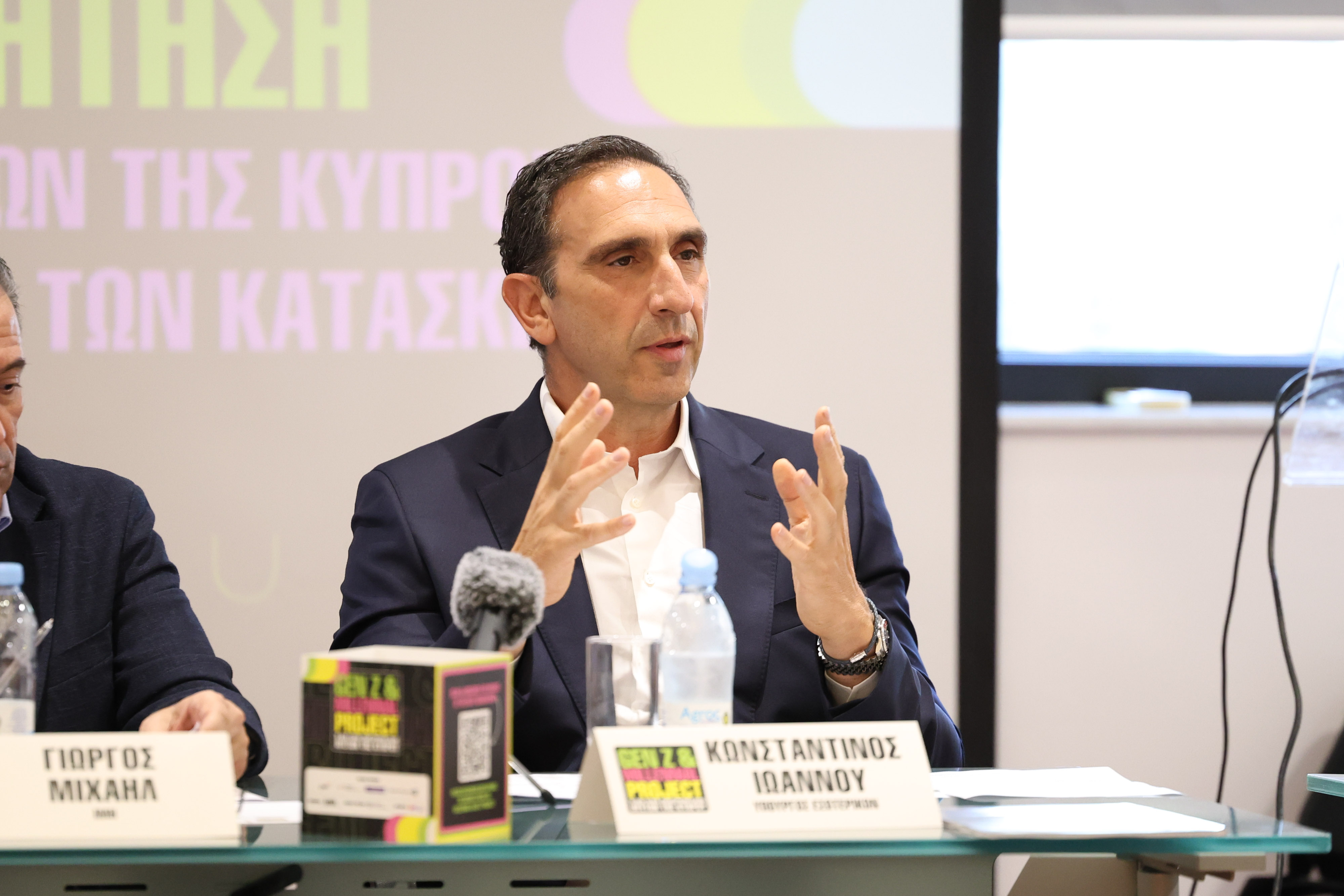
Interior Minister Constantinos Ioannou has defended the government’s business-friendly approach to housing and development, saying the private sector is better placed than the state to deliver projects quickly and efficiently.
Speaking during a discussion with young business people in the land development and construction sectors, held as part of the Gen Z & Millennial Project, Ioannou said the government’s position was clear.
“As far as business is concerned, our political direction and our ideology are certainly to help business, in contrast to other ideological spaces,” he said.
He pointed to recent party proposals for wealth taxation and restrictions on property purchases by third-country nationals, saying the government instead sees entrepreneurship as a driver of growth, employment and wider economic activity.
“We applaud entrepreneurship for understandable reasons, because through the development of companies and businesses, the economy grows, the contribution to GDP, employment, and so on. Therefore, the benefits are multiple,” he said.
Ioannou also addressed the long-delayed bill on shared buildings, saying the Interior Ministry had completed its work after two years of consultations, but the legislation remains before parliament.
The bill, he said, was submitted a year and a half ago, with discussion effectively beginning only in November, before objections were raised by district local government organisations (EOA) over the management responsibilities they would assume.
“My first action during the first session of the Interior Committee will be to request that the bill be examined,” he said, adding that the aim was to secure approval as soon as possible.
The proposed legislation provides for common funds and memos against apartments that fail to pay shared expenses, in an effort to modernise the management of apartment buildings.
“Now they will operate as they operate in a modern European country,” Ioannou said, adding that “we as the executive branch did our job and we expect the parliament to do its part.”
On housing, the minister challenged Direct Democracy leader Fidias Panayiotou’s proposal for the government to build 10,000 apartments at a cost of €1.5 billion, saying no explanation had been given as to where the money would come from.
He compared the proposal with the government’s current plan for 500 apartments on state land, which will cost €75 million and is being funded by the EU.
“So do you understand that when you want €75 million for 500 apartments, what would be the cost to build 10,000 apartments as Panayiotou suggests” he asked.
Ioannou also rejected criticism from Alma that the government’s housing incentives were designed to benefit developers, saying the scheme applies to any plot over 800 square metres and has also been used by small and medium-sized companies.
“We believe that the private sector can build faster, more efficiently, and more cheaply than the government,” he concluded.





Click here to change your cookie preferences