
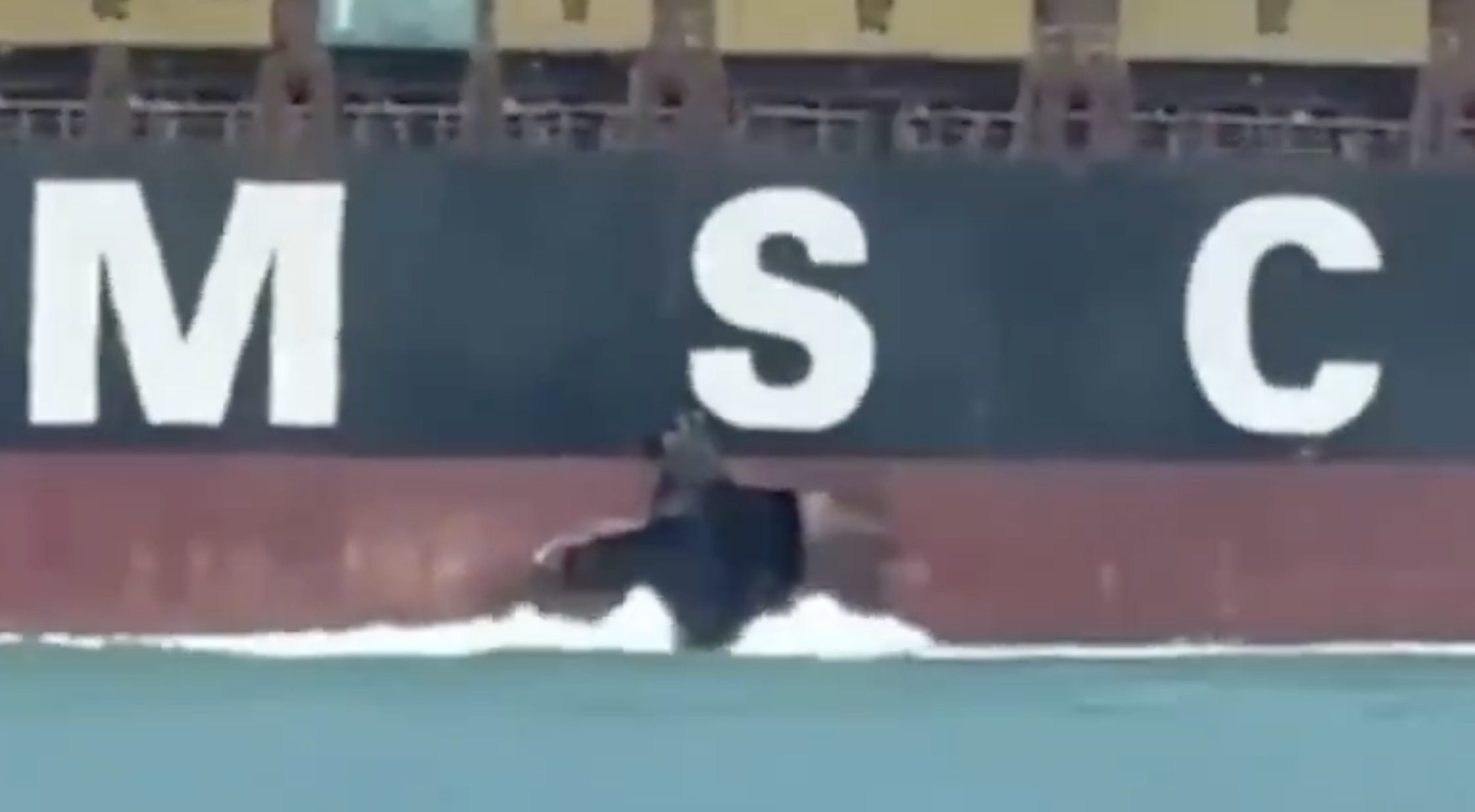
A Panama-flagged MSC container ship has been damaged by a large explosion off Iraq, raising fresh concerns over the safety of commercial vessels operating in the northern Arabian Gulf as regional tensions continue to disrupt shipping routes.
The vessel, reported to be the MSC Sariska V, was struck while transiting approximately 40 nautical miles southeast of Umm Qasr, Iraq, according to the United Kingdom Maritime Trade Operations (UKMTO), which cited military authorities.
The ship was hit on its starboard side by an unknown projectile at around 09:50 UTC, triggering what UKMTO described as a “large explosion”.
A later update from the organisation confirmed that a fire on board had been extinguished, while no injuries to the crew were reported. UKMTO also said it was not aware of any environmental impact, adding that authorities were investigating the incident.
Video circulating on social media appeared to show heavy damage to the starboard side of the containership, with a visible hole above the waterline. The vessel’s operator had not publicly commented on the incident at the time of reporting.
The nature of the damage has prompted maritime security analysts to suggest that the ship may have been struck by an uncrewed surface vessel rather than a mine.
“MSC SARISKY V was struck with what is likely a USV in Iraqi territorial waters after it had completed unloading its cargo at the port of Umm Qasr in southern Iraq,” Martin Kelly, head of advisory for EOS Marine, wrote on LinkedIn.
He also linked the attack to the wider targeting of MSC-linked tonnage in the region, saying that “MSC remains a target for Iran owing to Israeli affiliation.”
The incident comes after the vessel had reportedly been operating inside the Gulf for several months. According to data from Pole Star Global’s PurpleTrac database, the MSC Sariska V had been trading within the region since before the latest escalation began, having transited the Strait of Hormuz on October 10, 2025, and remained in the Gulf thereafter.
Maritime analyst and former merchant mariner Sal Mercogliano, who runs the What’s Going on With Shipping? YouTube channel, said the vessel had effectively been trapped inside the Persian Gulf since the outbreak of the US-Iran conflict on February 28.
“The ship has been trapped in the Persian Gulf since February 28, when the war started,” Mercogliano wrote on social media.
He noted that MSC had established an overland service to the Persian Gulf, with cargo moving across Saudi Arabia and the UAE, after deep-sea services were disrupted by the security crisis.
Although the ship appeared heavily laden with containers, Mercogliano said its draft suggested many of the boxes were likely empty.
The latest strike is significant because it took place away from the Strait of Hormuz, where much of the recent focus has been concentrated. Since the escalation between the United States and Iran, most attacks on commercial shipping have been reported around the Strait of Hormuz, the Gulf of Oman, and waters extending towards Bahrain and Qatar.
However, the attack on the MSC vessel points to a widening area of risk, particularly for ships serving ports in Iraq and Kuwait.
It also follows earlier incidents in the northern Gulf. On March 4, a tanker anchored about 30 nautical miles southeast of Mubarak Al Kabeer, Kuwait, reported a large explosion on its port side, followed by the sighting of a small craft leaving the area. The vessel sustained damage and initially reported a discharge from a cargo tank, although a later update clarified that the release was ballast water.
A week later, on March 11, UKMTO reported that two tankers had been struck by unknown projectiles about five nautical miles south of Al Basrah. Fires broke out on both vessels, prompting the evacuation of all crew members. No injuries or environmental damage were reported.
The latest incident also follows reports that Iran previously attacked and seized MSC-linked vessels, including the MSC Francesca and MSC Epaminondas, as they attempted to transit the Strait of Hormuz on April 22.
Meanwhile, tensions between Washington and Tehran have remained high despite diplomatic efforts and a theoretical ceasefire.
Over the weekend, Iran’s Islamic Revolutionary Guard Corps said it had targeted an air base used by US forces for an attack on Iran. US Central Command later reported self-defence strikes against Iranian radar and command-and-control sites for drones in Goruk, Iran, and on Qeshm Island.
Centcom said the response also included the destruction of two one-way attack drones that posed “clear threats to ships transiting regional waters.”
The incident comes as shipping executives gather in Athens for Posidonia 2026, where security in the Gulf, freedom of navigation and the resilience of global supply chains have become central concerns.
Industry figures have warned that any future agreement between the United States and Iran would need to include credible security guarantees before commercial operators fully restore normal activity in the region.
For shipowners and charterers, the attack on the MSC Sariska V adds another layer of uncertainty to an already fragile operating environment. While the reopening of the Strait of Hormuz remains a key diplomatic and commercial priority, the latest explosion shows that risks are no longer confined to the world’s most closely watched chokepoint.
Instead, the threat appears to be spreading deeper into the Gulf, forcing operators to reassess exposure not only near Hormuz, but also around Iraqi and Kuwaiti waters that remain vital to regional trade.




Click here to change your cookie preferences