
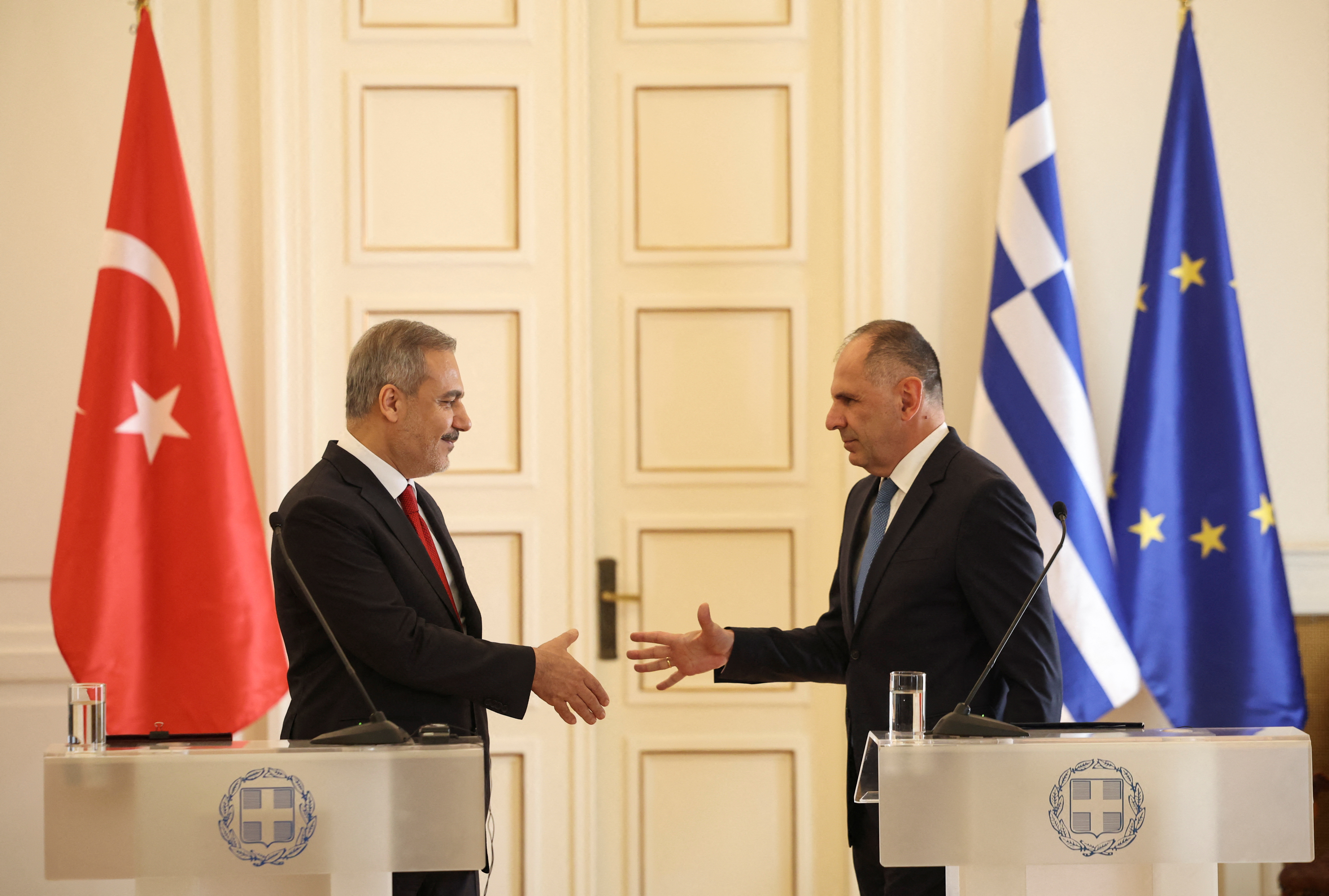
Turkish Foreign Minister Hakan Fidan and Greek Foreign Minister Giorgos Gerapetritis on Wednesday discussed the Cyprus problem when they met on the sidelines of the south-east European cooperation process summit in the Bulgarian capital of Sofia, according to reports.
Multiple news outlets reported that the pair had “reviewed developments on Cyprus”, with both set to meet United Nations envoy Maria Angela Holguin next week, and with it expected that an enlarged meeting on the Cyprus problem may be convened next month or in August.
Holguin had met both Turkish Cypriot leader Tufan Erhurman and President Nikos Christodoulides on Monday, saying after those meetings that she was “quite positive and optimistic”.
Meanwhile, both leaders stressed that they will be aiming for tangible results to be achieved from the next enlarged meeting on the Cyprus problem when it takes place, with Christodoulides saying after his meeting with Holguin that “the goal is to lead us into an enlarged meeting, during which the resumption of talks will be announced”.
Erhurman made no statements after his meeting with Holguin, but said during an appearance on political talk show Er Meydani on Tuesday that an enlarged meeting must “yield meaningful results”.
“What those meaningful results are will be clarified through preliminary studies. If they point to the meeting being held by the end of June or mid-July, that is fine, but if something meaningful is not ready by August, then it could be delayed until September … We need to be truly prepared to go there and achieve meaningful results,” he said.
The round of meetings comes with sources having informed the Cyprus Mail that Turkish President Recep Tayyip Erdogan has green-lit the “new initiative” being undertaken by the UN with the aim of bringing about a resumption of formal negotiations on the Cyprus problem.
Erdogan is said to be of the view that the lack of a solution to the Cyprus problem has “unduly cost Turkey through no fault of its own”in recent decades.
The sources said that Turkey’s support of both the 2004 referendum and the 2017 negotiations, both of which were rejected by the Greek Cypriot side, constitute evidence of Erdogan’s “pragmatic and constructive stance” and “will to engage in the hope of securing a solution to the Cyprus problem”.
However, while progress on the Cyprus problem may be looking more likely, relations between Turkey and Greece have appeared somewhat strained in recent months, with Turkey having announced plans to pass the “maritime jurisdiction law” through the country’s parliament.
The bill will, if passed, codify the country’s maritime claims in the Aegean and Mediterranean seas in line with the “Blue Homeland” doctrine, known as the “Mavi Vatan” in Turkish, with those claims clashing with Greek claims in both areas.
As such, Greek newspaper Kathimerini reported on Wednesday that Gerapetritis had “raised concerns” with Fidan over the bill.
He had at last month’s informal summit of European Union foreign ministers in Limassol called for the bloc’s 27 member states to “articulate a single, strong voice against revisionism”, with that comment appearing to be directed at neighbouring Turkey.
Earlier, Christodoulides had also expressed his opposition to the bill, saying that he expects for there to be a “European” response should Turkey’s parliament pass the bill.
“It affects Cyprus, it affects Greece, it also other European states, but it also affects the United States, which has interests in this particular region,” Christodoulides said, adding that those interests are “based on international law” and “on the 1982 [United Nations] convention on the law of the sea [Unclos]”.



Click here to change your cookie preferences