
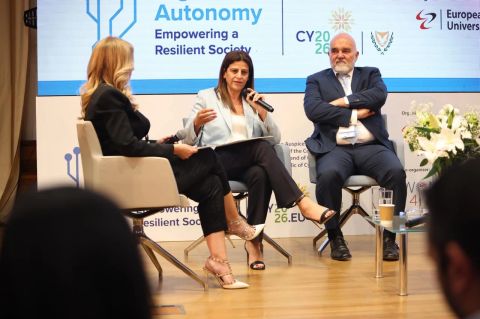
Digital gender inclusion is not only about access to technology, but about ensuring that women and girls have a real role in shaping the digital world, according to gender equality commissioner Josie Christodoulou.
Writing on her personal platform after taking part in a panel on digital gender inclusion, Christodoulou linked effective policymaking to a simple but often overlooked starting point: identifying the problem, looking at the data and asking who is absent from the discussion.
“When designing policies, we must always start with questions such as ‘What is the problem? What does the data tell us? Who is absent from the discussion and decision-making?’” she said.
The same approach, she noted, is particularly important in technology, where the challenge is not simply whether women, girls and young people can use digital tools, but whether the systems around them are designed to include them from the beginning.
“As far as technology is concerned, the question is clear. Do we ask women, girls and young people to adapt to the systems, or do we change the systems themselves so that they leave no one behind?” she said.
For Christodoulou, digital inclusion therefore goes beyond devices, platforms and technological tools. It also concerns women’s and girls’ place in the digital environment, from design and innovation to leadership.
“Digital inclusion is not just about access to technology,” she said.
“It is about the equal participation of women and girls in the design, innovation and leadership of the digital world,” she added.
The commissioner also pointed to the government’s wider work on equality, saying that efforts continue “systematically and strategically to promote gender equality in all areas”.
Her remarks followed the Digital Gender Inclusion Panel, held as part of the European conference Skills for Digital Autonomy – Empowering a Resilient Society.
The conference was co-organised by European University Cyprus, the CYBER.EUC Research Centre and Women4Cyber Cyprus.





Click here to change your cookie preferences