
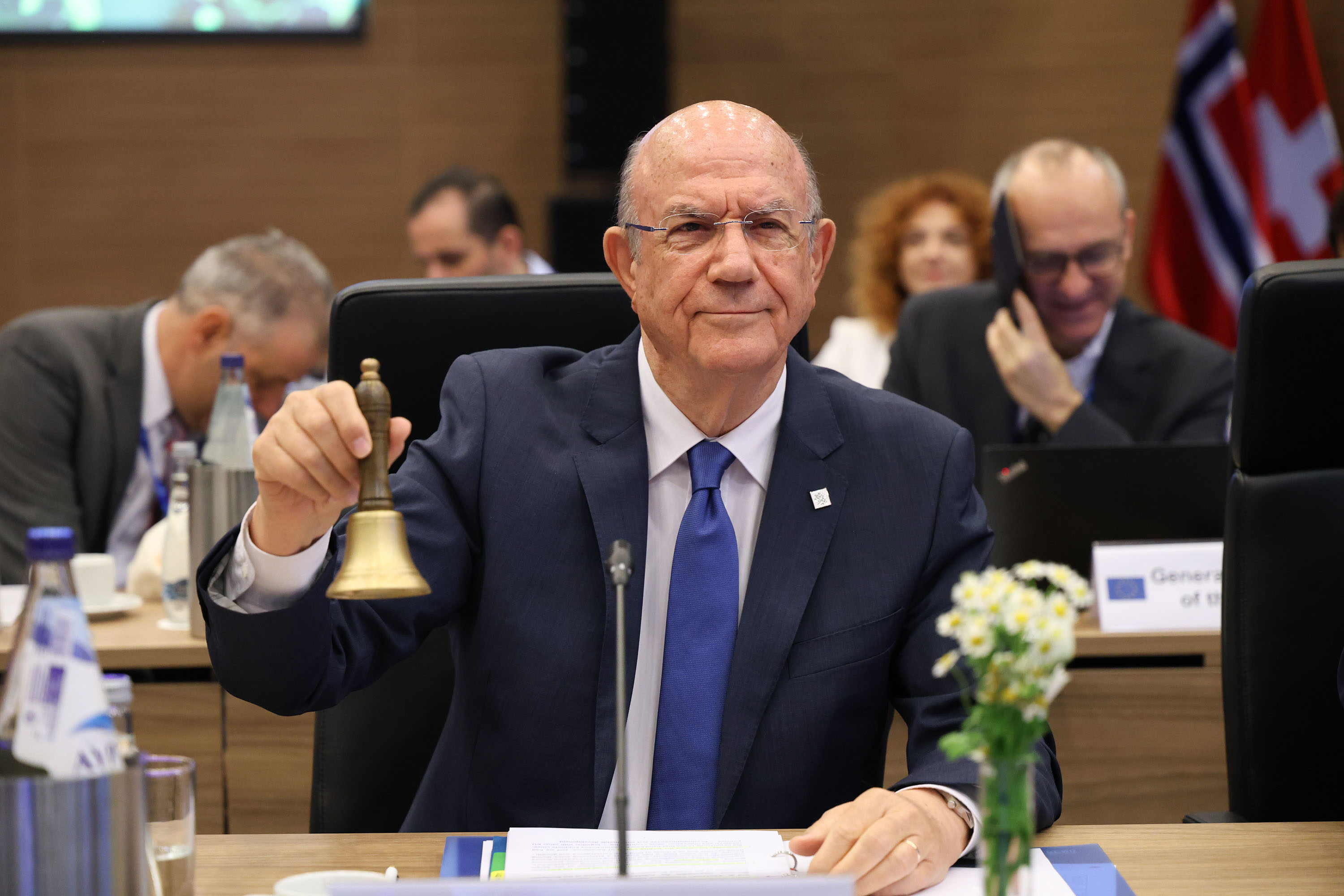
Finance Minister Makis Keravnos on Friday hailed the striking of an agreement among the European Union’s member states on a mechanism to monitor and evaluate the bloc’s next multiannual financial framework, its budget for the period covering the years between 2028 and 2034.
“Every budget needs appropriate oversight and evaluation. The multiannual financial framework is no different. The new performance regulation is geared towards delivering maximum transparency, maximum accountability and maximum visibility for the EU budget,” he said.
He added that “in short, it is about making sure that it delivers for member states, regions, beneficiaries and citizens alike”.
The mechanism, known as the “performance framework regulation”, aims to simplify the means through which the multiannual financial framework is monitored, with the council saying that it aims to “increase coherence between budgetary programmes, reduce complexity for beneficiaries, boost transparency and lower costs across the board”.
As such, the regulation, as agreed by member states on Friday, will set out principles and targets, including what the council described as the principle of doing “no significant harm” and principles related to gender equality and the environment, across the multiannual financial framework.
It also aims to harmonise the system through which EU spending is monitored, as well as “optimising budget performance reporting”, including through the creation of a new, online “single gateway”.
Additionally, it will bring about common rules regarding the evaluation of programmes and activities.
Friday’s agreement will allow the Council of the EU to enter negotiations with the European Parliament regarding the monitoring mechanism’s makeup, with the council saying that its position will aim to provide “legal certainty, operational stability and flexibility” to member states.
The council said it wishes to strengthen the monitoring of the principle of doing “no significant harm”, with particular regard to the environment, by asking that the European Commission devise a methodology for assessing compliance with it.
It also said it wishes to “improve efficiency and cut down on administrative burdens”, and as such, said that it would push for reporting requirements for member states regarding their use of EU funds to be “proportionate” and “in accordance with the ‘once-only principle’”.
The agreement comes as member states begin to coalesce around a common negotiating position for the multiannual financial framework, with a partial agreement also having been reached regarding the Horizon Europe programme – the EU’s research and innovation funding mechanism.
In recent weeks, partial agreements among member states regarding funding for the EU’s foreign policy arm, known as “Global Europe”, and on competitiveness were also reached, after the Cypriot government, in its capacity as the holder of the Council of the EU’s rotating presidency, had submitted a budget proposal, known as a “negotiating box”, earlier this month.
Regarding that proposal, President Nikos Christodoulides had said at last week’s European Council summit that Cyprus had “achieved our goal of presenting a negotiating box with figures and securing partial general approaches on the key financial instruments and on other sectoral proposals”.
On this matter, he acknowledged the discord among other member states regarding the Cypriot government’s proposal, saying that in his own intervention during the summit, “I told my colleagues that I see it as a success the fact that not a single one of you is 100 per cent satisfied with the figures” put forward by the Cypriot government.
“This is precisely because it must be a balanced compromise,” he said, before stressing the “utmost importance” of reaching a conclusion and having the budget itself ready by the end of this year.
While no politician has publicly confirmed the reason for this, it is widely understood that the EU and its 27 member states plan to do this to ward off the risk of elections next year in France and Poland – and the possible election of the far right in both countries – derailing efforts to reach an agreement.




Click here to change your cookie preferences