
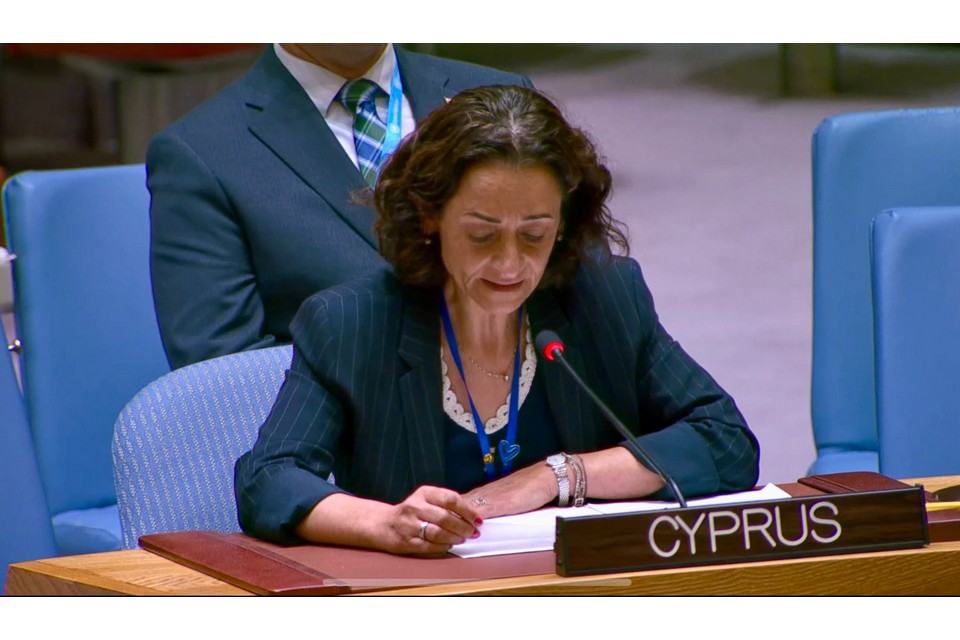
Cyprus has called for stronger international action to support survivors of conflict-related sexual violence and end impunity for perpetrators, while highlighting the lasting impact of sexual violence during the 1974 Turkish invasion of the island.
Addressing a United Nations Security Council open debate on the women, peace and security agenda, Cyprus’ permanent representative to the UN, Maria Michael, said hundreds of women and girls, as well as men and boys, were subjected to sexual violence by Turkish troops during the invasion.
“The pain of those survivors remains an open wound for Cypriot society,” she said, adding that Cyprus’ own experience continues to shape its commitment to recognition, justice, accountability and support for survivors worldwide.
Michael said the latest report by UN Secretary-General Antonio Guterres once again highlighted the alarming scale of conflict-related sexual violence.
“As a country that has experienced foreign military invasion and has endured Turkey’s continued occupation for more than five decades, Cyprus knows firsthand the devastating and long-lasting consequences of conflict-related sexual violence,” she said.
She also referred to a resolution adopted by the European Parliament condemning sexual violence committed by Turkish troops during the 1974 invasion and calling for accountability and support for survivors, describing it as an important step in preserving historical memory and raising awareness at both European and international levels.
Michael stressed that Cyprus unequivocally condemns all forms of gender-based violence.
“These crimes continue to be used as tactics of war, terror, torture and political repression,” she said, warning that they devastate individuals and communities while undermining the prospects for lasting peace.
She noted that rape and other forms of conflict-related sexual violence may constitute war crimes, crimes against humanity or acts of genocide under international law, stressing that accountability is essential to both justice and prevention.
Michael outlined three priorities for the international community: placing survivors at the centre of all responses, ending impunity and ensuring the full, equal, meaningful and safe participation of women.
She said survivors must have timely access to justice, healthcare, legal aid, psychosocial support and reparations without fear of stigma or retaliation, while urging states to strengthen investigations and prosecutions of conflict-related sexual violence.
She also called for greater use of existing UN Security Council sanctions regimes to reinforce accountability and deter future violations.
Existing UN security council sanctions regimes, she added, should be fully utilised to reinforce accountability, deter future violations and send a clear message that perpetrators will face justice.
Highlighting the role of women’s protection advisers and local women’s organisations, Michael urged continued funding and support for their work in prevention, early warning and assistance to survivors.
Turning to the broader women, peace and security agenda, she said sustainable peace cannot be achieved without the full and meaningful participation of women.
She noted that Cyprus adopted its second national action plan on women, peace and security earlier this year, reaffirming its commitment to implementing UN Security Council Resolution 1325 and strengthening measures on participation, protection, prevention, relief and recovery.
Michael added that Cyprus continues to support women and girls affected by conflict through humanitarian assistance and development cooperation under Cyprus Aid.
Concluding her address, she said international law requires more than declarations.
“It requires concrete action to protect survivors, hold perpetrators accountable, address the root causes of conflict-related sexual violence and ensure that these crimes are never accepted as an inevitable consequence of war,” she said.
“Cyprus stands ready to continue working with the international community to strengthen the global response to conflict-related sexual violence and advance the full implementation of the women, peace and security agenda.”




Click here to change your cookie preferences