
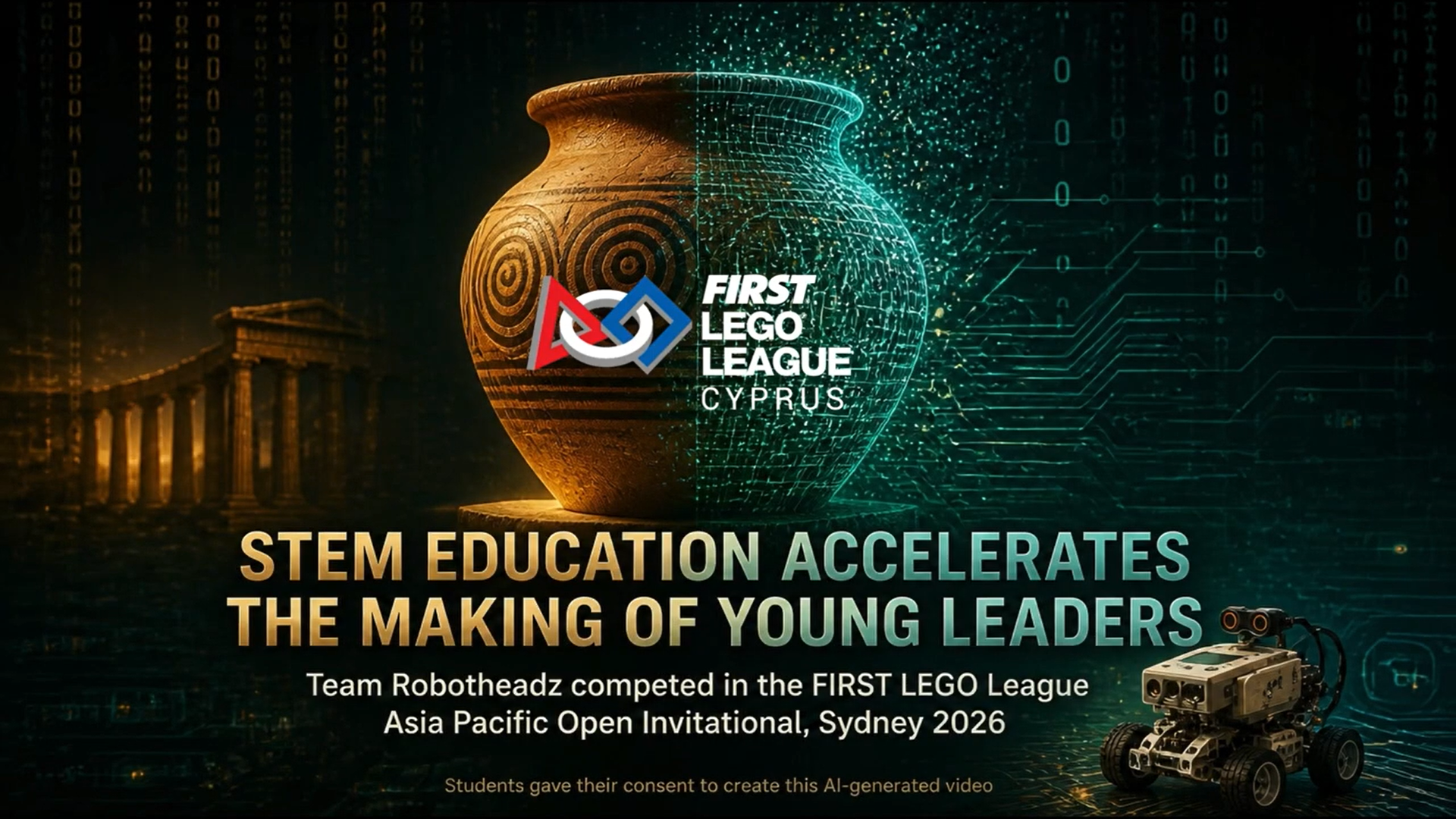
Ten young Cypriots have taken 3,000 years of the island’s history to Sydney, with an AI video now helping bring their robotics project and educational game to a wider audience.
RobotHeadz, made up of five boys and five girls, represented Cyprus at the FIRST LEGO League Asia Pacific Open Championship, held at Macquarie University from July 9 to 12.
Accompanied by their coach, Pericles Cheng, and their parents, the students travelled to Australia after defeating teams from across the island and securing the national title.
The Sydney event brought together young innovators to compete in robotics, research and teamwork under this year’s archaeology-inspired “Unearthed” theme. The challenge asked teams to explore how technology could help uncover, preserve and explain the past.
RobotHeadz answered with Artifact GO, a mobile educational game that transforms Cyprus into a virtual excavation site.
Players choose one of the island’s districts, remove layers of earth and discover archaeological objects carrying stories from Cyprus’ past. Among them is a Bronze Age juglet linked to the island’s ancient copper trade with Egypt.
That history is reflected in the Amarna letters, diplomatic correspondence dating from the 14th century BC. A letter held by the British Museum records the ruler of Alashiya, commonly associated with ancient Cyprus, addressing the Egyptian king as his brother and promising to send copper in exchange for luxury goods.
Through Artifact GO, however, the students have taken that history beyond museum displays and textbooks. By combining programming, gaming, digital design and archaeology, they created an interactive way for younger users to explore Cyprus’ cultural heritage.
The game was also designed with wider use in mind. According to Cheng, it could eventually be adapted for other countries, allowing students elsewhere to discover their own archaeological sites, objects and historical roots through the same format.
RobotHeadz earned its place at the Sydney event after winning the Champion’s Award, Core Values Award and Robot Design Award at the FIRST LEGO League Cyprus 2026 national final. It was the team’s third consecutive national title, following international appearances in Florida in 2024 and Houston in 2025.
The AI-generated introductory video was prepared to support the students’ participation and illustrate the thinking behind Artifact GO. It presents Cyprus as a large excavation site, showing how an archaeological discovery can open the door to a wider story about trade, diplomacy and the island’s place in the ancient world.
Consent was obtained for the photographs used to create the students’ AI avatars, according to the disclaimer accompanying the video.
The initiative is expected to be followed by an interview with Cheng, as well as a session for students examining the risks of using generative AI without the right precautions, supervision and guidance.
The planned discussion will address responsible use of the technology in line with Education Ministry guidance, while helping students understand that AI-generated material must be approached carefully, particularly when personal photographs, historical facts and educational content are involved.
The aim is not simply to promote the video, but to encourage students and parents to engage with Artifact GO as an educational tool and to show how technology can make history more accessible.
Behind the team’s journey was a wider network of support. The Cyprus Computer Society, which organises the national FIRST LEGO League competition, worked alongside volunteers, coaches and other supporters, while international participation received backing from the research foundation and the Office of the Chief Scientist.
Before travelling, the students met Chief Scientist Demetris Skourides and presented their application. The team also carried material showcasing Cyprus’ scientific and cultural work, including 3D-printed artefacts, audiovisual content on the island’s heritage and information about national research projects.
RobotHeadz’ achievement goes beyond a national trophy or a place at an international competition.
The students had to research historical evidence, programme a working product, design and test a robot, divide responsibilities and find new answers when an idea failed.
Sydney provided the international stage. However, the more important story began in Cyprus, where ten young people looked at archaeology, robotics and artificial intelligence and decided that the past could be explored in an entirely new way.




Click here to change your cookie preferences