
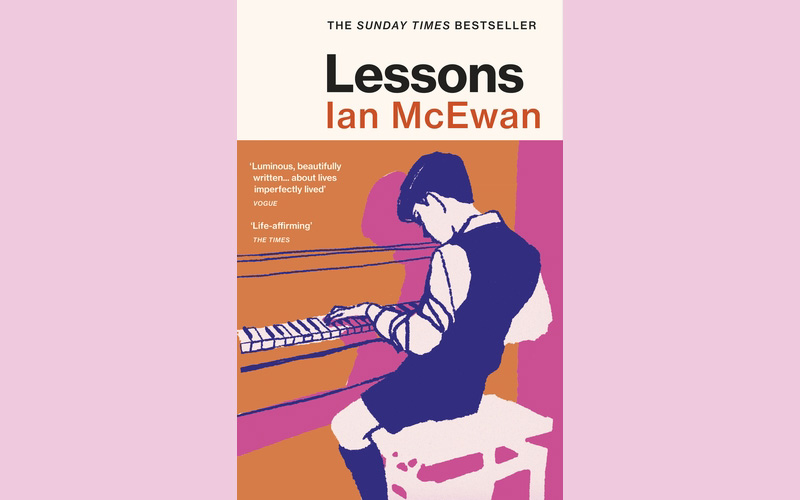
Book review: Lessons by Ian McEwan
By Philippa Tracy
It begins with a memory. A piano lesson. A room with “an orange-tiled floor” and a young female teacher with “deep red” lips and nails. The latter is an immediate and obvious clue to the danger she represents to 11-year-old Ronald Baines. Roland has recently been sent to a boys boarding school in rural England; his father, Captain Baines, serving with the British army in Libya, thinks that children get “in the way of a marriage” and Roland is too “girlishly” close to his mother. He also thinks playing the piano will make Roland popular. It is 1959, and attitudes are very different.
When Roland makes a mistake attempting Bach’s first prelude, his teacher, Miss Miriam Cornell, cruelly pinches the inside of his leg. That is the first hint of anything sexual. Three years later, during the 1962 Cuban missile crisis, when Roland believes the world is about to end, he turns up at Miriam’s cottage, knowing, at age 14, that he will allow the 25-year-old teacher to seduce him. Over the course of the next 60 years, Roland will keep returning, at least in his mind, to the two-year relationship that follows. While he spends his life analysing his choices, it becomes clear that Roland is less someone who actively makes choices and more someone who reacts to events that happen to him and unfold around him.
Roland’s story plays out against a backdrop of major global and political events, from the fall of the Berlin Wall to New Labour and the Iraq war, the financial crash, Brexit and Covid lockdowns. These events impact Roland socially and emotionally. But what continually haunts him is what happened with Miriam. It seems as if he might, too easily, blame every subsequent failure or mediocrity in his own life, on her having “meddled” with his, “over distances of time and place.” He struggles to understand the relationship and all future relationships. And many years later, when he wants to find Miriam, to hold her to account for what he then recognises as abuse, he wonders about the joy she gave him, and if he was complicit.
All of Roland’s relationships with women, are complicated, starting with his mother, who, it turns out, has her own secrets. Then there is his first wife, Alissa Baines. When she disappears from their London home, leaving their baby son, Lawrence, her keys and a note, she asks Roland to forgive her, because she has been “living the wrong life.” He is confused. She returns to her native Germany and goes on to become the country’s greatest writer. Yet still, he believes that she “held him in a headlock from wherever she was.”
Roland, despite his many middle-class opportunities, turns out to be a failed writer, and a mediocre musician; in his fifties he plays lounge music on a piano in a London hotel. For much of this 500-page novel, Roland seems to judge his own inadequacies, his mediocrities, and his passive responses to almost everything through the prism of the actions of the women in his life. His relationship with his father may have been a better place to start. Like most people, his real lessons come much later in life, in his sixties. He realises that he needs to be able to take action and make choices. By then the reader is hoping it’s not too late.





Click here to change your cookie preferences