
Kazakos calls for toll-free Hormuz in talks with Bahrain minister
Cypriot shipping executive Thomas Kazakos has taken the International Chamber of Shipping’s (ICS) campaign for a toll-free Strait of Hormuz to Bahrain’s Foreign Minister, as the industry steps up pressure for the restoration of safe and unrestricted passage through one of the world’s most important maritime routes.
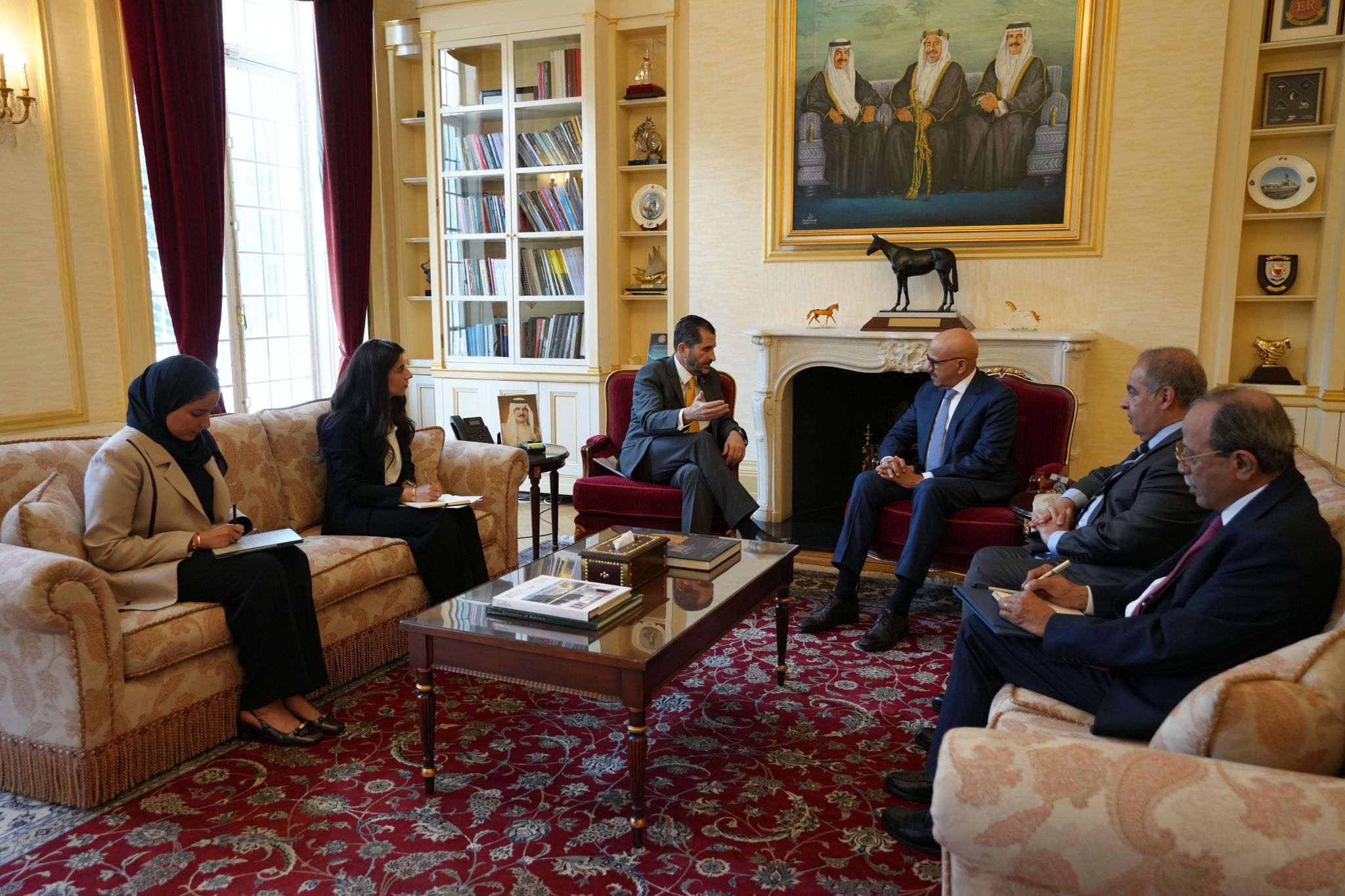
The ICS Secretary General met Bahrain’s Foreign Minister Abdullatif bin Rashid Al Zayani at the kingdom’s embassy in London last week, with discussions focusing on the continuing conflict, maritime security and the protection of seafarers.
Reflecting on the talks, ICS said that “it is vital we continue supporting the preservation of freedom of navigation as the foundation of international maritime governance”, stressing that, in the context of the continuing conflict in the Strait of Hormuz and the surrounding region, “no tolls should be imposed”.
The organisation explained that “this is a message echoed in ICS’ current campaign, which we are working on alongside our members, to emphasize the importance of freedom of navigation and a toll-free Strait of Hormuz”.
According to a Bahraini account of the meeting, Kazakos and Al Zayani also reviewed cooperation between Bahrain and ICS and considered closer coordination on information-sharing, maritime expertise, navigational safety and responses to emergencies and disputes at sea.
At the same time, they discussed efforts to restore shipping through the Strait to the conditions that existed before the conflict escalated on February 28, 2026, safeguarding international trade as well as global energy and food supplies.
Both sides called on the international community and the UN Security Council to support the reopening of the waterway, while also drawing attention to the humanitarian consequences for thousands of seafarers confined in the Gulf and separated from their families.
The meeting was attended by Bahrain’s Ambassador to the United Kingdom and Dean of the Arab Diplomatic Corps, Shaikh Fawaz bin Mohammed Al Khalifa, together with the minister’s accompanying delegation.
The campaign follows repeated interventions by Kazakos over the legal and commercial consequences of introducing charges or restrictions in the Strait. Responding to the latest attacks on shipping in July, he said that “the principle of freedom of navigation has been sidelined during the war, hindering global trade and crucial energy supply routes”.
Kazakos stressed that “there is no legal mechanism by which a toll or restrictions can be placed on vessels passing through the strait”, encouraging all countries to uphold what he described as a fundamental principle of maritime law.
He added that “everyone must now focus on a permanent return to vessels being able to pass through the Strait of Hormuz unimpeded without paying a toll or other clearance mechanism”.
That position has also been formally supported by the IMO Council, which said transit passage through straits used for international navigation must not be threatened, impeded or suspended. It further reaffirmed that passage through Hormuz should remain free from tolls and charges, while any regional arrangement must guarantee non-discriminatory and unimpeded access for all vessels.
Nevertheless, the humanitarian and operational situation remains difficult. The IMO’s latest official update, dated July 30, said more than 20,000 seafarers, port workers and offshore personnel continued to be affected across the region.
An IMO operation launched in June succeeded in evacuating 136 vessels and an estimated 2,900 seafarers before it was paused following a further attack in the Gulf of Oman. The organisation is now monitoring conditions while seeking the security guarantees required for the plan to resume.
Only days before meeting Al Zayani, Kazakos warned that “the pressure on shipping in and around the Strait of Hormuz, Black Sea and the Red Sea has highlighted the vulnerability of the global maritime network and the risks faced by those who keep it moving”.
He explained that “freedom of navigation is not an abstract principle”, but “a fundamental part of a system that allows ships to trade safely, enables essential goods and energy supplies to move, and supports economies and communities around the world”.
Concluding that intervention, Kazakos insisted that “freedom of navigation is not negotiable”, adding that neither is “the safety of the seafarers who make global trade possible”.
Following the London meeting, ICS thanked Al Zayani “for taking the time to meet with our Secretary General and hold these crucial discussions”.





Click here to change your cookie preferences