
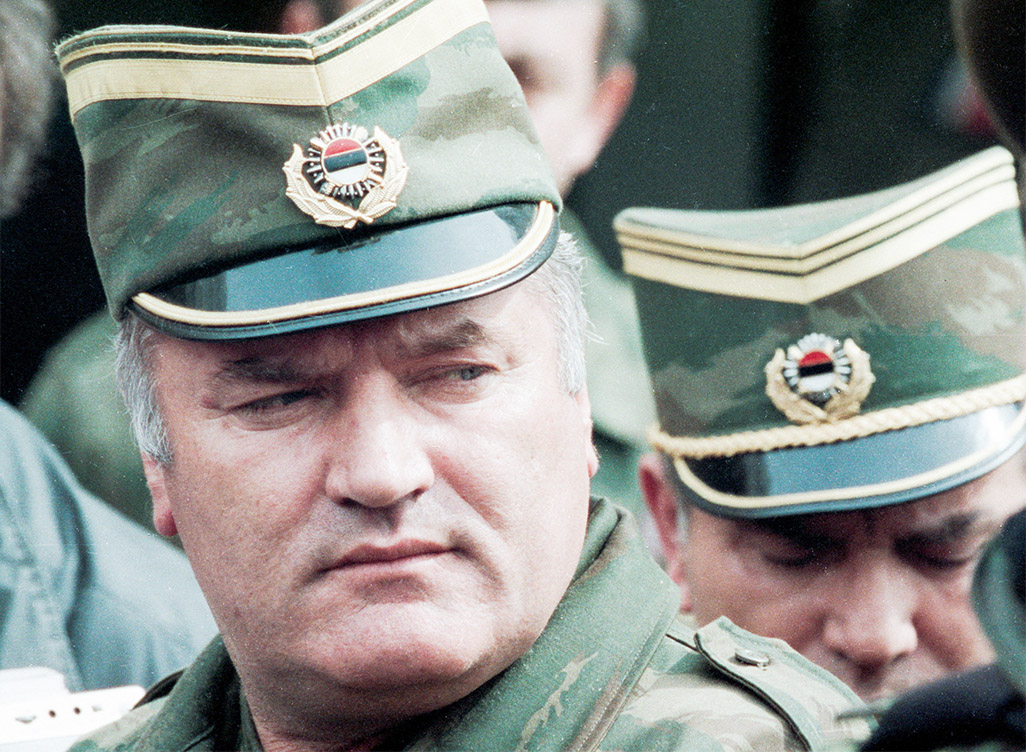
Ratko Mladic, the former Bosnian Serb military commander convicted of genocide over the Srebrenica massacre, will be buried “with the military and state honours he deserves”, Serbian justice minister Nenad Vujic said on Friday.
Mladic, who had been seriously ill for months, died yesterday in The Hague, where he was serving a life sentence for genocide, war crimes and crimes against humanity.
Vujic told local radio station K1 that Serbian officials were awaiting word from authorities in The Hague on when his body would be handed over.
Mladic died days after the International Criminal Tribunal for the former Yugoslavia rejected a request from both his family and the Serbian government to transfer him to a military hospital in Belgrade for treatment.
He was one of three men, alongside former Yugoslav president Slobodan Milosevic and former Bosnian Serb political leader Radovan Karadzic, whose actions defined the descent of the former Yugoslavia into mass slaughter following the fall of communism.
The 1992 to 1995 war in Bosnia killed around 100,000 people and displaced a further 2.2 million.
In Srebrenica, forces under Mladic’s command executed 8,000 Bosnian Muslims who had sought refuge in what was meant to be a UN protected enclave, the worst massacre in Europe since the Second World War.
The prospect of a state funeral has reopened deep wounds from the war, for in Bosnia, politicians and representatives of victims’ organisations have warned that any official glorification of Mladic insults the memory of the dead and undermines the rulings of international courts.
Emir Suljagic, head of the Srebrenica Memorial, said Mladic’s death changed neither the court’s findings nor the historical record, nor the existence of the mass graves.
In Republika Srpska, by contrast, the public held memorial events and lit candles in his honour.
The plan has also caused division within Serbia itself, as Marinika Tepic of the Freedom and Justice Party recalled that Mladic had been finally convicted of extremely serious war crimes, while the Democratic Party said his death could not change facts already examined and judged by international courts.
Croatia’s defence minister Ivan Anusic linked the case to what he described as Serbia’s excessive military buildup, saying Zagreb had already informed its Nato allies of concerns over Belgrade’s rearmament and that the experiences of the 1990s obliged his country to watch Serbia’s current choices closely.
Russia’s Security Council secretary Sergei Shoigu offered condolences to Mladic’s family, called his conviction by the tribunal unjust and described the conditions of his detention as inhumane.
Serbian president Aleksandar Vucic struck a more cautious tone on the funeral’s details, saying that if the family wished for Mladic to be buried in Serbia the state would handle arrangements “in a dignified manner”, while dismissing some reports on the ceremony as “journalistic speculation”.
Mladic’s own wish, according to reports, was to be buried in Belgrade’s Topcider cemetery, beside his daughter Ana, who died in 1994.





Click here to change your cookie preferences