
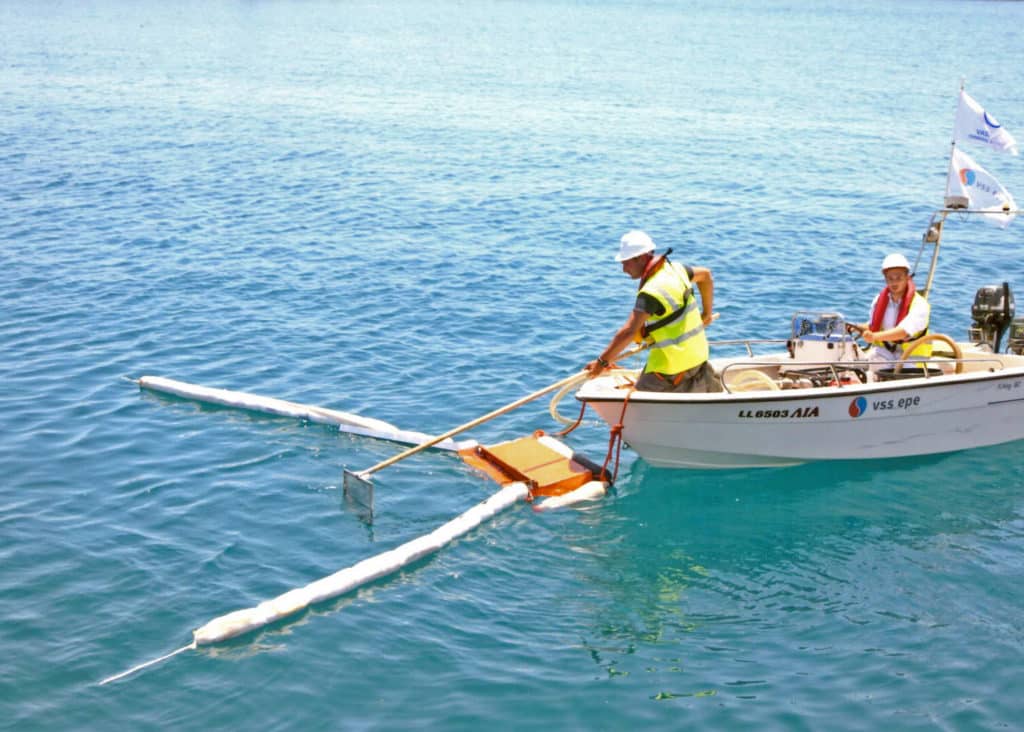
The pollution of the sea off the Limassol coast became an issue of public debate in the last few days. An increasing number of people were complaining about the dirty waters, prompting Deputy Shipping Minister Marina Hadjimanolis, to call a broad meeting on Thursday to establish the causes and decide how to tackle the marine pollution.
The meeting was attended by the mayors of Limassol and Amathus, officials from the Department of the Environment, the Limassol EOA, the fisheries department and the Ports Authority. Despite the big collection of experts, the meeting was reportedly unable to establish the causes of the foam, unpleasant smells, waste and unidentified substances appearing in the Limassol sea, nor was it able to come up with a plan of action. Hadjimanolis mentioned a cabinet decision to establish a coastguard which would contribute to more effective monitoring of Cyprus’ waters, but we doubt this would make any difference.
Many possible sources of pollution were mentioned at Thursday’s meeting, including a discharge pipeline from an under construction high-tower building, fish farms, pleasure boats, ships, rainwater and untreated wastewater. As a first step, the meeting decided that government services would record all possible sources of pollution and each would be dealt with by the relevant authority. The problem, according to Amathous mayor Kyriacos Xydias, was that there we 17 to 18 state services involved in these matters, the implication being that there was systematic passing of the buck. He wanted a platform set on which the responsibility of each state service was listed.
It is apparent that the problem is a result of the ineffective control of the state services. Speaking on a radio show, former leader of the Green Party and former Commissioner for the Environment, Charalambos Theopemptou, did not pull his punches. “It is not possible that for 12 years similar incidents are recorded while the state machinery, becomes active only when there is a new episode.” As regards the possible sources of the pollution, he said he could name eight, but over 12 years, “even if they were numerous they (state services) should have found a way to control them.”
Was there any doubt that this was another failure of our ineffective, responsibility-phobic state services? Too often we blame most things on the politicians, while the civil servants who are paid handsomely to ensure rules and regulations are respected by businesses, avoid any responsibility. But is it the politicians who must ensure that a discharge pipeline from a construction site goes far enough into the sea? Are politicians issuing licences to fish farms and are they responsible for inspecting them? Are the politicians turning a blind eye to the dumping of sewage into the seas just 120 metres from the shoreline instead of 500 metres?
A few weeks ago, the deputy mayor of Moni, Giorgos Evripidou, brought to public attention the dumping of sewage into the sea because the Moni treatment plant did not have the capacity to treat all the sewage delivered. This was because the Vati treatment plant which treats cesspit sewage has been out of operation since 2025. The good news is that Vati could be in operation again next month, but why has it taken so long for it to be repaired and start operating again? We suspect that if Evripidou had not made a big noise and provided evidence of the polluted seas – he commissioned tests of the sea water – the authorities would have carried on ignoring the matter. In the last few weeks, because of the deputy mayor’s public protest, the Environment Department has decided to investigate; as if it does not know what is going on in Moni.
We suspect that without the ordinary people and mayors kicking up a fuss about the pollution of the sea off the Limassol coast the 17 to 18 state services responsible for ensuring businesses and public organisations comply with anti-pollution rules and regulations, would have carried on doing nothing. They may act now, but there must be no easing of the pressure, because they could very easily revert to the do-nothing approach, the only approach highly-paid, indolent civil servants are comfortable with.





Click here to change your cookie preferences