
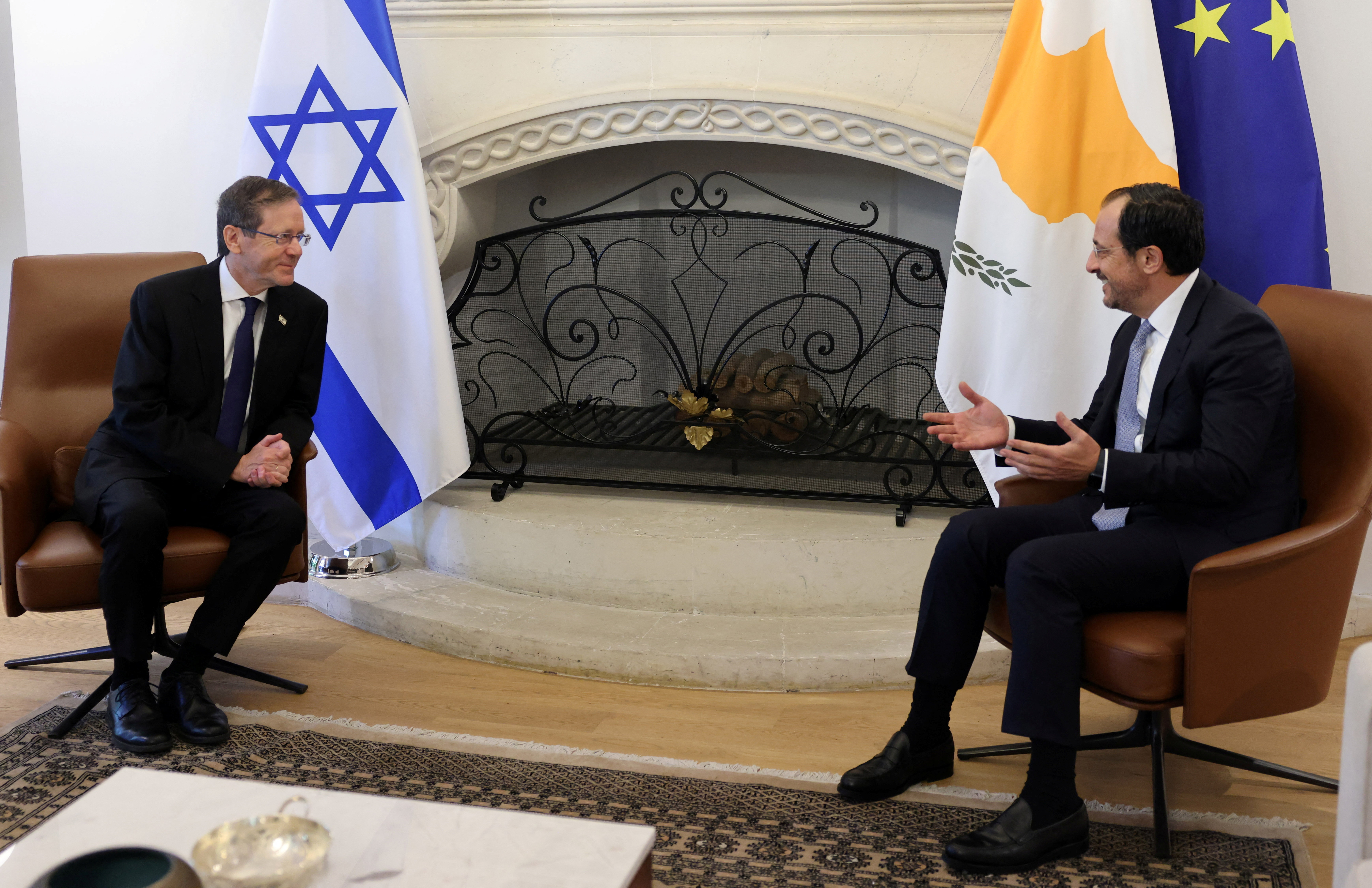
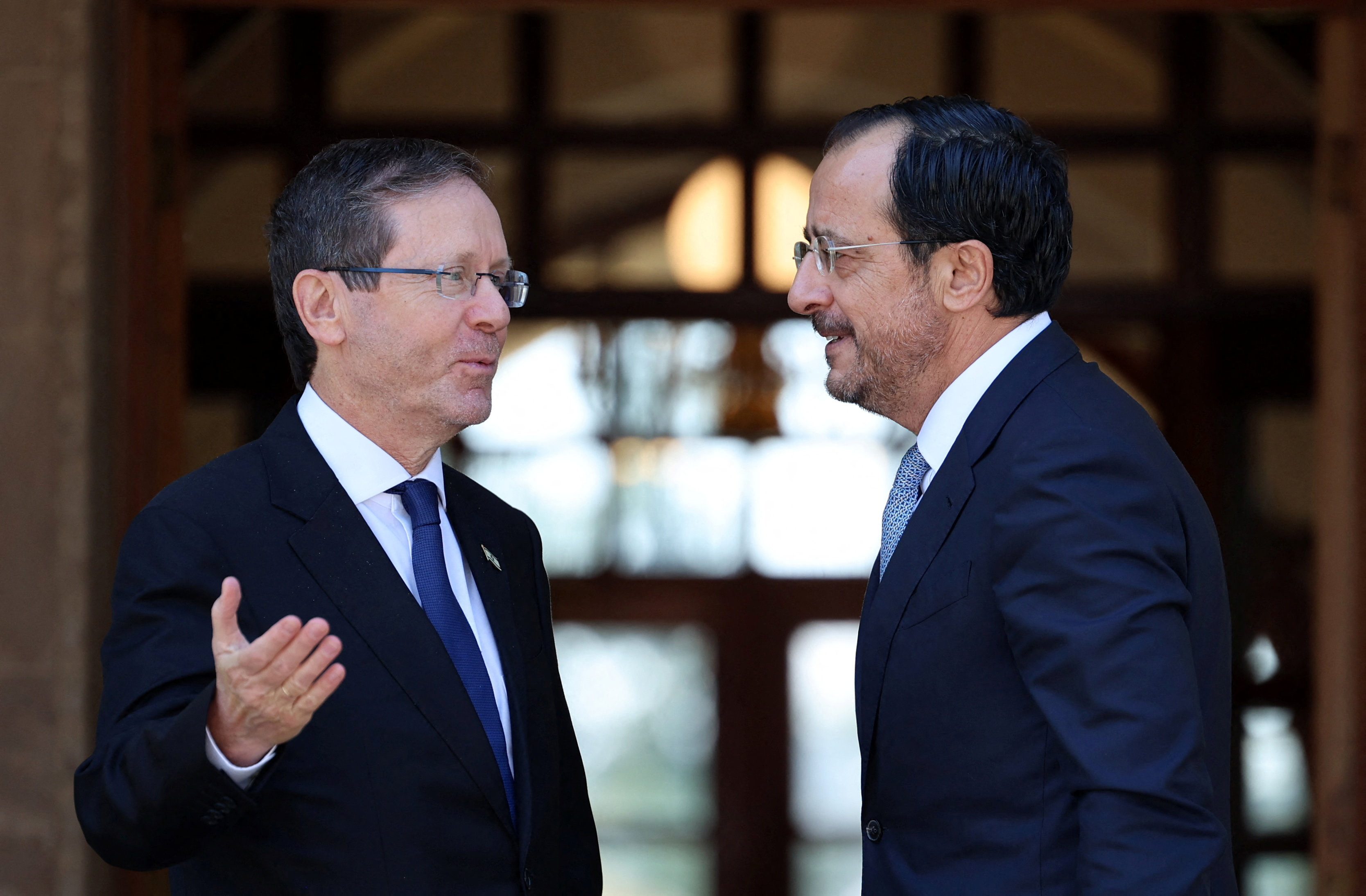
Israeli defence companies are interested in establishing operations in Cyprus to potentially benefit from the European Union’s SAFE defence financing programme, as President Isaac Herzog held talks with President Nikos Christodoulides in Nicosia on Thursday.
The issue was among those discussed during Herzog’s one-day working visit, with the two sides also examining defence cooperation and Cyprus’ plans to acquire additional military equipment from Israel.
Speaking to the Cyprus Mail, Professor Michalis Stavrinos, a former diplomat who lectures in international politics at the European University of Cyprus, said the timing of the Herzog visit was timely “given regional developments and Turkey’s own bolstered presence in the eastern Mediterranean”.
He further remarked upon Cyprus’ cooperation over the Great Sea Interconnector, the European project involving the southern corridor and the indirect security coverage provided by Greece and Israel’s Achilles Shield defence system as indicators of a “strategic alignment” with Israel.
He referred to the recent Mecca joint defence agreement between Turkey, Saudi Arabia and Pakistan, saying Cyprus’ cooperation with Israel could provide a counterbalance to the new regional arrangement, “more so one would say than with Greece alone”.
Cyprus is eligible for up to €1.18 billion in financing under Safe, the EU’s ‘security action for Europe programme’, which is designed to support defence investment by member states.
Cyprus submitted its investment plan last year and the European Investment Bank approved it in January, with the EU subsequently approving the loan agreement.
Under Safe rules, however, an Israeli company establishing a presence in Cyprus would not automatically be granted unhindered access to procurement.
Contractors generally must be established and have their executive management structures in the EU, while companies controlled by third-country entities can be subject to screening or guarantees approved by the host state.
The rules also limit the value of components originating outside the EU to 35 per cent of the estimated component cost.
A source close to the defence industry told the Cyprus Mail that “in many cases if a company is wholly European, they have access to Safe procurements unhindered”, while companies partnered with a non-EU country may enjoy only peripheral access.
The source said the difficulty arose when a company appeared to be an entirely European venture but was backed by foreign capital, making the application of the rules more complicated.
Non-EU companies can participate where the EU has concluded a security and defence partnership with their country.
Israel has already used European industrial partnerships to participate in the continent’s defence market.
Rafael holds a 20 per cent stake in EuroSpike alongside German companies Rheinmetall and Diehl Defence, with the joint venture responsible for marketing and production of Spike missiles in Europe.
More recently, Rafael, the German state of Lower Saxony as well as Israeli-founded Aurelius Capital signed a letter of intent to acquire Volkswagen’s Osnabruck plant, with plans for defence production including components for air defence systems.
On Israel’s interest in using Cyprus as a base for access to Safe, Stavrinos said the practice was in itself not unusual.
“The practice is certainly applied by others,” he said, citing Turkey’s procurement of certain armaments from Italian defence companies through similar ventures.
Israel is already one of Cyprus’ largest suppliers of defence equipment. During Thursday’s discussions, the two sides agreed to remain in contact over the specific equipment Cyprus could acquire under its armament programme, such as the Merkava tanks being discussed as an alternative to Greece’s aging Leopard 1A5 units.
Cyprus has in recent years expanded its defence procurement, including the acquisition of the Barak MX air defence systems and radar platforms from Israel, alongside plans to obtain advanced attack helicopters.
Herzog and Christodoulides also discussed the development of the Aphrodite gas field, as well as the progress on the Great Sea Interconnector (GSI) project.
Israeli officials indicated that the agreement concerning the field was close to completion.
Christodoulides raised a separate issue dating back to 2011 concerning plans for a Cyprus-Israel agreement to avoid double taxation.
Tourism was also discussed, with Christodoulides commending the increase in flights between the two countries, remarking that there was now “more than 200 flights a week between Cyprus and Israel”.
Herzog himself expressed strong personal affection for Cyprus, commenting that he “loved the country…since childhood”, before describing Christodoulides as “a great friend” to Israel and said he appreciated the “dialogue and openness, frankness” between them.
During his opening remarks, Herzog also expressed a personal wish for a future trilateral between the presidents of Cyprus, Israel and Lebanon, saying “my dream is that I wish we could meet with the president of Lebanon, yourself and myself, even here”.
He said such a meeting could help the region move “towards peace”, but the proposal was presented as a wish rather than a comprehensive initiative agreed by the three countries.
The discussions also covered Israeli investors who had been active in properties in the north, with Israel having organised an information campaign domestically against property purchases following the arrest of Simon Aykut.





Click here to change your cookie preferences