
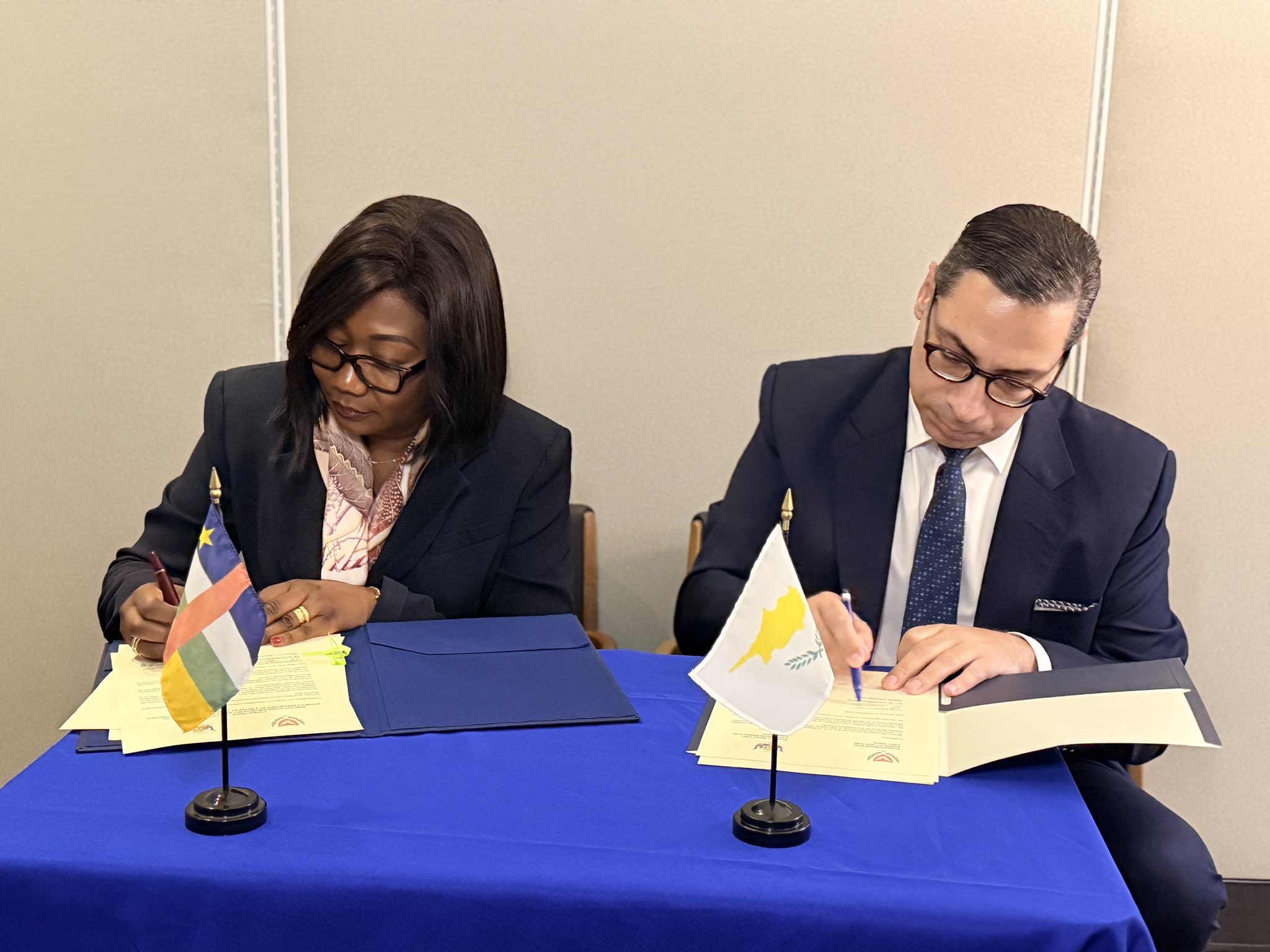
Cyprus and the Central African Republic established diplomatic relations on Monday, with foreign ministers Constantinos Kombos and Sylvie Baipo Temon meeting on the sidelines of the United Nations general assembly in New York,
Kombos said he and Temon had held a “fruitful discussion”, and that he was “delighted to sign the joint communique establishing diplomatic relations”.
He added that he is “looking forward to working together to identify areas of shared interest and opportunities for cooperation” between the two countries.
The Central African Republic borders Chad, Sudan, South Sudan, the Democratic Republic of the Congo, the Republic of the Congo and Cameroon, and is home to around 5.5 million people.
Its capital is the city of Bangui, which lies on the northern bank of the Ubangi River, on the other side of which sits DR Congo.
The territory was initially established in 1903 as Ubangi-Shari, part of French Equatorial Africa, and became autonomous in 1958 after the Movement for the Social Evolution of Black Africa (Mesan) party won every seat in the 1957 territorial election.
Mesan leader Barthelemy Boganda was named the country’s first prime minister, and chose the name Central African Republic for the country, reportedly because he envisaged a larger union of countries in the region.
Boganda was killed in an aeroplane crash in 1959, with French newspaper L’Express reporting traces of explosives had been found in the wreckage. The accident’s cause was never determined.
David Dacko was overthrown twice
Following his death, his cousin David Dacko took control of Mesan and the country, and became the first president of the Central African Republic when it received full independence from France in 1960.
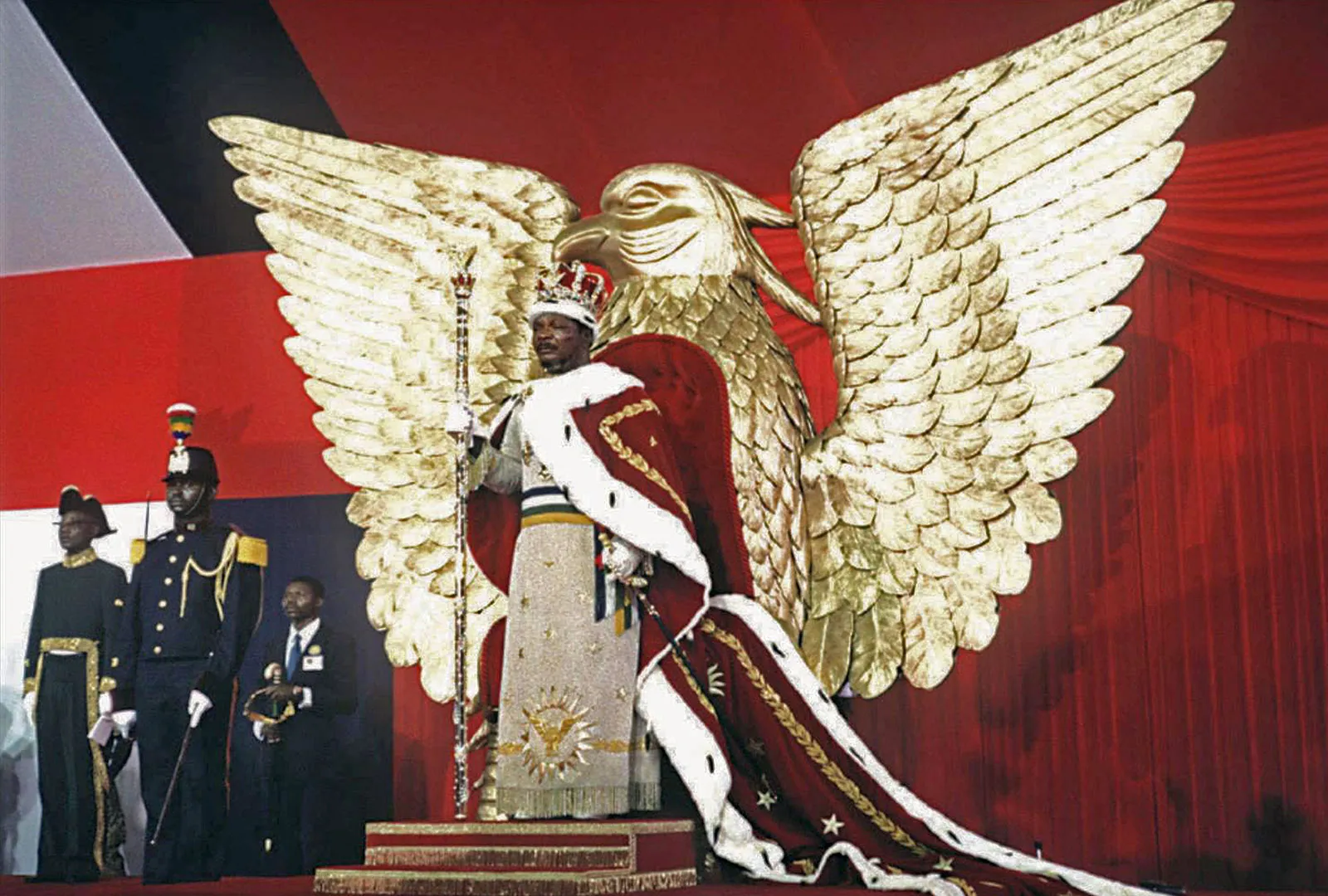
Dacko was then overthrown by a coup d’état in 1965, with colonel Jean-Bedel Bokassa taking control of the country. Bokassa declared himself president for life in 1972, and then Emperor Bokassa I of the Central African Empire in 1976.
He was then overthrown by France in 1979, with Dacko being restored to power, though Dacko was overthrown for a second time in 1981 and replaced by general Andre Kolingba, who ruled with a military junta until 1985, which developed into a hybrid regime in the years which followed.
Free and fair elections were eventually held in 1993, but internal politics remained unstable under democratically elected president Ange-Felix Patasse, who served until he was overthrown by general Francois Bozize in 2003.
Bozize, too, suspended the constitution, but was unable to prevent a bush war from breaking out, though he held onto power until 2013, when armed rebels forced him from power. Bozize was later indicted for crimes against humanity and incitement to genocide.
The country is currently led by Faustin-Archange Touadera, who won the first democratic elections held in the aftermath of the fall of Bozize in 2016.
Touadera is reportedly supported by Russian and Rwandan troops, with the former being made up both of members of Russia’s state-run Africa Corps and independent remnants of the Wagner Group, the private military company formerly led by Yevgeny Prigozhin.
He has long held close ties with Russia, saying during a visit to Moscow in March that “we did hold elections, and Russia made a significant contribution”, and that “Russia made these elections possible by providing security”. Previously, he has described Putin as a “great leader”.
Away from politics, he has a doctorate in mathematics from the Lille University of Science and Technology, and two wives, named Brigitte and Tina.




Click here to change your cookie preferences