

Although the Cypriot economy has proved resilient to external shocks, posting positive growth numbers and low unemployment, it remains vulnerable to latent blind spots, the Fiscal Council said on Thursday.
Presenting the council’s 2026 interim report, its chairman Andreas Charalambous said GDP grew by 3.8 per cent in 2025, with a 3 per cent forecast for this year – “very satisfactory under the circumstances”.
At the same time, the fiscal situation remains on a good trajectory, with a 3.4 per cent budget surplus in 2025, while public debt shrank further to 55 per cent of GDP – under the 60 per cent threshold.
Another plus relates to the joblessness rate, hovering around 4.4 per cent last year, and dropping further to 3.6 per cent during the first half of this year.
The Fiscal Council attributed the economy’s resilience to migration inflows in recent years, as well as to foreign corporations setting up shop in Cyprus. Foreign companies create jobs, generate income and consumption, boosting economic activity while also increasing the export of services.
However, there is a caveat when it comes to migration. Migrants now account for more than 20 per cent – perhaps up to 30 per cent – of the population, and at the same time an ageing population has led to a contraction of the number of people who are of working age.
Therefore, the council said, future growth cannot be modeled on rising employment margins, but rather on higher productivity – where Cyprus does not perform well.
On the minus side, inflation rose considerably in 2026, impacting low-income households disproportionately.
Though most of the inflation is imported, linked to geopolitical events, Charalambous said it also has to do with Cyprus’ weakness in transitioning to ‘green energy’.
“Reliance on conventional forms of energy keeps energy costs high, rendering the economy more susceptible to international crises.”
At the same time, despite solid numbers in the services sector and tourism, the country’s current account is in deficit – chiefly due to reliance on imported fuel, particularly at a time of rising oil prices.
The Fiscal Council drew attention to chronic weaknesses in public finances which, it said, are not always reflected in a snapshot of the economy, but rather become apparent when looking at long-term trends.
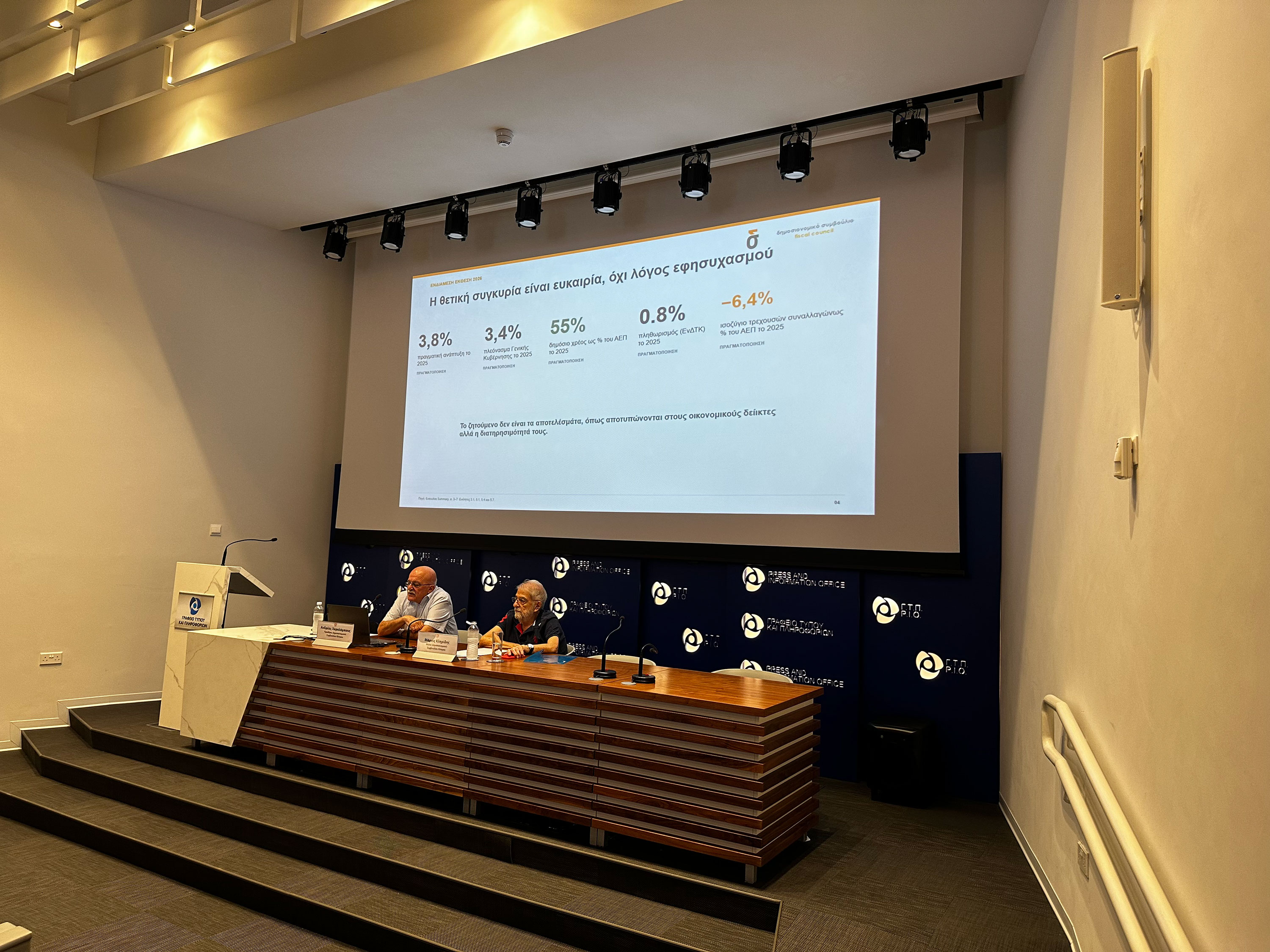
For example, low public investment remains a problem. Despite ‘ambitious’ goals set in the state budget each year, implementation remains low. Indicatively, during the first six months of 2026 implementation of government-backed development projects came to just 25 per cent.
This low performance “demonstrates limited administrative capability, as well as problems in designing and implementing large-scale projects…”
Meantime funds absorption from the Recovery and Resilience Facility remains low, according to an assessment by the University of Cyprus.
Another issue is that most social spending is not adequately targeted.
“Essentially, Guaranteed Minimum Income is the only social expenditure granted according to strict means-testing,” Charalambous commented.
The government should also tread carefully with planned projects such as the electrical interconnection with Greece and Israel, as well as the stalled LNG terminal at Vasiliko. Both these may require significant government outlays, the Fiscal Council warned.
On pension reform, Charalambous noted that today about four working people are funding one pensioner, whereas in the future the ratio could drop to 2:1. This could pose a viability issue for the social insurance fund.
Summarising the report’s “central message”, Charalambous said the current positive fiscal and economic situation gives Cyprus the tools to cope with future challenges, provided that chronic weak spots are dealt with in a timely manner.
If not, these shortcomings could gradually translate into fiscal cost and derail the positive status of the economy.





Click here to change your cookie preferences