
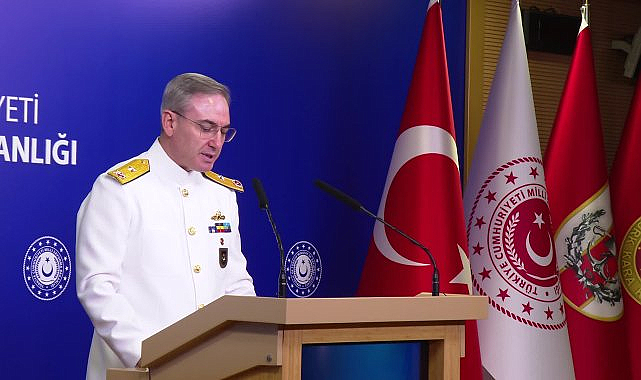
Turkey is “closely monitoring military developments on the island of Cyprus”, the country’s defence ministry’s spokesman Zeki Akturk said on Thursday, offering criticism for the Republic of Cyprus’ efforts to bolster its military prowess in conjunction with other states/
“We reiterate that the Greek Cypriot administration in southern Cyprus’ ongoing armament activities and the military cooperation it is developing with third countries could negatively affect the delicate balance and security environment on the island,” he said.
He added that “such steps do not contribute to building trust between the sides or to peace and stability on the island”.
“The recent claims that the Greek Cypriot administration’s air defence systems do not pose a direct threat to the Turkish Cypriot people and the TRNC cannot justify disregarding the security, legitimate rights, and interests of the Turkish Cypriot people,” he said.
To this end, he added that “our ministry is closely monitoring all developments in the region and taking the necessary precautions”, and that “the Turkish armed forces are also continuing their training and activities without interruption in the international waters and airspace of the Mediterranean”.
“Our country, as a guarantor nation, will continue to take the necessary measures, in cooperation with the TRNC’s authorities, to protect the security, peace, and wellbeing of the Turkish Cypriot people, as it has in the past, and as it will continue to do today and in the future,” he said.
The air defence systems he referenced is the Israeli Barak MX surface-to-air missile system, which is designed to defend against airborne threats including aircraft, helicopters, anti-ship missiles, drones, ballistic missiles, cruise missiles, and combat jets.
It was installed last year, and will be publicly displayed for the first time at Cyprus’ independence day parade next Thursday.
Cyprus, Egypt, Greece agreed to protect energy infrastructure
Additionally, on Wednesday, Cypriot Defence Minister Vasilis Palmas signed a joint statement with his Greek and Egyptian counterparts Nikos Dendias and Ashraf Salem Zaher, pledging to “develop military cooperation and coordination” between the three countries’ armed forces to “enhance security and stability in the eastern Mediterranean region”.
The statement also said that “views converged on the importance of strengthening common frameworks for the protection of supply lines, gas fields, and offshore energy infrastructure in the eastern Mediterranean against various threats, particularly in light of the recent conditions prevailing in the region”.
Promises to protect energy infrastructure come with a dispute brewing between Greece and the Republic of Cyprus and Turkey over the ownership of swathes of the eastern Mediterranean.
This dispute has come to the fore with it expected that in the coming weeks, Greece will issue a navtex to warn ships in the region of planned seabed surveys in the seas between Crete and Cyprus, with that navtex concerning waters which are claimed by both Greece and Turkey.
These conflicting claims have impeded attempts to carry out seabed surveys between Cyprus and Greece before, with Turkish naval vessels being deployed in 2024 after the Italian research vessel the Ievoli Reulme strayed into what Turkey believes to be its own waters.
The naval vessels escorted the research ship away from Turkey, but not before Greece, too, dispatched a number of its own naval vessels, including the frigates the Nikiforos Fokas and the Aittitos, to the area.
Greek Foreign Minister Giorgos Gerapetritis has since indicated that should a similar dispute arise again, Greece would once again be prepared to send warships into the disputed waters should Turkey do the same.
Erhurman warned against involving ‘big brothers’
Away from the matter of the interconnector, Palmas was in December forced to deny that the governments of the Republic of Cyprus, Israel, and Greece were planning to combine to create a military “rapid reaction force”.
“I am telling you that these issues which have such a high level of decisions are made by the political leadership, and as the political head of the defence ministry, I am telling you that no such issue has been raised and we have not discussed any issue,” he said at the time.
Asked whether the idea would be an “unlikely or fantasy scenario”, he said that “even if a meeting were to take place which had different contents, it would be wrong for us to bring some confidential issues to light”.
Earlier this year, Turkish Cypriot leader Tufan Erhurman also offered criticism for the efforts made by the Republic of Cyprus in recent years to bolster its defence capabilities.
He said that a few years ago, he had “sent a message to the Greek Cypriot leadership saying, ‘frankly, I understand what you are trying to do; you think that by arming yourselves and enlisting the support of some major powers, you will create a military balance against the Republic of Turkey’”.
However, he said, such an effort would be “futile” and “impossible to achieve”, while he also warned of “another consequence”.
“If you are dreaming of having your ‘big brothers’ behind you so that you can feel safe, know that in no place will these ‘big brothers’ actually stand behind you. They will get in front of you, and you will be seriously damaged,” he said.





Click here to change your cookie preferences