
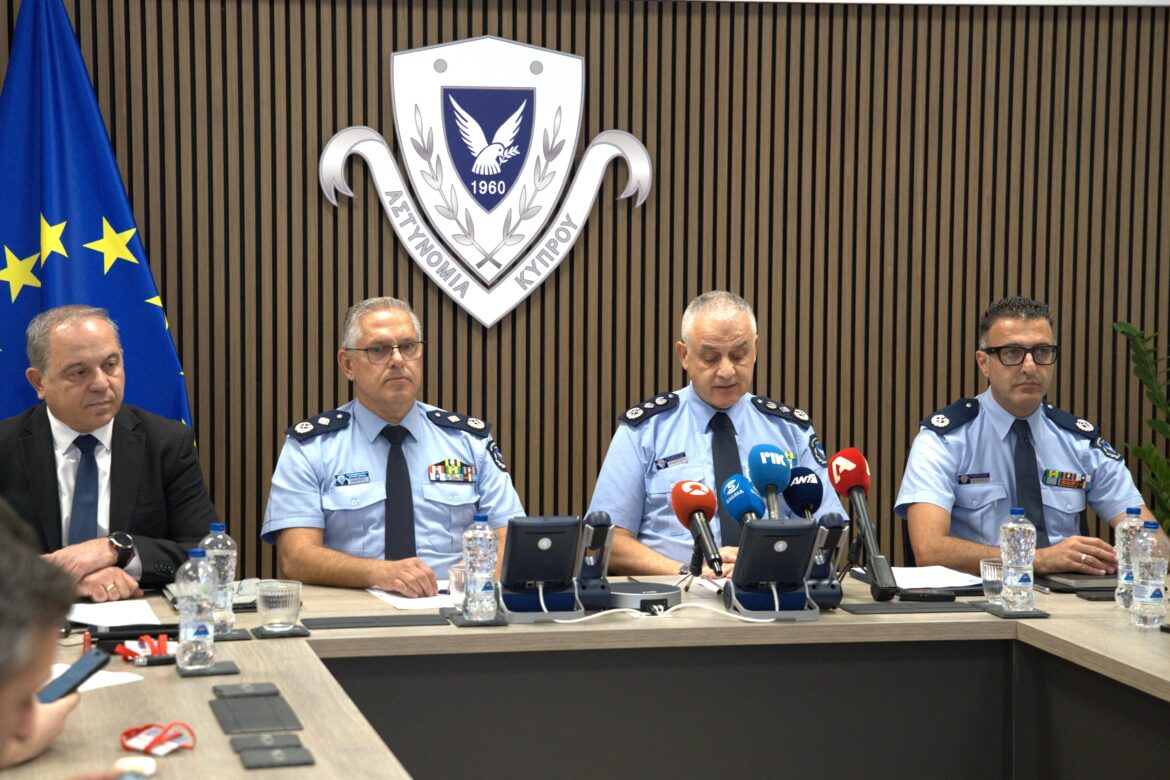
Police said a communications law is essential as they the presented the new Directorate for Combatting Organised Crime, which police chief Themistos Arnaoutis said will officially begin operating on Monday, October 12.
The gap was highlighted as police unveiled on Wednesday the new Directorate for Combating Organised Crime (DAOE) – dubbed a Cyprus FBI – designed to shift the force away from pursuing individual offenders towards dismantling entire criminal networks, their finances and international connections.
Arnaoutis said police were waiting for parliament to approve legislation governing telecommunications interception so that investigators could use the measure legally.
“Interception is an important tool” in carrying out investigations effectively, he said.
“At this stage we do not have this capability.”
While stressing that it was not the only investigative tool available to police, Arnaoutis acknowledged that the inability to intercept telephone communications was “a weak point” in investigations. Police, he said, were attempting to compensate through other investigative means and through cooperation with Europol and foreign law enforcement agencies.
Arnaoutis said the force had repeatedly appeared before the relevant parliamentary committee during the previous House term, together with the government, attorney-general’s office and other state services, to explain the need for the legislation.
“It is now a matter for the political parties in parliament to pass this legislation,” he said. “We need it. We are the only ones who do not have this important tool in our arsenal.”
Asked by the Cyprus Mail about concerns that interception powers introduced to tackle organised crime could ultimately be used against the general public, Arnaoutis pointed to what he described as strict safeguards envisaged under the proposed framework.
Police would need to secure a court order, with the approval of the attorney-general, before intercepting an individual’s communications, he said, while an independent body would oversee the process.
The procedures would also be electronically recorded.
“If you have evidence and you meet the requirements of the law, you proceed. If you do not, you cannot,” he said, rejecting the possibility that police could simply decide to monitor an individual.
It is worth noting that in a recent interview with the Cyprus Mail Justice Minister Costas Fitiris defended the government’s proposed constitutional amendment to Article 17, which would expand the circumstances under which communications data may be accessed during investigations into serious crime.
Arnaoutis described the official launch of the DAOE as one of the most important reforms under the Police 2030 modernisation programme. The directorate has already been operating in practice for several months and police said at least four cases handled under the new structure are now before the courts.
Arnaoutis said its creation reflected a fundamental change in the nature of serious and organised crime and highlighted the fact that criminal groups increasingly operate across borders, exploit technology and legitimate businesses, maintain international connections and engage simultaneously in several different areas of criminal activity.
The objective, he said, must be to dismantle criminal networks and, where possible, prevent their activities before they develop adding that “this reality requires us to change as well”.
DAOE director Christos Andreou said the criminal environment facing police today was significantly different from that of 10 or 15 years ago explaining that criminal organisations now exploit legitimate business structures, technology and encrypted communications while building international networks that allow them to move activities and capital between countries.
Citing the latest European assessment, Andreou said 731 of Europe’s most threatening criminal networks had been identified, while around 85 per cent used legitimate businesses to facilitate or conceal their activities.
“These are not simply statistical figures,” he said, they demonstrated, he added, that authorities were no longer dealing simply with individual criminals.
“And Cyprus is part of this reality.”
The philosophy behind DAOE is consequently broader than pursuing individual suspects as Andreou explained that the international experience showed that criminal organisations were not dismantled by removing one person. They have structures, companies, financial resources and the capacity to adapt.
Police must therefore understand how a network is structured, map relationships between its members, identify its financial mechanisms, interrupt its international connections and deprive it of the economic resources that allow it to continue operating.
Particular importance will be placed on financial investigations. “The real power of a criminal organisation lies to a large extent in its financial gains,” Andreou said.
Illegal profits allow groups to finance new criminal activities, establish infrastructure and regroup even after significant police operations.
“To truly weaken a criminal network, you must also strike at its economic power,” he said.
The directorate brings intelligence gathering and analysis, operational investigations, financial investigations, technology and international cooperation under a common command and set of operational priorities; intelligence-led policing will be central to the model.
The new directorate builds on the existing expertise of the anti-narcotics service Ykan and the police intelligence and information analysis service. Arnaoutis stressed that drugs would no longer be approached as something separate from the wider organised crime picture.
“Drugs are part of organised crime. They are not above organised crime,” he said.
The new structure will have four broad pillars, covering intelligence management and analysis, narcotics, investigations into other forms of organised crime, and strategic analysis and international cooperation, meaning that information will enter a common system be analysed and then directed to the appropriate operational unit.
Europol was described as a particularly important operational partner, not simply as a source of expertise but as part of an active network through which police forces can rapidly connect individuals, intelligence and criminal activities across jurisdictions.
The objective was to hit a criminal network “not only at the point where the criminal activity takes place, but throughout its route and its connections”.





Click here to change your cookie preferences