
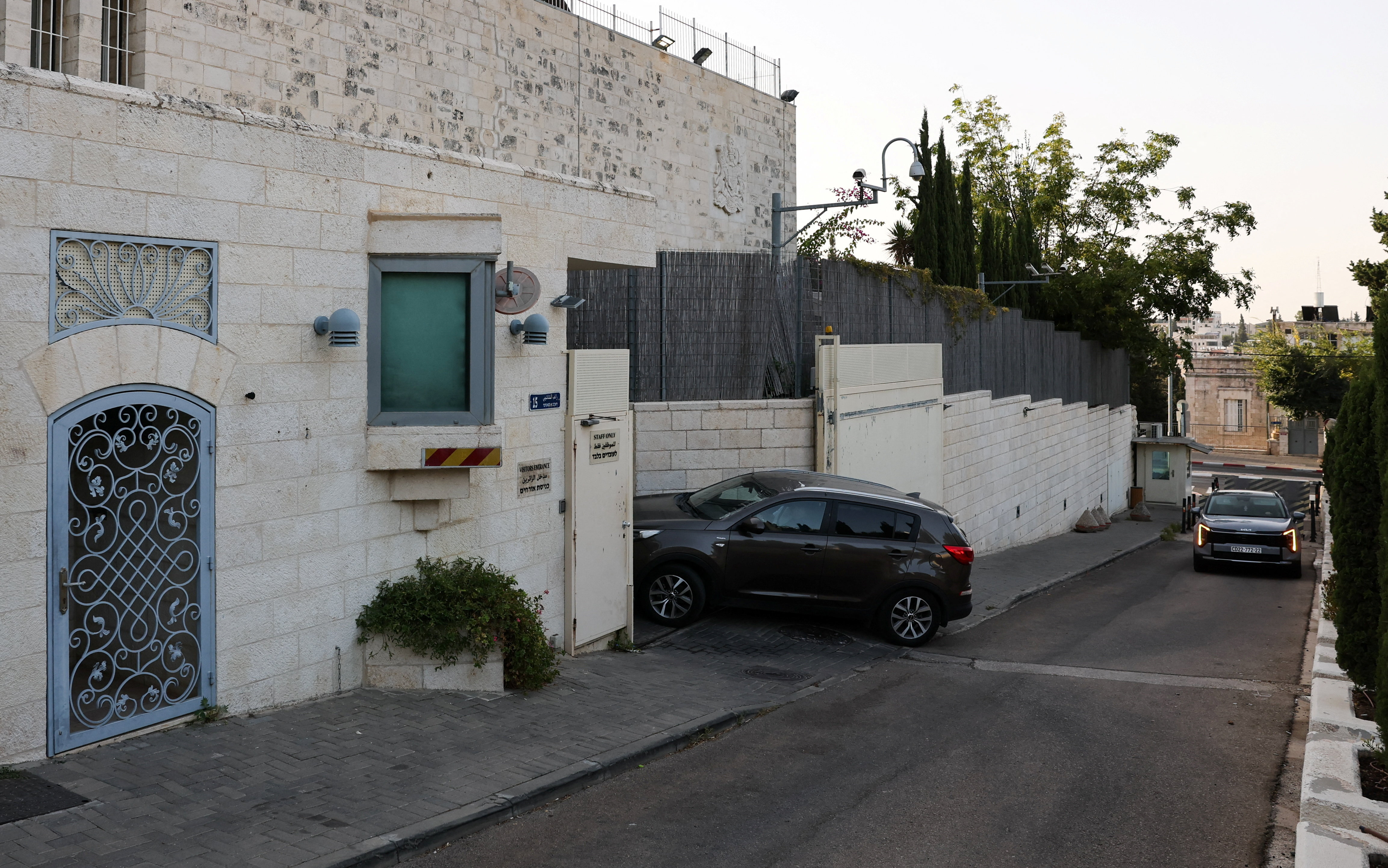
Workers removed signs from Britain's East Jerusalem consulate ahead of an Israeli closure deadline, as a dispute over sanctions on West Bank settlements threatens further diplomatic retaliation.
Britain said on Thursday its nearly 200-year-old consulate in Jerusalem would remain operating at a smaller scale, renamed as the “UK Mission” in the city, after Israel ordered it shut in a dispute over sanctions on settlements.
Israel last month issued a 30-day deadline for Britain to close the consulate after London announced sanctions targeting Israeli settlements in the occupied West Bank, a dispute that has strained relations between the longtime allies. The deadline expired on Thursday.
Gideon Saar, Israel’s foreign minister, said in a statement that the consulate, in East Jerusalem, would formally end operations but that some British diplomats would be allowed to continue work in the building under a deal struck between Israel and Britain.
Saar’s British counterpart, Foreign Secretary Ed Miliband, said his country does not accept that Israel has the legal right to close the consulate. The consulate is in a part of the city Israel captured in a 1967 war, which Israel later annexed in a move that most countries do not recognise.
Miliband said that following discussions with Israel, “our Consulate General building will not be closing, and will be known as the UK Mission, Jerusalem from today.”
Miliband said the UK Mission would continue to “deliver vital services and our work with the Palestinian people.”
What’s happening with Britain’s Jerusalem consulate?
WHY IS THIS HAPPENING AND WHY NOW?
The dispute is over sanctions. Israel’s order for the consulate to shut was retaliation for Britain saying it would impose a ban on the trade of goods made in Israeli settlements.
On September 8, Israel ordered Britain to close the East Jerusalem consulate within 30 days and remove its diplomats from the city. The deadline expired on Thursday, with Britain and Israel announcing a compromise that would keep the facility open.
WHY IS THE CONSULATE IN JERUSALEM, AND WHERE IS THE EMBASSY?
The consulate is located in the Sheikh Jarrah neighbourhood of East Jerusalem and handles Britain’s relations with Palestinians in the city as well as in the occupied West Bank and in the Gaza Strip. It also provides consular services to Palestinians.
The consulate has been in Jerusalem since around 1839, according to the National Library of Israel, when the area was part of the Ottoman Empire and long before Israel’s establishment in 1948.
East Jerusalem is considered occupied territory under international law.
Britain’s embassy in Israel, like most countries’, is in Tel Aviv, which is also home to some government departments. The Israeli prime minister’s office, presidency and parliament are in Jerusalem.
WHY IS JERUSALEM’S STATUS SO COMPLICATED?
Jerusalem has long had a bitterly contested status.
It was under British control under the Mandate for Palestine. That ended around the time of Israel’s creation in 1948.
Under a United Nations resolution, Jerusalem was meant to come under international governance due to its special status in Judaism, Christianity and Islam.
In the event, Arab countries attacked Israel after its establishment, and the 1948 Arab-Israeli war resulted in Israeli control of West Jerusalem and Jordanian control of East Jerusalem, including most of the city’s holy sites.
Israel captured East Jerusalem in the 1967 Six-Day War and annexed it in 1980, coming to control the entire city.
Israel considers the whole of Jerusalem as its capital, but most countries do not recognise that claim and consider East Jerusalem occupied by Israel.
Palestinians want East Jerusalem as the capital of a future state. Decades of negotiations have failed to determine a final status.
WHICH OTHER COUNTRIES HAVE THE BRITISH CONSULAR ARRANGEMENT?
Turkey and several Western countries including France, Belgium, Greece, Italy, Spain and Sweden.
HAS ISRAEL CLOSED ANY OF THEIR CONSULATES?
No. France joined Britain in announcing sanctions, along with Canada, which does not have a consulate in Jerusalem. Israel has not taken action against Paris.
WHAT ABOUT THE UNITED STATES, ISRAEL’S CLOSEST ALLY?
The United States moved its embassy from Tel Aviv and merged it with its consulate in Jerusalem during President Donald Trump’s first term in 2018, the first US administration to make the move.
The US was meant to have moved it by 1999 under a Congressional law, but successive presidents postponed the move on national security grounds, in efforts to avoid scuttling chances for peace between Israel and the Palestinians.
Earlier on Thursday, Reuters journalists saw workers in the consulate remove a plaque reading “British Consulate General” and another sign for its consular section. The British flag was still flying over the building.
Israel last month ordered Britain to close the consulate within 30 days and remove its diplomats from the city, after Britain announced sanctions targeting Israeli settlements in the occupied West Bank, including a trade ban on goods made there.
The United Nations and most countries consider the Israeli settlements to be illegal under international law. Israel disputes this.
Israel has been adamant the consulate will close even as Britain sought to keep it open, including sending the country’s top national security adviser to Israel last week for talks.
Britain’s consulate was founded in 1839, long before the State of Israel was established in 1948. The closure order does not affect Britain’s embassy in Tel Aviv, which handles diplomatic relations with Israel’s government.
The consulate, in the Sheikh Jarrah neighbourhood of East Jerusalem, handles Britain’s relations with Palestinians in Jerusalem, as well as in the West Bank and Gaza. It also provides consular services to Palestinians.
The British sanctions announcement, and Israel’s order to close the consulate, mark a new low in a relationship that has deteriorated over the past three years. Britain has repeatedly criticised Israel over its actions in the war in Gaza and over Israeli settler attacks on Palestinians in the West Bank.
Prime Minister Benjamin Netanyahu’s government, which faces an election later this month, has accused Britain’s governing Labour Party of being hostile towards Israel.




Click here to change your cookie preferences