
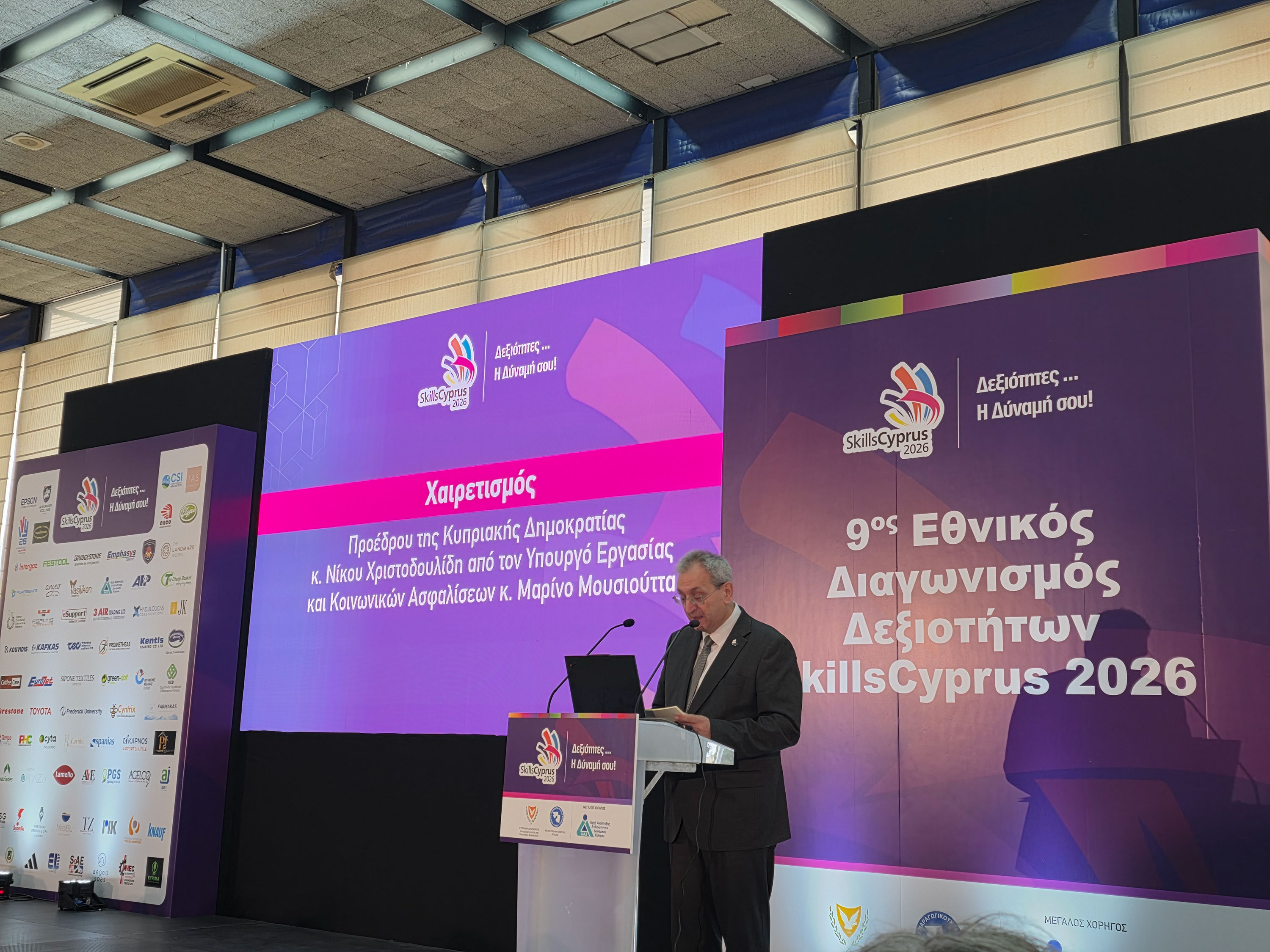
Only 17.9 per cent of secondary education students in Cyprus are enrolled in vocational education programmes, compared with an EU average of 52.4 per cent, President Nikos Christodoulides said on Thursday, highlighting the need to make technical and vocational training more attractive to young people.
In an address at the opening of the ninth National Skills Competition, SkillsCyprus 2026, at the State Fair in Nicosia, read on his behalf by Labour Minister Marinos Mousiouttas, Christodoulides said Cyprus continued to lag behind other EU member states in participation in technical and vocational education.
Citing the European Commission’s latest country-specific recommendations, he said that while Cyprus remained among the EU’s fastest-growing economies, challenges persisted in productivity, innovation and skills development.
The Commission had highlighted the need to address labour shortages and improve employment quality by increasing the participation of vulnerable groups in the labour market and expanding the capacity and attractiveness of vocational education and training.
“Skills competitions aim to contribute precisely in this direction,” Christodoulides said, adding that they helped demonstrate the “excellent prospects for career advancement and professional recognition” offered by technical and vocational fields.
He also referred to the establishment of the Technical Gymnasium, describing it as “an innovation that constitutes a milestone in the Cypriot educational landscape”.
The institution has already expanded since its introduction, he said, demonstrating both the gap created by the previous absence of such a specialised school and the preferences of students.
Christodoulides emphasised the importance of developing digital, green and entrepreneurial skills to prepare young people for the demands of the modern labour market.
Addressing the impact of artificial intelligence, he said technical and vocational occupations involving practical work, judgement, adaptability and problem-solving would not be easily automated.
“Technology will transform many of these jobs, but it will also increase the need for people with modern technical skills who can make use of new tools,” he said.
This, he added, was another reason to encourage young people to seriously consider technical and vocational education as a career path offering meaningful employment prospects.
The president also referred to government reforms, including the introduction of a new system for evaluating teachers and educational work, as well as tax reform, which he said would leave households with more disposable income and support young families and families with university students.
He placed particular emphasis on pension reform, which he said was entering its final stages and had three principal objectives: improving pension adequacy, particularly for low-income pensioners, ensuring fairness in the distribution of contributions and benefits, and safeguarding the system’s sustainability for future generations.
“It is, in essence, a social contract between generations, which we must strengthen today so that we can pass it on securely to our children,” he said.
Christodoulides linked investment in young people’s skills to stronger productivity, competitiveness, economic resilience and social cohesion.
“Internal strength, however, is not built only through numbers and equipment. It is built primarily through people, through the knowledge, skills and talent of our young people,” he said, adding that “every investment in the younger generation is an investment in our country itself”.
Referring to the competition’s international dimension, he said cooperation with European skills development organisations, including those from Greece, Slovenia, Croatia and Poland, reflected the government’s emphasis on international engagement and European cooperation.
Competition expands to 18 skills categories
Cyprus Productivity Centre deputy director Nikos Philippou said this year’s competition had been upgraded, with the number of skills categories increasing from 12 in 2024 to 18 in 2026.
Around 20 interactive “Try a Skill” stations have been established at the venue, allowing visitors to test their abilities in different technical and vocational fields.
The event will also feature presentations by professionals who have distinguished themselves in their respective sectors, while scholarships and prizes have been secured for competitors and visitors.
These include two full scholarships from the School of Automotive Engineering and 15 scholarships worth between €2,000 and €4,000 from Frederick University.
Philippou said the competition was also introducing a volunteering programme for the first time, with approximately 25 volunteers assisting with student tours and interactive activities.
He highlighted Cyprus’ success at the EuroSkills 2025 European competition, where the Cypriot delegation won a bronze medal in the team entrepreneurship competition.
Three-day event at State Fair
SkillsCyprus 2026 runs from October 29 to 31 at the State Fair in Nicosia, with young participants competing across 18 technical and vocational specialisations.
Organised by the Cyprus Productivity Centre, a department of the labour ministry, the competition aims to promote technical and vocational education, showcase young people’s skills and encourage them to pursue vocational careers.
Successful competitors will have the opportunity to join a preparation programme with the prospect of representing Cyprus at EuroSkills 2027, scheduled to take place in Düsseldorf, Germany, from September 22 to 26, 2027.
The competition is open to the public.
The Cyprus News Agency is among the event’s media sponsors.



Click here to change your cookie preferences