
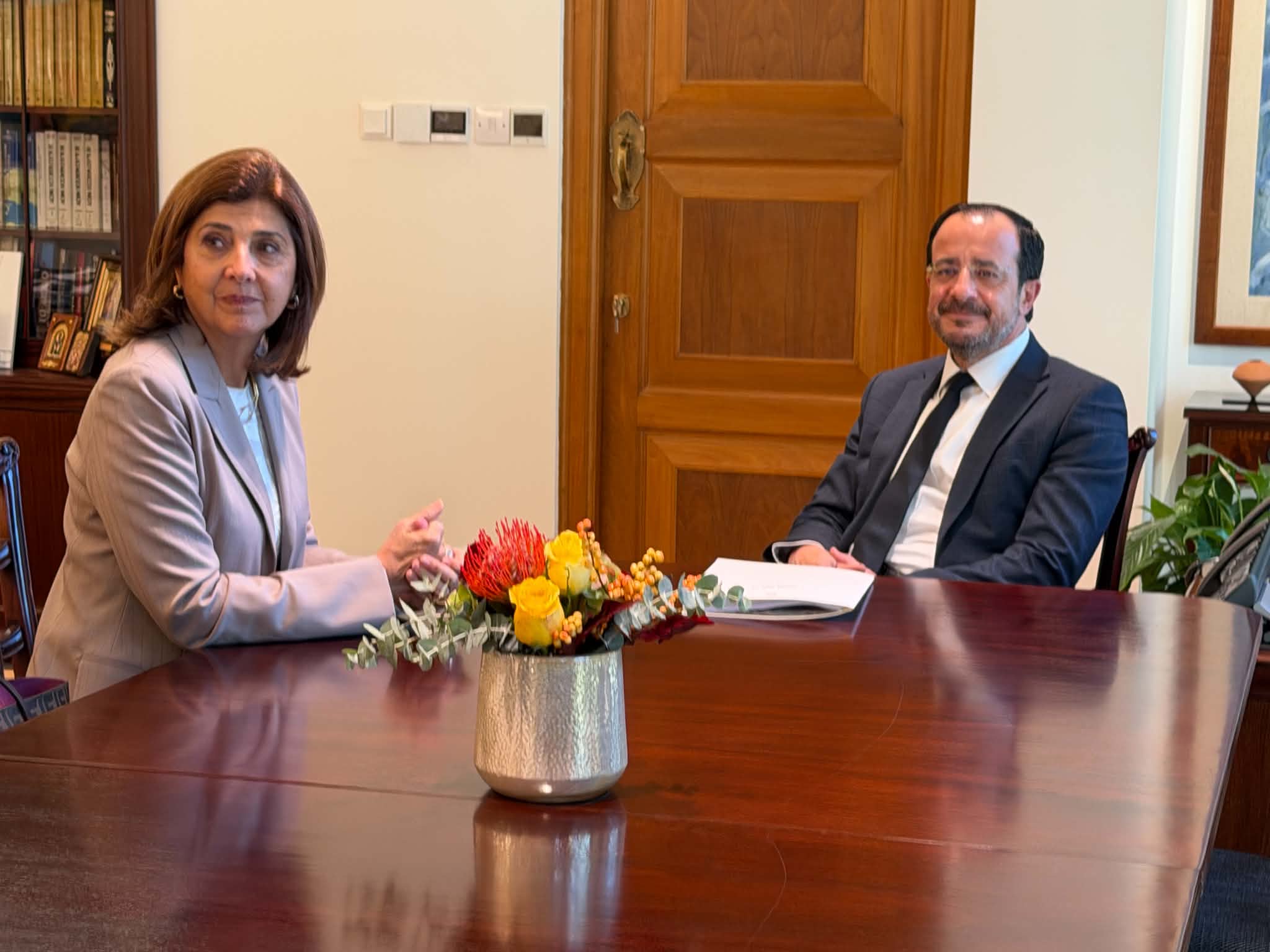
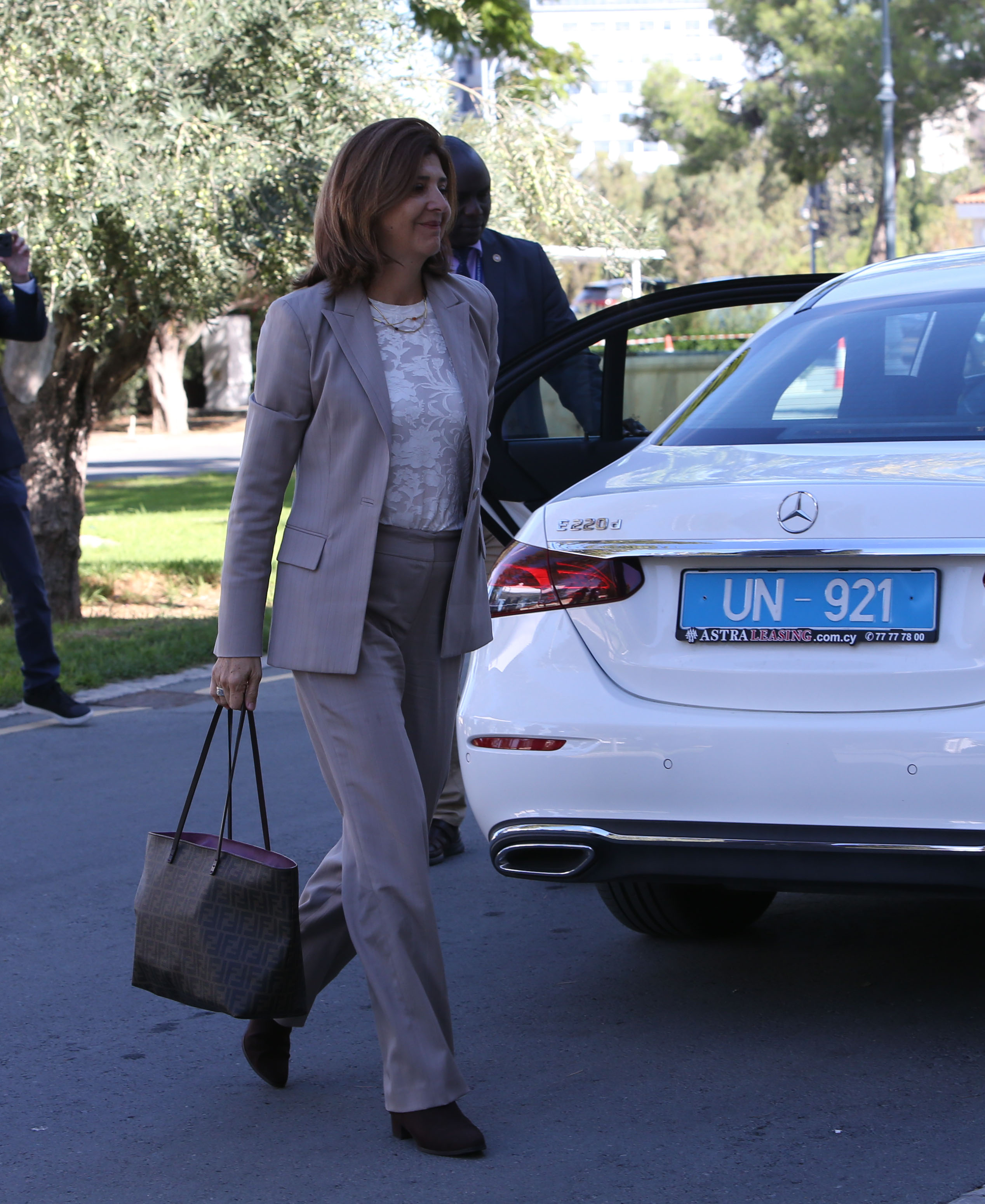
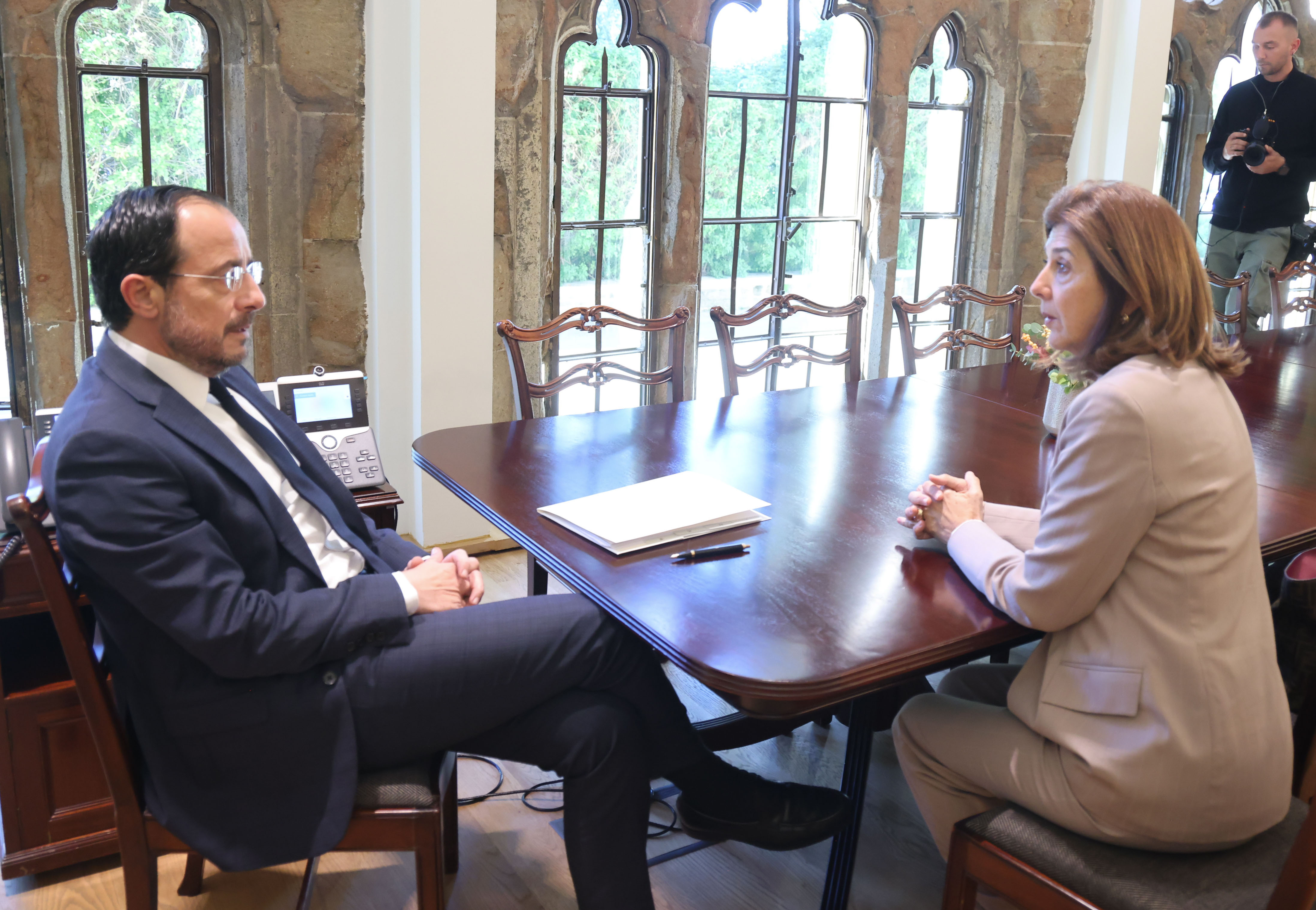
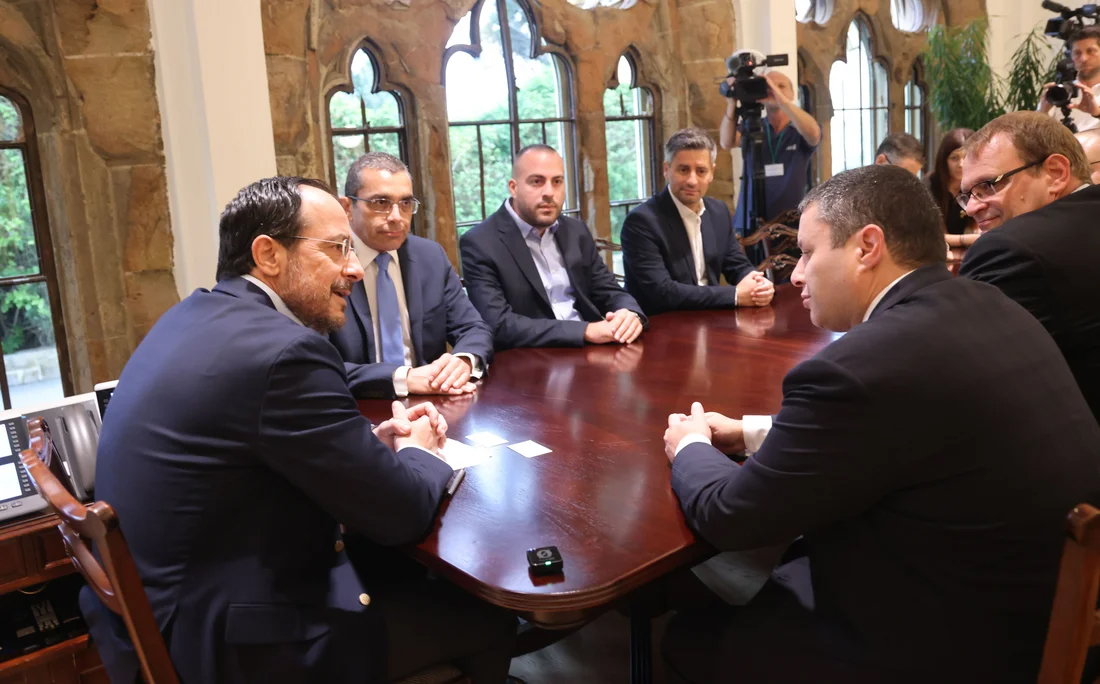
United Nations Cyprus problem envoy Maria Angela Holguin said that she remains optimistic over the prospect of an enlarged meeting on the Cyprus problem being held before the end of the year, after she met President Nikos Christodoulides at the presidential palace.
“Yes, I am optimistic … If there are some advances in the [confidence-building measures], in methodology, and in some substance, and if we can get this, we are going to have the 5+1,” she said, with the term “5+1” used to describe an enlarged meeting involving the island’s two sides, its three guarantor powers, Greece, Turkey, and the United Kingdom, and the UN.
Regarding Friday’s meeting and her planned meeting with Turkish Cypriot leader Tufan Erhurman, she said that “we are pushing and continue pushing”, and that “this is what the secretary-general asked of me, is until the last minute of his mandate, he wants to see if we can move forward on the Cyprus issue”.
Incumbent UN Secretary-General Antonio Guterres will leave office at the end of the year, with it still not yet clear who will replace him. It was Guterres who had first that enlarged meeting will only be achieved “after adequate progress” is achieved on confidence-building measures, the meeting’s methodology and the substance of the talks.
Holguin on Friday made no reference to efforts to choose Guterres’ successor, focusing instead on the content of her meeting with Christodoulides, which she described as “good”, before saying that she had wished to “listen from Christodoulides about his meetings with Tufan”, which have been taking place on a weekly basis since the summer.
Of those weekly meetings of Cyprus’ two leaders, she said that “I think it has been very good that they have these kinds of meetings together and I would still hope to see if we can [achieve] something”.
“We are going to have a trilateral meeting on November 9 and … I am here, I am an optimist, and I hope we can get something next week,” she said.
Leaders took vow of silence on Cyprus problem after Tuesday
The two leaders most recently met on Tuesday, and said after that meeting that both he and Erhurman had “agreed not to make further statements regarding specific issues” related to the Cyprus problem until Holguin’s arrival at the earliest.
Both men had also met the bicommunal technical committees on cultural heritage and on youth, as well as the civil society steering committee, following their one-on-one meeting.
Of those meetings, Christodoulides said that they were “constructive” and that “various views and suggestions were put forward” by committee members.
He added that those suggestions will be discussed by himself and Erhurman going forward.
Christodoulides insists Varosha proposal is ‘mutually beneficial’
Prior to Tuesday’s meeting, Christodoulides had stressed that his proposal to open and repopulate the fenced-off area of Varosha under the United Nations’ administration and open the port of Famagusta under the European Union’s control is “mutually beneficial”.
“I believe this is a mutually beneficial proposal. It creates a positive situation for both sides and serves as a practical test of whether we are truly committed to moving forward, specifically by taking bold confidence-building measures which also send a strong message to society as a whole,” he said.
Erhurman had said last week that he had rejected the proposal, lamenting that it fell short of an entry into force of the European Union’s direct trade regulation.
“Is this the entry into force of the direct trade regulation? No, it is not the entry into force of the regulation, but since [the port] would be under EU control, direct trade would begin,” he said.
As such, he said, the proposal was unbalanced.
The direct trade regulation is a pending EU regulation which would allow Turkish Cypriot goods, as certified by the Turkish Cypriot chamber of commerce, to be exported directly into Europe via the Green Line, and given preferential treatment inside the European single market as European goods.
It was proposed in July 2004, three months after the rejection of the Annan plan to reunify Cyprus by the Greek Cypriot side in a referendum, and shortly after the Republic of Cyprus’ accession to the EU.
Menelaou had cited progress on crossing points
Previously, Greek Cypriot chief negotiator Menelaos Menelaou had said that a dispute over the routing of the planned transit road between Athienou and the Nicosia suburb of Aglandjia “has been overcome”.
He said that the outstanding dispute now remains over the question of whether a planned crossing point to connect Louroujina, the southernmost Turkish Cypriot village, with nearby Lymbia, will open at the same time.
The Turkish Cypriot side’s position is that the road between Athienou and Aglandjia constitutes two crossing points, one in Athienou and one in Aglandjia, and that they are part of a package of four alongside plans for a crossing point in the eastern Nicosia suburb of Mia Milia, and one in Louroujina.
However, the Greek Cypriot side treats the road between Athienou and Aglandjia as one crossing point, counterweighted by the Mia Milia crossing point, and is therefore of the view that the Louroujina crossing point should only be opened if a second transit road, through the Turkish Cypriot Kokkina exclave in the Tillyria region, also be opened.
Click here to change your cookie preferences