
By Paul Lambis
It started out as a lavish affair. Celebrities turned up to the red carpet, dressed to the nines, embracing the return of Hollywood’s most anticipated event with sparkling gowns and over-the-top silhouettes; photographers with their incessantly flashing light bulbs screamed at a deafening pitch, capturing for all eternity the stars’ nervous but confident smiles, awkward waves and amusing poses.
As a cinephile, I make it a point to view most of the critically acclaimed films nominated for the Academy Awards before the ceremony, so that I can formulate my own opinions on the acting, directing, screenplay, set and costume design, and the overall film itself. After all, film is an artistic medium in which the viewer is exposed to a variety of concepts and feelings; one person’s masterpiece is another’s disaster.
One of my personal favourites in the Best Actor category was undoubtedly Will Smith. His towering performance in the biopic King Richard as Richard Williams, the father of Venus and Serena Williams, made Smith the widespread favourite to win this year’s Oscar.
As one of the most successful actors of his generation, with a string of blockbusters under his belt, Will Smith’s performance in 2001 as boxing legend Muhammed Ali in the biographical sports drama, Ali, made him Oscar-worthy material. Five years later, Will Smith’s heart wrenching performance as talented but struggling salesman Chris Gardner in The Pursuit of Happyness, earned Smith the second of his three career Oscar nominations, and remains one of his best reviewed films.
Having the skill of being professionally consistent as a critically acclaimed actor in Hollywood is no easy task. Will Smith continued to research the right ingredients that would ensure his longevity in America’s land of cinematic dreams, shifting away from high-profile blockbusters to riskier projects, finding more danger in his artistic choices.
However, life is a series of peaks and valleys, and it was only a matter of time until Smith had to face the fact that he was a mere mortal, not a Hollywood deity.
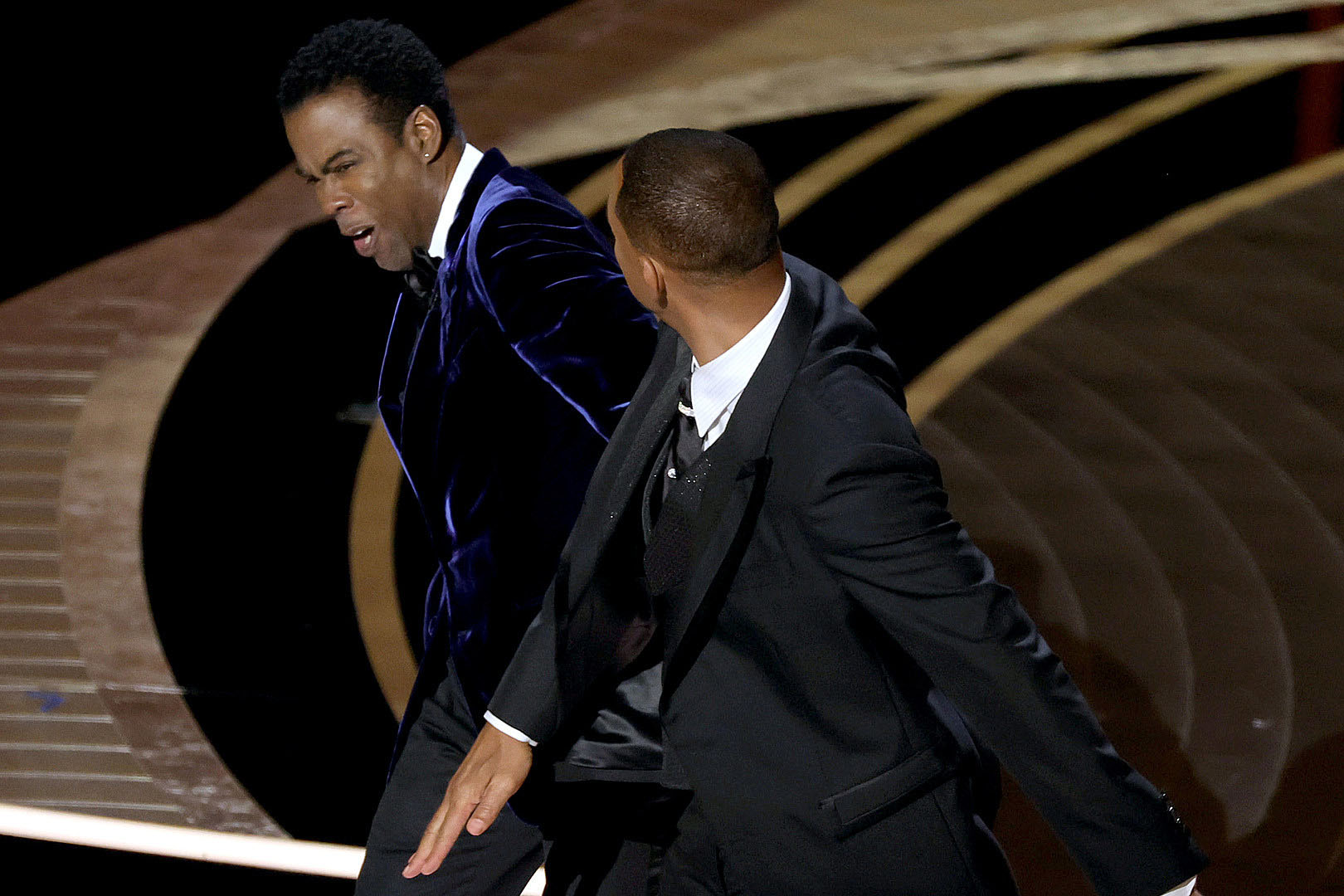
At last Sunday night’s Oscar ceremony, Will Smith stunned the audience when he stormed the stage and slapped presenter Chris Rock in the face after the comedian made a joke about Smith’s wife, actress Jada Pinkett Smith.
Rock took to the stage at the Academy Awards to present the prize for best documentary. He began by making jokes about audience members, including Pinkett Smith, whom he dubbed “G.I. Jane” due to her short hair. Pinkett Smith has previously spoken about her struggle with alopecia, an autoimmune disease that causes hair loss. Shortly after Rock’s joke, Smith came to the stage and slapped the comedian across the face, then proceeded to curse him out on live television.
Although Smith did not formally apologise to Chris Rock when he won the award for Best Actor on the night, he did so the following evening on social media, confessing that he was “embarrassed by his actions” and that they were not representative of the man he aspires to be. His apologies came as the academy, a major Hollywood union, and others chastised him for his behaviour, which surprised the world and cast a pall over the Oscars.
The altercation soon turned into fodder for meme makers, becoming the most talked-about moment of the Oscars. Could the slap be interpreted as a symbol of Hollywood’s double standards, a model of toxic masculinity, and, to some extent, a justification for Smith’s actions? Is it possible for an act of violence to appear normal and acceptable, especially when it takes place in front of a large crowd and broadcast across the world?
If Will Smith had not played out his interpretation of chivalry, the focus would have been on Chris Rock’s bad sense of humour, as well as the fact that insulting someone for a physical condition over which they have no control is inappropriate. Chris Rock would have had to make amends as a result.
Will Smith’s actions were condemned by the academy, which launched a formal investigation into the incident, looking into additional action and consequences in accordance with their standards of conduct.
However, this is Hollywood, and Will Smith is a popular celebrity who the public admires for his vulnerabilities. And when someone is liked, their actions are justified. After using his teary acceptance speech to defend his behaviour as an act of spousal devotion, and publicly apologising to Chris Rock on Instagram the following evening, the academy will more than likely slap Will Smith on the wrist, and it will be back to business in the land of glitz and glamour.




Click here to change your cookie preferences