
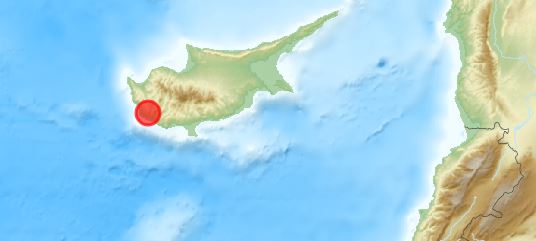
Seismic activity in and around Cyprus is “expected to ease” after the two strong earthquakes which struck near Paphos on Wednesday, geological survey department director Christodoulos Hadjigeorgiou said on Thursday.
He described Wednesday’s quakes as “intense” and unprecedented” while speaking to the Cyprus News Agency, and compared them to the two deadly earthquakes which struck in southeastern Turkey in 2023.
After the two earthquakes, he said, “there was then milder seismic activity until 9.30pm on Wednesday night, while on Thursday morning, two new earthquakes were recorded in the wider area”.
He added that the geological survey department is “on alert” and “monitoring seismic activity”, and said that while seismic activity in the region is “expected to ease”, people “should be vigilant and react with calmness, and not with panic”.
The first earthquake struck shortly after 11.30am on Wednesday, and measured 5.3 on the Richter scale, with its epicentre in the Paphos district village of Ayia Marina.
While no serious structural damage was recorded, people were seen exiting office buildings and homes as a precaution in the aftermath of the quake, with Ayia Marina mukhtar Marios Stylianou confirming that the epicentre village had escaped unscathed, and that its elderly residents are “well”.
The second earthquake also measured 5.3 on the Richter scale and struck shortly after 4.30pm.
Hadjigeorgiou had said on Wednesday that the second major earthquake had been “slightly weaker” than the first, though he did stress that there had been “a series” of smaller tremors throughout the day, and that the phenomenon “needs to be studied”.
According to the Euro-Mediterranean seismological centre, more than 30 tremors were detected in Cyprus throughout Wednesday, two of which had magnitudes between four and five on the Richter scale.
While the earthquakes were felt across the island, civil defence spokesman Panayiotis Liasides confirmed during an appearance on television channel Alpha that there had been “no reports of serious damage or injuries”, and that there had been “small landslides but nothing serious”.
Meanwhile, Greece’s earthquake planning and protection organisation chief Efthymios Lekkas urged caution in the next 48 hours “because the nature of the faults is not always known”.
“We know that faults exist and intersect the terrestrial space. However, we do not know the faults which are located in the underwater space and how these faults are connected to one another,” he said.
He also said that the boundary of the African and Anatolian tectonic plates and the “Cyprus Arc”, a curved plate boundary to the south of the island where the African plate subducts under the Anatolian plate, “can cause a noticeable earthquake”, potentially measuring as high as eight on the Richter scale.
“According to historical data, we may have an earthquake measuring eight on the Richter scale, but this is a very, very extreme case. In 365 AD, there was a magnitude eight earthquake in Kourion, near Limassol, where southern Cyprus was completely destroyed,” he said.
Despite this, he said, smaller earthquakes are more likely, with the 1996 Paphos earthquake, which measured 6.8 on the Richter scale, appearing more likely to be repeated.
In the 1996 earthquake, two people were killed by secondary causes, while in an earthquake of similar magnitude – 6.6 – in 2022, a total of 1,586 chickens were killed in the Paphos district village of Kallepia after panic among the flock induced a stampede.





Click here to change your cookie preferences