
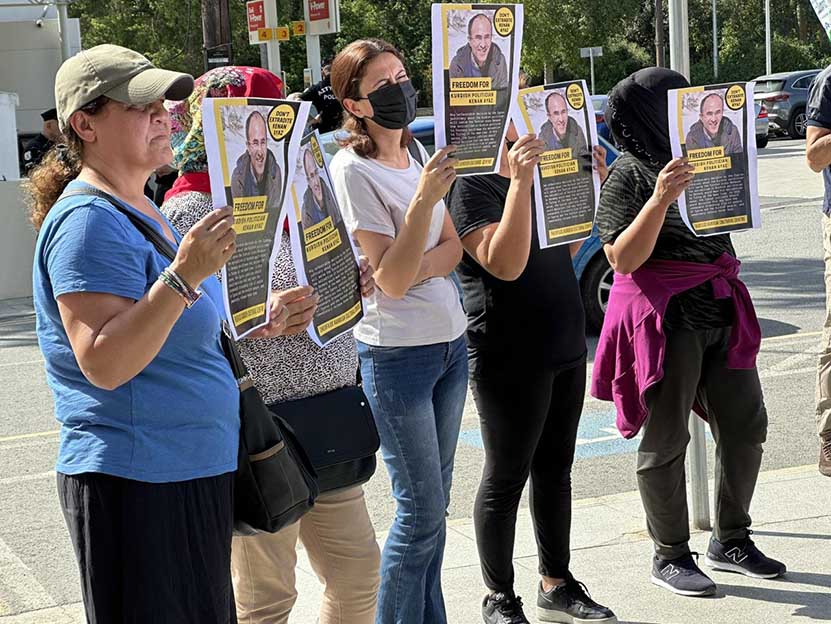
President Nikos Christodoulides has approved the release from prison of Kurdish activist Kenan Ayaz, concluding nearly three years of detention linked to his extradition and conviction in Germany.
The release followed sustained public pressure and was confirmed in a statement issued by the Kenan Ayaz trial observatory on Monday.
Ayaz was freed around four months before his expected release date, after serving two-thirds of his sentence.
The observatory heralded Ayaz’s release as a coordinated achievement through “the combined efforts of his defence team and solidarity groups in Cyprus and Germany”.
The group confirmed that his residence permit had been arranged by the Deputy migration ministry and that his political refugee status had been renewed.
According to local media sources, the release request was signed by the president on Friday.
Ayaz, who had returned to Cyprus in 2025 to serve the remainder of his sentence, is expected to be freed following the completion of the relevant administrative procedures.
Ayaz was arrested at Larnaca airport in March 2023 after Germany issued a European arrest warrant against him.
He was extradited later that year and, in September 2024, a German court sentenced him to four years and three months in prison for alleged membership of the Kurdistan Workers’ Party (PKK), a charge he has consistently denied.
Rights groups and supporters have described the prosecution as politically motivated, stressing that the conviction was not based on acts of violence.
Ayaz was detained in Germany for more than two years before being transferred back to Cyprus to serve the remaining part of his sentence after German authorities agreed to its recognition by the Cypriot courts.
“Every day that Kenan Ayaz remains in prison places a moral burden on the Republic,” observatory representatives said during a press conference in Nicosia last year, warning that continued detention risked legitimising what they described as political persecution.
Ayaz’s lawyer, Efstathios Efstathiou, has said the German conviction rested largely on his client’s participation in peaceful demonstrations and cultural events.
“There is no allegation of violence or involvement in criminal activity,” he said, adding that such activities were protected by the European convention on human rights.
Efstathiou confirmed that an appeal against the conviction was lodged with the European court of human rights in October 2025, describing the case as “a politically motivated prosecution”.
Akel MP Giorgos Koukoumas described the case as “outrageous”, saying the Cyprus should not have executed the European arrest warrant.
“EU member states are obliged to refuse such warrants where there is a risk of persecution on political grounds,” he said.
Former Ecologists leader George Perdikis similarly called for Ayaz’s immediate release, arguing that Cyprus had sent him to face trial abroad despite the absence of any offence under domestic law.
Ayaz had lived in Cyprus for more than a decade before his arrest, having been granted refugee status after earlier periods of detention in Turkey.
Supporters have frequently pointed to his public statements linking the Kurdish struggle with what he described as Cyprus’ “own experience of division and occupation”.
“He returned to continue his struggle for a world without oppression and occupation,” it said, describing his detention in Germany as involving harsh conditions.
The PKK has been listed as a terrorist organisation in the European Union since 2002, a designation repeatedly upheld by European courts.
Turkey has long considered the group a major security threat.
In 2025, however, the PKK announced it would lay down its arms and end its armed campaign, a move welcomed by international actors as a step towards de-escalation.
President Christodoulides’ decision to approve the release request was welcomed by campaigners as a corrective step.
Ayaz has not yet made a public statement since his release.
His legal challenge to the German conviction remains pending before the European court of human rights.




Click here to change your cookie preferences