

Recent technical signals surrounding Dogecoin have hinted at a potential price decline, with the asset still trading 88% below its all-time peak. At the same time, decentralized finance project Mutuum Finance (MUTM) continues to advance development of its lending protocol, expanding features and testing its ecosystem as it moves forward with its roadmap.
Dogecoin tests $0.088 support as bearish signals grow
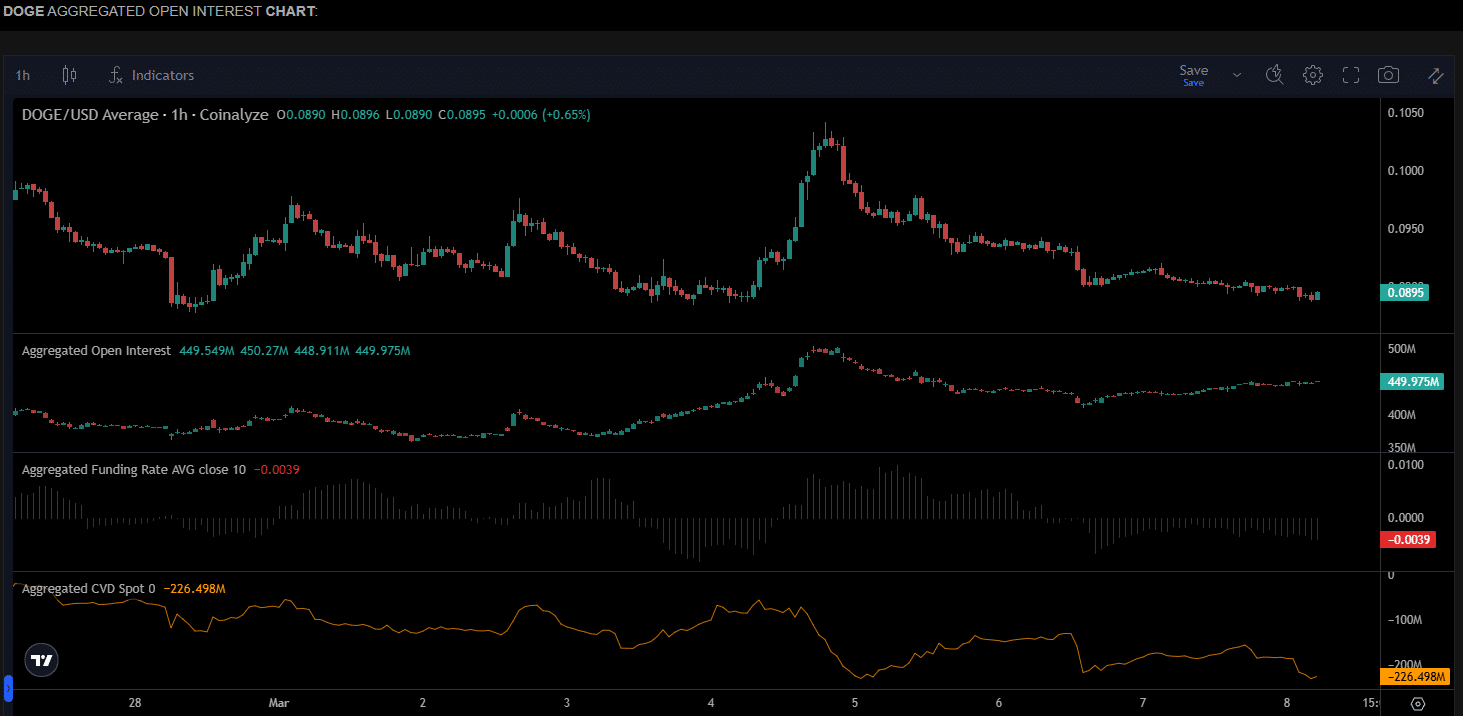
Dogecoin is facing pressure after failing twice to break the $0.10 resistance level since late February. The token slipped 1.24% in the past 24 hours, while Open Interest rose 4.6%, suggesting traders expect further movement. Several indicators point to weakening momentum. The Funding Rate has remained negative since March 6, On-Balance Volume (OBV) continues to decline, and the RSI is still below the neutral 50 level. Fibonacci levels, on the other hand, highlight $0.117, $0.109, and $0.103 as strong resistance zones. DOGE is now testing the $0.088 support level. If this level breaks, the price could move lower, especially if the broader market led by Bitcoin remains weak.
Mutuum Finance ecosystem
Mutuum Finance (MUTM) is a decentralized protocol built on the Ethereum network that generates returns through lending and borrowing. The platform operates in a non-custodial way, meaning users keep full control of their assets while using the protocol. The project has raised over $20.78 million in funding, while holders of its utility token, MUTM, approach 19,100. MUTM is valued at $0.04.
Passive income
Mutuum Finance allows non-custodial lending through its Peer-to-Contract (P2C) and Peer-to-Peer (P2P) lending models. P2C lending allows users to deposit assets into liquidity pools that borrowers can access, with interest rates determined by pool utilization. In contrast, P2P lending enables direct agreements between lenders and borrowers.
P2C lending allows users to generate passive income through mtTokens. When assets are deposited into the protocol’s pools, users receive mtTokens that represent and track their position. For example, if someone deposits $8,000 in LINK, they would receive $8,000 worth of mtLINK. The mtTokens (mtLINK) are interest-bearing receipts that gradually increase in redeemable value based on borrowing demand in the pool. If the pool averages around 8% APY, the mtLINK could be redeemed for $8,640 after one year, representing about $640 in passive income.
Users can withdraw their funds at any time, including both their original deposit and the interest earned. The actual APY changes depending on borrowing demand within each pool. Higher demand for liquidity pushes interest rates up for lenders, while lower demand reduces rates but leaves more capital available for borrowers.
Mutuum Finance offers staking dividends distributed to users who stake mtTokens in the protocol’s safety module. These dividends are paid in MUTM tokens, which are acquired through a buyback-and-redistribute mechanism. A portion of the protocol’s revenue is used to purchase MUTM tokens on the open market, which are then distributed to the stakers.
Development progress
With the V1 Protocol already running on the Sepolia testnet, Mutuum Finance continues to follow its development roadmap, which is now in Phase 3: Finalizing Mutuum. V1 protocol enables public testing of key features, including liquidity pools, mtTokens, debt tokens, and an automated Liquidator Bot. Toward the end of Phase 2: Building Mutuum, Halborn Security conducted an independent audit of the protocol’s lending and borrowing smart contracts before the testnet rollout.
Dogecoin is showing signs of weakening momentum as it struggles to hold key support levels, with several technical indicators suggesting a possible short-term price drop. At the same time, Mutuum Finance is pushing ahead with protocol development. The lending and borrowing protocol already has a testable version, released as part of Phase 3 of its roadmap, allowing users to interact with and evaluate its core functionality.
DISCLAIMER – “Views Expressed Disclaimer – The information provided in this content is intended for general informational purposes only and should not be considered financial, investment, legal, tax, or health advice, nor relied upon as a substitute for professional guidance tailored to your personal circumstances. The opinions expressed are solely those of the author and do not necessarily represent the views of any other individual, organization, agency, employer, or company, including NEO CYMED PUBLISHING LIMITED (operating under the name Cyprus-Mail).





Click here to change your cookie preferences