
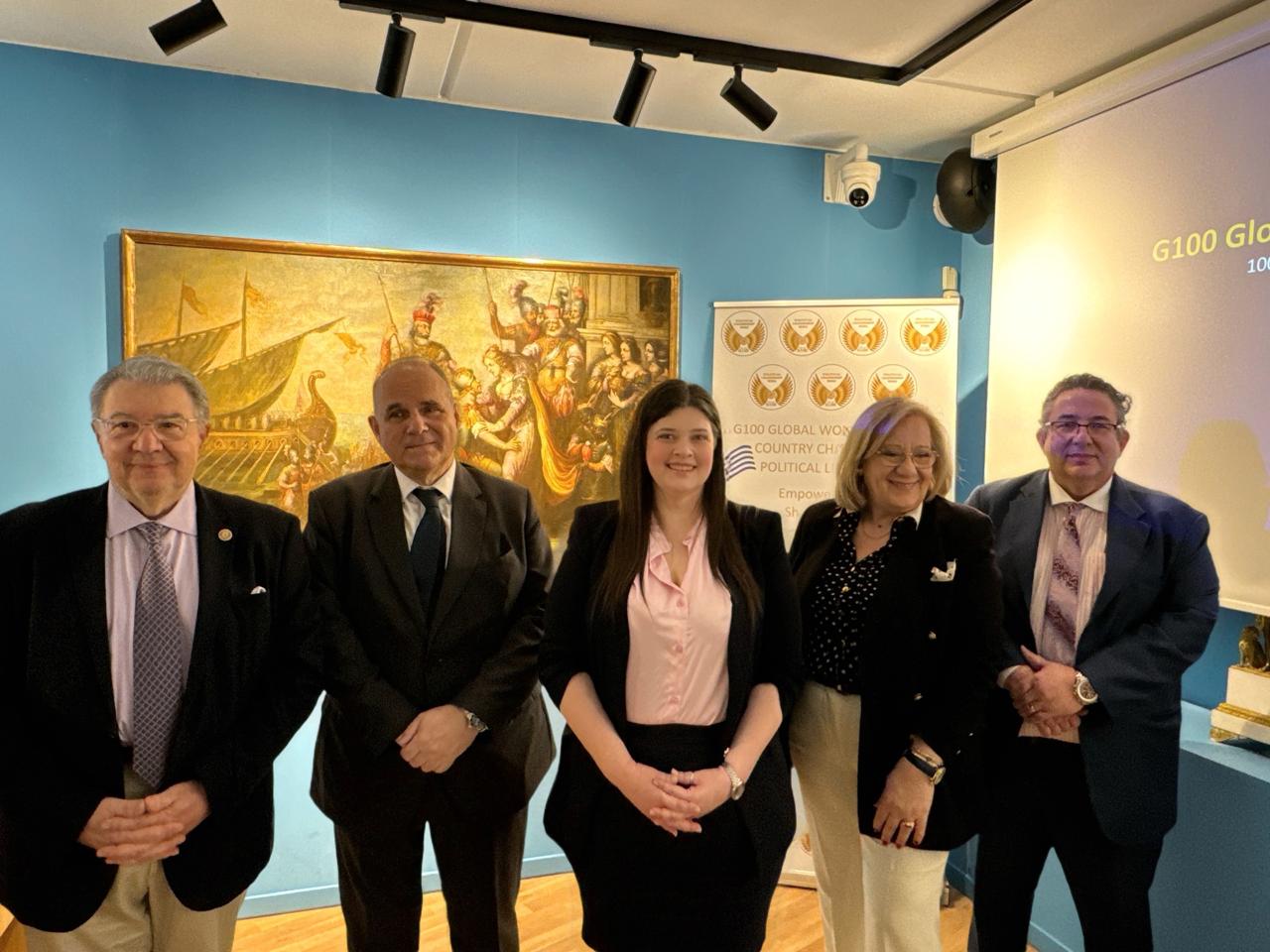
Chief Scientist of the Republic of Cyprus, Demetris Skourides, delivered a high-level keynote address at the G100 Greece Diplomatic Meetings in Athens, positioning inclusive leadership not as a social imperative alone, but as a critical driver of innovation, competitiveness, and sustainable growth.
Addressing an audience of policymakers, diplomats, institutional leaders, and global stakeholders, he set out a clear and strategic message: that the underrepresentation of women in leadership and innovation is not only an issue of equality, but a structural limitation on performance, growth, and long-term resilience.
The event, marking the launch of the Greece Country Political Leadership Wing of the G100, was held under the broader vision of the Women Economic Forum, bringing together a powerful cross-section of political, diplomatic, academic, and civil society leadership.
Among those in attendance were Eleonora Meleti, member of the European Parliament, Katerina Patsogianni, Representative of the Ministry of Social Cohesion and Family, Alexandra Palli, Vice Regional Governor representing the Governor of Attica, and John Chryssoulakis, international president of Aristotle forum, alongside a distinguished diplomatic presence including H.E. Lina Skerstonaite, Ambassador of Lithuania, H.E. Gerda Vogl, Ambassador of Austria, H.E. Alison Joy Duncan, Ambassador of Australia, H.E. Nahida Rahman Shumona, Ambassador of Bangladesh, H.E. Julie Lymberopoulos Karnakis, Ambassador of Panama, and Mme Jela Vuletic Manthou, Chargé d’Affaires of Montenegro.
Institutional and academic voices also played a central role in the dialogue, with participation from Dr. Eleftheria Mpernidaki, Vice President of the Independent Authority for Accessibility of Persons with Disabilities, Mr. Constantine Veletzas, President of the Philhellenism Museum, George Sarris, Political History Writer, and Dr. John Koutroubis, Journalist, CNN Greece, as well as academic leaders and emeritus professors from leading Greek universities and the National Technical University.
The discussion, moderated by Katerina Vourlaki, Journalist and Vice Mayor of Amarousio Attica region, reflected the depth and diversity of perspectives required to address leadership in a rapidly evolving global context.
In his keynote, titled “Open the Door, Expand the Future”, the Chief Scientist delivered a powerful narrative linking historical legacy, modern innovation, and future leadership systems.
Drawing from figures such as Hypatia, Aspasia of Miletus, and Laskarina Bouboulina, he underscored that women have long acted as “architects of possibility,” shaping societies even when excluded from formal systems of power.
Framing the issue through a strategic and economic lens, he emphasised that the underrepresentation of women in leadership and innovation is not merely a question of equality, but one of systemic inefficiency. While startups with at least one female founder raised a record $73.6 billion in venture capital in 2025, all-female founding teams continue to receive only a fraction of global funding, highlighting a significant gap in the effective allocation of talent and capital.
“This is not anecdotal. This is arithmetic,” he noted, stressing that innovation without inclusion is inherently limited and that diversity in leadership directly correlates with stronger performance, better decision-making, and long-term resilience.
The event itself reflected the global and cross-sector nature of this mission, with participation from organisations including AHEPA, Rotary International – Greece, Daughters of Penelope – Greece Chapter, Y.W.C.A. of Greece, Panathenaic Women’s Association of Greece, Lions Clubs International – Greece, Union of Women of Greece, and advocates for women’s rights, equality and social protection.
Further contributions from The American College of Greece, Meropeio Foundation, ESIEA, Soroptimist International, Naftemporiki, Adopt a Ship Programme, ITEP, and the European Union of Women – Greece Sector, reinforced the importance of a multi-stakeholder approach in shaping inclusive leadership ecosystems.
Chief Scientist also extended his support to the inspiring work of Maria Militsopoulou, alongside the Greece Country Chair of the Political Leadership Wing, whose dedication to the G100 Mission Millions network is reshaping how inclusive innovation is understood and advanced on a global scale. Special appreciation was also extended to Olga Pavlidou Koutroubis, Greece Country Chair of the Political Leadership Wing, and to the global leadership of G100, Dr. Harbeen Aurora and Dr. Hartini Osman, for their vision and commitment.
Beyond the data, the Chief Scientist articulated a clear framework for modern leadership and what he defines as “active allyship,” drawing on his broader engagement with women leaders across Europe, including platforms such as G100 and the “Women Who Built Europe” Summit in Brussels.
He emphasised that leadership today requires a shift from passive support to deliberate, consistent action advocating for women even when they are not initially considered, ensuring their work is recognised in decision-making environments, and supporting talent early in its development. He reinforced that inclusion must be understood not as a social obligation, but as a performance imperative, where inequality represents inefficiency and diversity delivers measurable returns.
He further highlighted the importance of linking gender equity with national strategy, innovation policy, and digital transformation, pointing to the “Minds in Cyprus” initiative, led by President Nikos Christodoulides, which positions diaspora talent, particularly women, as a critical national capability that connects markets, transfers knowledge, and accelerates innovation.
“Do not wait to be invited to the table. Step up and lead fearlessly,” he stated.
Chief Scientist also emphasised that leadership must ultimately be measured through action and outcomes, referencing tangible progress in advancing female-led research and innovation through national frameworks and funding mechanisms.
Concluding his address, he noted that progress at scale is achieved through collaboration, shared responsibility, and the courage to rethink traditional leadership models, emphasizing that when we open doors for women leaders, we do not simply advance society, we accelerate it.




Click here to change your cookie preferences