
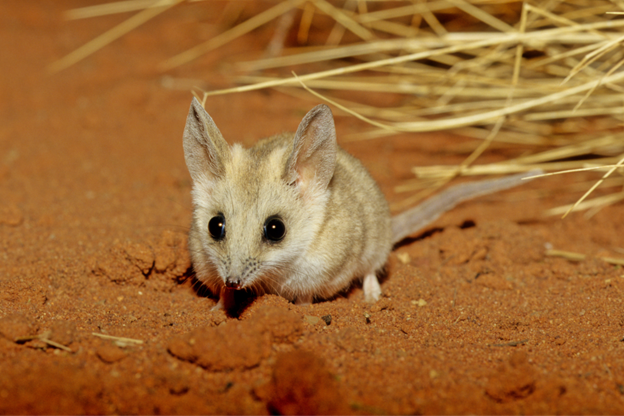
The fat-tailed dunnart is native to Australia’s arid scrublands and largely unknown outside of science. It may also be the key to saving some of the continent’s most endangered species.
There is an unassuming creature at the center of one of conservation science’s most ambitious efforts. The fat-tailed dunnart, a mouse-sized marsupial native to the arid scrublands of Australia, has long lived in the shadow of the country’s more celebrated wildlife. But inside Colossal Biosciences’ labs, and across field sites in South Australia, this small animal is doing outsized scientific work.
Marsupial reproductive biology has been something of a black box to researchers for decades. Unlike placental mammals, whose reproductive systems scientists have studied and characterized at length, marsupials develop differently: much of early development occurs outside the womb, in the pouch. That fundamental difference has made captive breeding and de-extinction efforts exceptionally difficult for the group. Tools that conservationists rely on for animals like big cats or rhinos have often simply failed to translate.
Colossal is working to close that gap. The company is developing the fat-tailed dunnart as the world’s first marsupial model organism, a scientific reference species that researchers can use to understand, test, and ultimately apply marsupial reproductive biology across the entire group. The dunnart is well-suited for this role: it has a fast breeding cycle, a small and manageable size, and reproductive characteristics that make it practical for genetic and developmental research.
Cracking the code on marsupial reproduction
Colossal’s team has achieved a 50–60% IVF cleavage success rate: the share of fertilized eggs that successfully begin dividing into early embryos. That’s a major breakthrough for marsupial assisted reproduction. Meaningful marsupial IVF had barely been demonstrated at scale before this research began. The team has also developed a new superovulation protocol that yields an average of 20 mature oocytes per female, markedly improving the efficiency of reproductive science across the group.
Two dunnart colonies have been established, one at Colossal Australia and one at Colossal US, providing a stable research base for continued work.
A field survey conducted in November 2025 in South Australia located 28 wild dunnarts in a single outing, the largest group recorded to date, offering a clearer picture of where natural populations persist.
Wider conservation stakes
The stakes here extend well beyond one small marsupial. The dunnart research directly underpins two of Colossal’s most closely watched efforts: the de-extinction of the thylacine, a Tasmanian tiger last confirmed in the wild in the early twentieth century, and the preservation of the northern quoll, an endangered marsupial predator being pushed toward extinction by invasive cane toads.
The cane toad crisis is one of Australia’s most urgent ecological disasters. Introduced in 1935, cane toads secrete a bufotoxin lethal to native predators that evolved without any exposure to it. The northern quoll has no natural resistance, and populations have collapsed across large parts of its range. Colossal Australia is pursuing a genetic solution: a single nucleotide change in the quoll’s genome that researchers believe could confer resistance to the toxin. The team has already generated a northern quoll induced pluripotent stem cell (iPSC) line, a critical first step toward producing resistant animals, completing the process in just 12 days. Work is ongoing.
“Innovation such as this is just what’s needed to help turn around Australia’s dire conservation record and better protect threatened species,” said Euan G. Ritchie, Professor of Wildlife Ecology and Conservation, Deakin University, in the Colossal Foundation’s 2025 Impact Report.
Tools that travel
What Colossal is building with the fat-tailed dunnart is research infrastructure. Developing a model organism means future scientists can build directly on established protocols, cell lines, and reproductive data, adapting them for other marsupial species in need of conservation intervention.
Scientific advances developed for one purpose have a way of reaching further than expected: tools born from Colossal’s dire wolf de-extinction work, for example, have already proved applicable to living, endangered animals. Time and Forbes have both documented how de-extinction science is yielding dividends for conservation broadly.
For the fat-tailed dunnart, that potential is already visible. A species most people have never heard of is quietly becoming one of the most scientifically important animals in conservation biology — and one of the most hopeful.





Click here to change your cookie preferences