
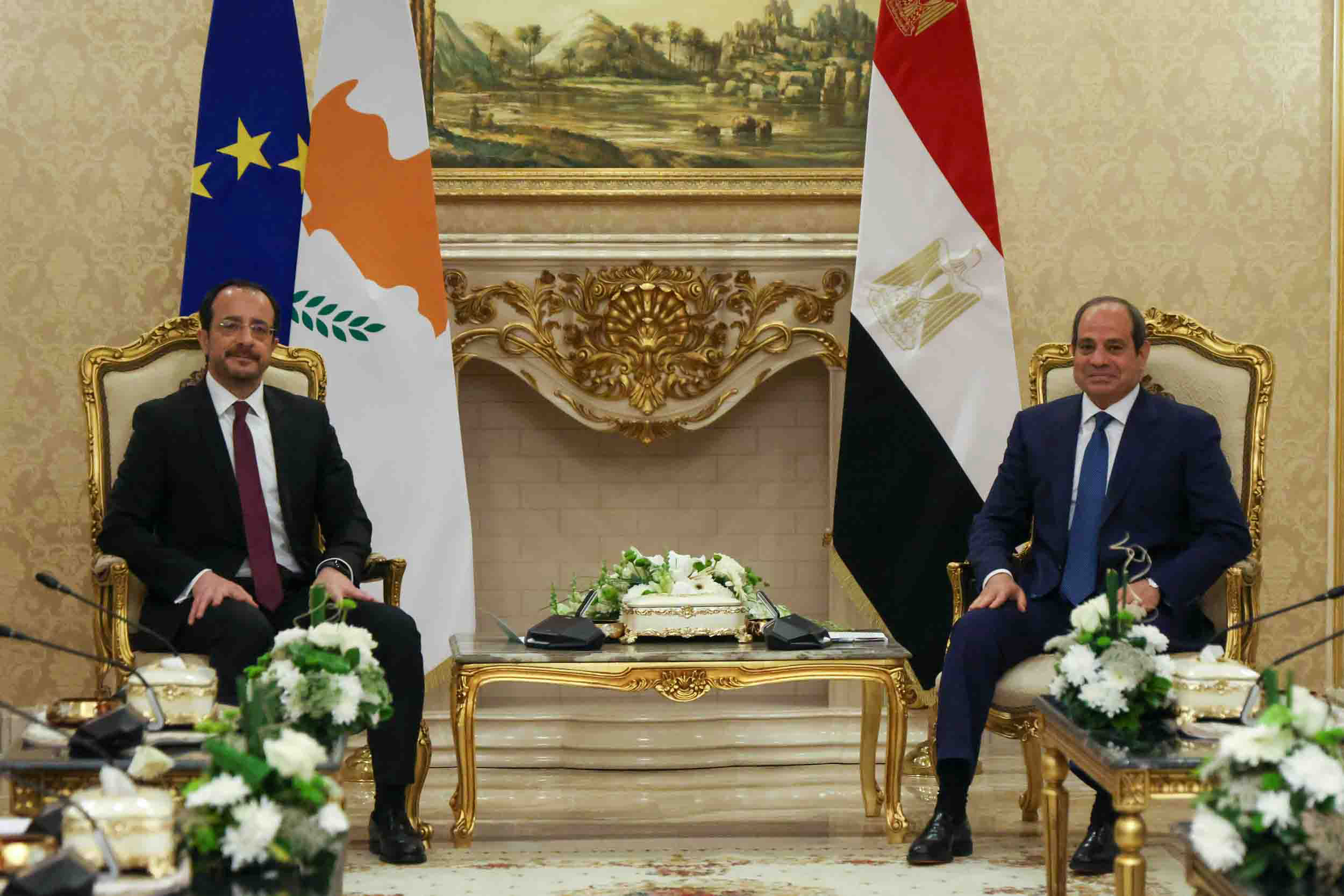
Despite the pomp that accompanied the meeting in Cairo between President Nikos Christodoulides and President Abdel Fattah el-Sisi on Monday there was nothing new to report. The governments of Cyprus and Egypt signed a “framework agreement” that did not differ at all from the one signed last year, according to Energy Minister Michael Damianos, although this time “Kronos and Aphrodite (gas fields) are included together in relation to the intention to take the deposits to Egypt.”
He explained that “it reaffirms the strategic choice of the two states to export Cypriot natural gas to Egypt. In last year’s agreement Egypt was designated as the host government for Block 6 (Kronos) whereas now Block 12 has been added. Director of the president’s press office Victoras Papadopoulos said the agreement was “a tangible step which can provide the impetus for the acceleration and completion of the pending energy agreements concerning the exploitation of the Cypriot gas fields, Aphrodite and Kronos.”
The other tangible step was the establishment of a joint technical committee, which, Damianos said, would be responsible for negotiating the terms of sale of the natural gas. It would examine both “commercial and technical parameters,” said the minister, without elaborating. The Cyprus government would rather sell the majority of its gas to Egypt for domestic use, because that would fetch a higher price than the natural gas going to the terminal in Damietta to be liquefied and exported.
All this is theoretical for now because the Eni-Total venture, which has the concession for Block 6, has not taken a final investment decision (FID), without which the commercialisation of the gas field cannot take place. The government had hoped that Eni-Total would have announced its FID for the Kronos gas field at the Egypt Energy Show on Monday, so that Christodoulides would have something big to report from his visit to Cairo. It did not happen because the government and Eni are in dispute over the way the costs would be shared.
In the end, Christodoulides left Egypt with nothing more than a non-binding framework agreement with Egypt, which is a confirmation of an agreement signed last year and which will be determined by the companies that have the licence for the block. It was another case of President Christodoulides hyping up an event and then coming back from it with very little.
On Sunday, the day before he went to Cairo, he had declared that Cyprus would start selling its natural gas by 2027 or 2028, but he was unable to make the same boast on his return. Sale of natural gas, according to oil industry insiders, will materialise two years after the FID is taken by the oil company and in the case of the Kronos gas field this has not happened yet. One day the government will learn that creating expectations is not a very wise policy.





Click here to change your cookie preferences